How the University of Edinburgh’s Freddy robot became a symbol of the first AI winter
Freddy II from the University of Edinburgh could recognize parts and assemble toy models, but a single assembly took up to 16 hours. When the project was…
AI-processed from Habr AI; edited by Hamidun News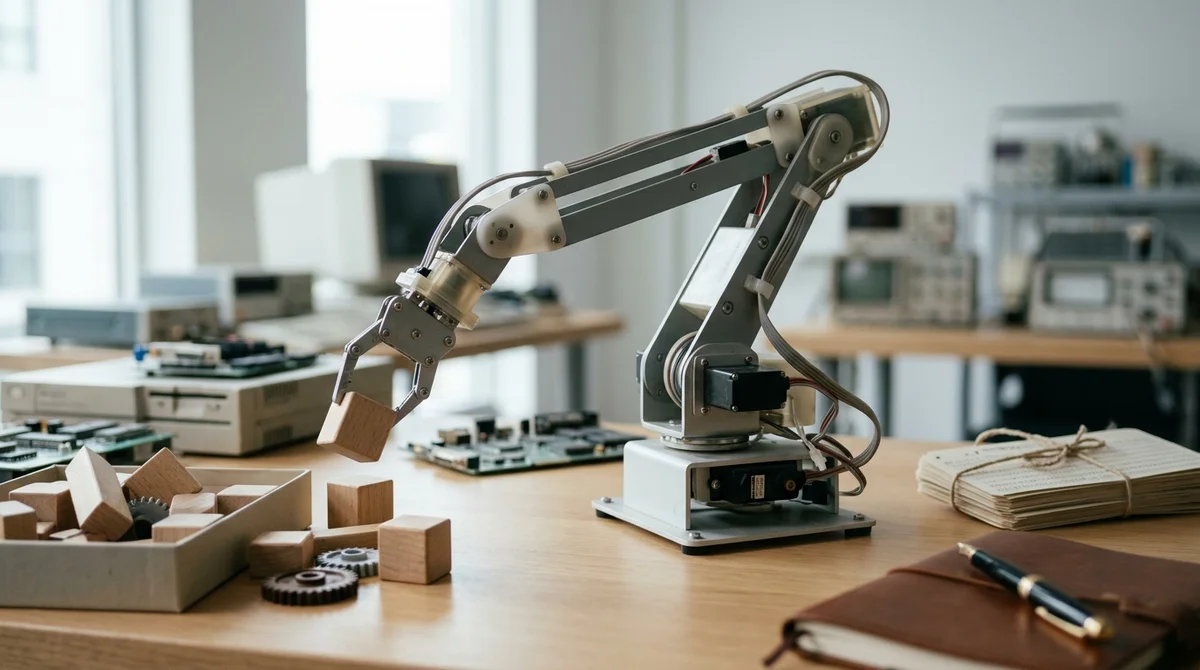
In the early 1970s, the University of Edinburgh showcased Freddy II as a prototype of an intelligent industrial robot: it recognized parts, grasped them with a manipulator, and assembled simple objects. But this very demonstration — impressive in concept and painfully slow in practice — helped critics convince British officials to cut AI funding.
Betting on Universality
In the 1960s, a near-engineering optimism prevailed around artificial intelligence: many seriously believed that within a decade, robots would work in factories and adapt to new tasks without complete reprogramming. Against this backdrop, at the University of Edinburgh, Donald Michie, Richard Gregory, and Christopher Longuet-Higgins launched a project meant to demonstrate that a machine could not only move around a room but perceive objects and act upon them meaningfully. The first version, Freddy I, could already see objects through a camera and distinguish, for example, a cup from other shapes.
But for the project to continue, this was insufficient: no practical use was apparent. So the team quickly moved on to Freddy II — a version equipped with a manipulator, additional cameras, separate computers for computation and control, and more complex logic. The task was ambitious even by today's standards: to teach the robot to understand the arrangement of parts and independently choose a sequence of actions.
What Freddy Could Do
Freddy II was not merely a laboratory cart with a camera. It had an arm with a gripper, a machine vision system, force sensors, and its own action description language, RAPT, which allowed rules to be set at the object level rather than individual motor commands. This was an important shift: engineers tried to move away from manual scripts — "move here, rotate there" — toward a more general approach where the robot itself determined the steps within a given task.
- Recognized parts on a work surface from camera images
- Grasped, lifted, and rotated objects in different orientations
- Used load cells to understand the fact of grasping and the force applied
- Assembled simple structures like a toy car or boat
The problem was that actual performance did not match expectations. A single simple assembly could take Freddy II up to 16 hours. Its work depended on slow actuators, camera limitations, and a large number of intermediate operations. For researchers, this was a strong result: the robot truly solved the task. For the public and officials — rather evidence that the promised revolution was still far away.
The Report Against the Project
In 1972, the British Research Councils commissioned mathematician James Lighthill to assess the prospects of AI and determine whether funding should continue. His conclusion was harsh: progress in intelligent robotics was far behind the grand promises, and attempts to build universal robots seemed overly optimistic. He essentially placed this direction in a zone of doubt, despite the fact that Michie's team already had a working prototype.
"Robots will not be able to reason about the world the way humans do."
Michie responded publicly and put Freddy II at the center of the debate. At BBC television debates on May 9, 1973, he showed how the robot assembled a toy car, and John McCarthy and other participants generally supported the idea that AI was an independent and promising field. But the effect was counterproductive: the more honest the demonstration looked, the easier it was for critics to point to the gap between ambitions and actual speeds. As a result, funding was cut, the project was closed in 1976, and Freddy itself was donated to the National Museum of Scotland.
What This Means
The Freddy story shows that the fate of a technological direction is often determined not only by scientific results but also by how they appear at any given moment to those who distribute money. Freddy was not the sole reason for the decline, but it became one of the most vivid episodes of the first "AI winter": promises outpaced computational capabilities, sensors, and market expectations.
Want to stop reading about AI and start using it?
AI News is a curated feed of AI/tech news. Hamidun Academy teaches you to use AI systematically in your work.