Meta to build seven gas-fired power plants for new AI data center in Louisiana
Meta is ready to pay for the power infrastructure for a new AI data center in Louisiana itself: the company will fund seven gas-fired thermal power plants…
AI-processed from 3DNews AI; edited by Hamidun News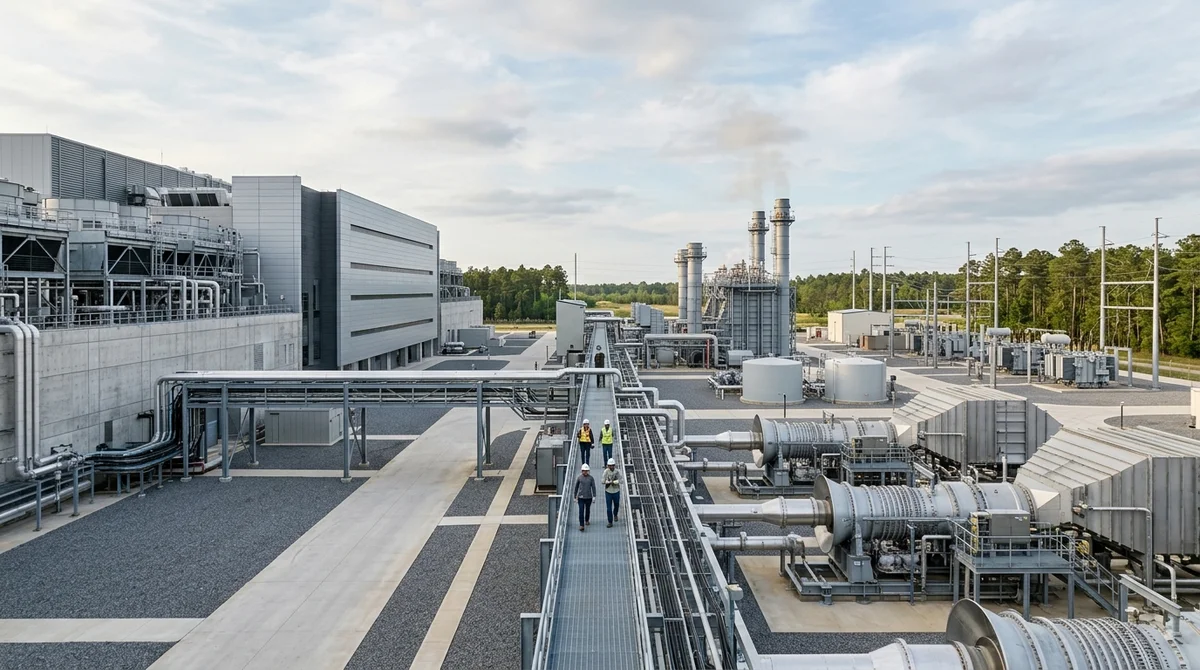
Meta is preparing an unusually direct response to the energy hunger of the AI era: the company will finance the construction of seven gas power plants in rural Louisiana to power a new data center. Essentially, this is dedicated energy infrastructure for a single facility — without shifting costs onto local residents.
Scale and Logic of the Project
Meta plans to finance seven new gas thermal power stations with a total capacity of 5.2 GW. For the data center market, this is not a cosmetic expansion, but an infrastructure project on the scale of a separate power system. The new plants are planned to be located in rural Louisiana, and their task is to fully meet the needs of the company's new data processing center. This approach allows Meta not to wait for the local grid to catch up with demand, and not to create a situation where the growth in load is paid for by household consumers or small businesses.
The statement about the absence of additional expenses for the population is key here. When a major data center comes to a region, it almost always brings questions about connections, network modernization, and new peak loads. If these costs are spread across the rate base, discontent arises quickly. Meta is trying to eliminate this risk in advance: the company needs a large power reserve for AI loads, but at the same time it is important for it to show that the project will not become a political problem at the local level.
Why Meta Chose Gas
The choice of gas looks pragmatic. Companies building infrastructure for AI need not abstract "green" power on the horizon of several years, but stable power supply on understandable timescales. Gas power plants in the US often turn out to be the fastest way to get large volumes of controlled generation. Nuclear projects take too long to build, solar and wind capacity alone is insufficient for such an object without energy storage and network investments, and existing transmission lines in many regions are already overloaded.
From the company's perspective, this is not simply a story about megawatts. Proprietary generation makes the project more manageable: easier to calculate economics, less dependence on third-party network decisions, and lower risk that data center deployment will be delayed due to infrastructure constraints in the region. It also simplifies discussions with local authorities and regulators, because the load and energy source are pre-linked in a single scheme. For a business competing on the speed of launching AI services, this predictability becomes a separate asset.
- predictable energy supply for round-the-clock data center operation;
- less dependence on power shortages in the regional network;
- less risk of delays due to lengthy network infrastructure agreements;
- more understandable project economics when energy costs are tied to the facility itself.
This is also a reflection of new market logic. Previously, an IT company could build a data center where there is land, incentives, and communication channels. Now a main filter is added to this list: can you quickly get guaranteed capacity in industrial volumes? If the answer is no, the timelines for launching AI services shift, and with them — the company's competitive position.
This is precisely why energy is transforming from a background issue into part of product strategy.
Downside of the Project
Such a project also has an obvious downside. Gas remains a fossil fuel, which means the story about accelerating AI infrastructure inevitably collides with the climate agenda. The more AI models require computation, the more often technology companies find themselves choosing between speed of launch and their own environmental commitments.
Meta here shows that at this moment, the priority becomes access to capacity: without it, you cannot quickly scale model training, inference, and new services. For Louisiana itself, this is also an important signal. The region is getting a major industrial-technology project, investments, and a new role in the US AI infrastructure chain. But along with this come questions that usually accompany energy-intensive facilities: what will be the impact on the environment, how many jobs will the construction create, and what will the region get after the data center is put into operation. Even if costs are not passed on to residents, public attention to such projects is only growing.
What This Means
The AI race is increasingly less about models, chips, and talent alone. Now it is also a competition for electricity, land sites, network connections, and the speed of bringing new capacity online. Meta's story shows a simple shift: winners will not only be those who know how to build strong models, but also those who can pre-secure energy for them on an industrial scale. For the entire market, this is a signal that energy is becoming as strategic a resource as computational accelerators.
Want to stop reading about AI and start using it?
AI News is a curated feed of AI/tech news. Hamidun Academy teaches you to use AI systematically in your work.