Former Coatue trader launched Epicenter fund, where AI system Eve serves as lead analyst
Former Coatue trader Rahul Kishor launched Epicenter Capital, where AI system Eve handles part of analysts' work. It tracks filings, listens to company calls, gathers trade ideas, and even rewrites its code after feedback. The fund has just three people, but the bet is that an AI team will make it possible to compete with Wall Street's biggest players.
AI-processed from Bloomberg Tech; edited by Hamidun News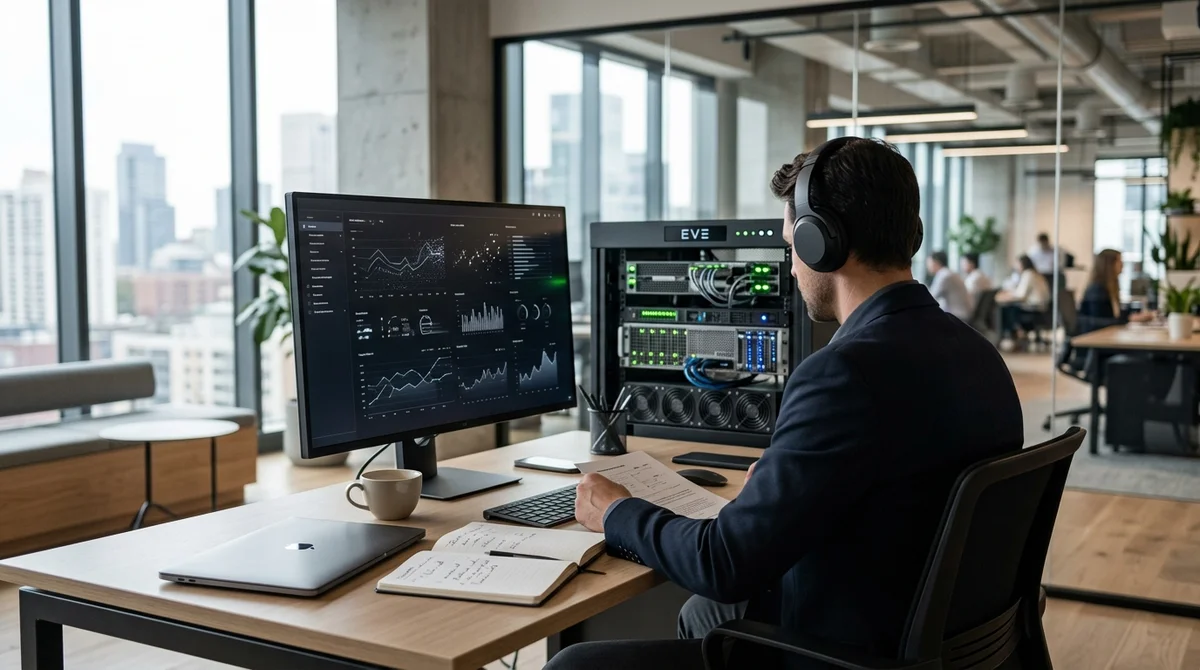
In the world of hedge funds, there is an instructive experiment unfolding: at Epicenter Capital, a key part of analytical work has been handed over to an AI system named Eve. The project of former Coatue trader Rahul Kishor is intended to demonstrate whether a small team with properly integrated AI can compete with firms employing hundreds of analysts.
More than just an assistant
Eve at Epicenter is not a chatbot for one-off questions, but a continuously working team member. The system monitors corporate filings, listens to quarterly earnings calls, tracks company leadership statements, gathers market signals, and helps shape new investment ideas. The fund builds a research pipeline around it, rather than using AI as a separate service layered on top of the old process. This is what makes the case unusual even by Wall Street standards. Here's what Eve does within the fund:
- tracks disclosures and filings from more than 13,000 companies
- reviews podcasts, news, and social media posts
- assists with due diligence and sourcing new investment ideas
- incorporates every email and every transaction into the fund's collective memory
- prepares a morning audio briefing for Kishor on the way to the office
The key detail is that Eve does not wait for a human to devise the perfect prompt. The system is connected to nearly all of the fund's workflows—from incoming emails to transaction history—and acts proactively. Every morning, it even compiles a brief audio briefing for Kishor so he can quickly get up to speed on the way to the office. For a small team, this is a way to dramatically expand coverage without hiring new people.
A three-person fund
Epicenter Capital is based in San Francisco and looks almost defiantly modest for the hedge fund world: besides Kishor, the team consists only of financial director Ivan Ting and analyst Jackson Dibble. The fund began accepting outside investors in July 2025. Among those who supported the launch are brothers Philip and Thomas Lafferty, co-founders of Coatue Management, as well as Coatue's public business CIO Jaimin Rangwalla and former Coatue trader Daniel Senft.
Kishor left to start his own venture after eight years at Coatue and is building the fund with extremely concentrated logic. The team is looking for 10 companies that, by their calculation, can deliver 10x returns over 10 years. Epicenter operates only on the long side and bets not on classical quantitative trading, but on a model with a minimal human team, where AI becomes a full participant in the investment process, not just an accelerator of research.
"Eve allows us to process 10 times more information 10 times faster,"
Kishor wrote in a letter to investors.
When AI learns by itself
The most interesting part of the story is not the volume of data, but the fact that Eve changes based on feedback. When the system receives comments from the team, it rewrites its own programming and learns like a junior analyst, only noticeably faster. For the traditional buy-side world, where many AI tools still amount to document search and note summarization, this is no longer automating routine tasks, but an attempt to automate the analyst's thinking process itself.
One telling episode: Eve parsed disparate corporate documents to understand how a specific company is bringing a new product to market. For a human analyst, such work might take a week, but the system completed it in one night. For the fund, this is an important signal: AI can already handle not just data sorting, but chunks of complex research work where you need to assemble a picture from fragments.
AI at Epicenter even monitors the cost of AI itself. Within the fund, Claude Code itself suggested migrating servers from Amazon Web Services to Cloudflare, which cut computational costs by 90%. For a three-person team, this kind of effect is critical: if the primary "workforce" costs thousands of dollars per year instead of hundreds of thousands per person, the fund's economics look very different and provide more room for experimentation.
What this means
The Epicenter story shows what the next stage of automation in finance might look like: not an assistant next to an analyst, but a fund designed from the ground up around an AI colleague. If this approach proves its effectiveness in returns, major investment firms will have to rethink not just their tools, but the very size of their research teams.
Want to stop reading about AI and start using it?
AI News is a curated feed of AI/tech news. Hamidun Academy teaches you to use AI systematically in your work.
The AI world, distilled — once a week
Seven stories that actually mattered, hand-picked. No noise, no reposts, no press releases.
Done! Check your inbox for a confirmation.