Saronic raised $1.75 billion to produce autonomous unmanned military ships
Saronic Technologies secured $1.75 billion to scale production of autonomous unmanned military vessels. The round was one of the most notable in defense tech…
AI-processed from Bloomberg Tech; edited by Hamidun News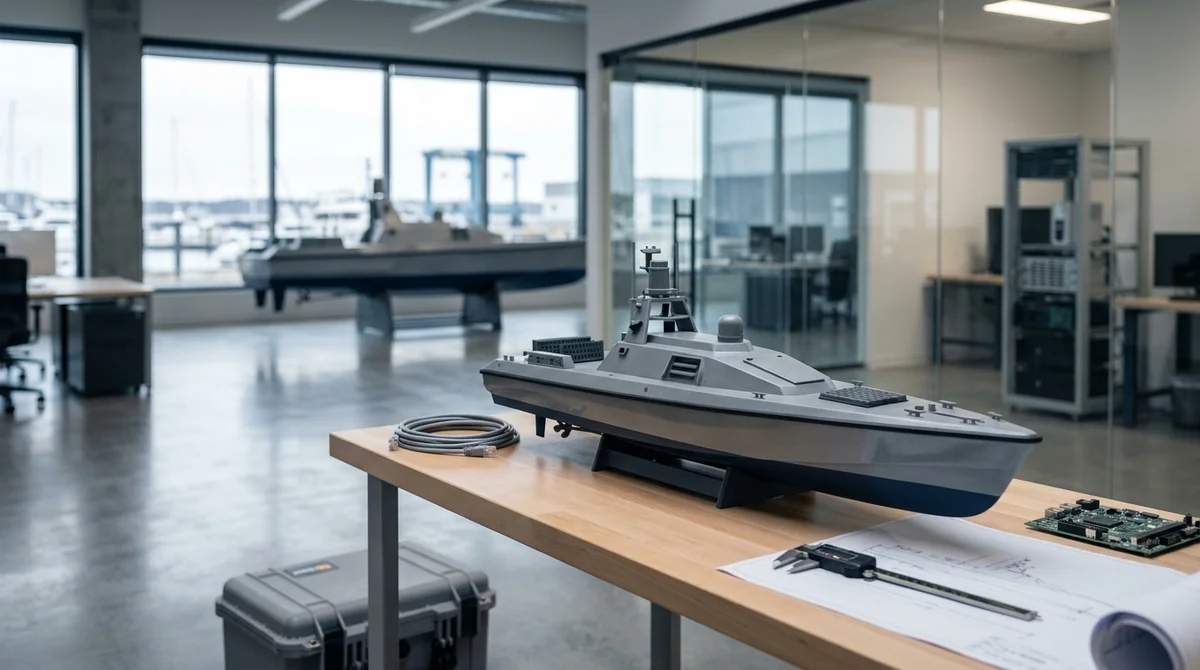
Saronic Technologies has raised $1.75 billion for the development of autonomous unmanned military speedboats and vessels. The large round shows that investors are increasingly entering defense tech, especially projects where AI and autonomy are quickly turning into series production.
Why the round is important
Saronic is a startup developing unmanned surface vehicles for military tasks. The company announced raising $1.75 billion — this is one of the most notable rounds in the defense technology segment in recent times.
Against the backdrop of growing security budgets and increased attention to autonomous systems, the market is clearly ready to finance not only software, but also heavy engineering infrastructure. For a young company, this means a rare opportunity to scale faster than the usual cycle for defense contractors. The fact of such financing is important not only for Saronic itself.
It shows that the interest of funds is shifting from experimental demonstrations to real platforms that can be produced in batches and integrated into existing military supply chains. If autonomous vessels were previously often perceived as a niche story, now it's already a separate bet on a new class of technology — platforms that can be produced in batches, deployed faster, and used without direct risk to personnel.
Where the money will go
Saronic's head said the new funds will help increase production of unmanned vessels. For such a business, money is needed not only for developing algorithms and electronics, but also for production base: hulls, power plants, sensor integration, water testing, certification, and logistics. In other words, the round is aimed not just at another prototype, but at transitioning to a larger industrial scale. Essentially, the capital can accelerate several directions at once:
- expansion of production capacity for assembling unmanned vessels;
- procurement of components and creation of a sustainable supply chain;
- testing, refinement, and improved reliability of autonomous systems;
- hiring of engineers, production teams, and defense contract specialists.
For hardware companies in defense, production usually becomes the main bottleneck. Writing software or assembling a demonstrator is faster than building stable production of products that must work in a complex environment and meet military requirements. That's why the round amount looks like an attempt to preemptively close the most expensive stage — turning technology into a series, where pace, reliability, the ability to execute large orders, and not miss deliveries to the customer matter.
Why the market believes
Investors in defense tech are now looking at autonomous platforms as one of the most pragmatic segments of the market. Unmanned surface vehicles can be used for reconnaissance, patrolling, mission escort, and other tasks where permanent crew presence is either expensive or dangerous. Against this backdrop, Saronic hits a strong trend: armies want more autonomy, and capital seeks teams capable of bringing a product to delivery, not staying at the level of presentations.
There is also a broader context. Defense startups were recently considered a difficult direction for venture capital due to long sales cycles, dependence on the state, and high cost of hardware. But demand for new systems, acceleration of procurement cycles, and the success of several notable players are changing this logic.
The closer a company is to actual production and an understandable customer, the easier it is to attract large money. Saronic, judging by the size of the deal, convinced the market precisely at this stage of maturity.
What it means
Saronic's round is a signal that autonomous military technology is becoming not a laboratory curiosity, but an industrial category with serious funding. For the AI market, it's another reminder: the largest bets are increasingly being made not only on models and software, but on systems where algorithms control physical machines in the real world. If this trend continues, the boundary between an AI startup and an industrial company will blur even faster.
Want to stop reading about AI and start using it?
AI News is a curated feed of AI/tech news. Hamidun Academy teaches you to use AI systematically in your work.