Jensen Huang showed how Nvidia is redefining agentic AI infrastructure
At GTC 2026, Jensen Huang shifted the AI conversation from chips to infrastructure as a whole. Nvidia is positioning Vera Rubin as a system for agentic…
AI-processed from Habr AI; edited by Hamidun News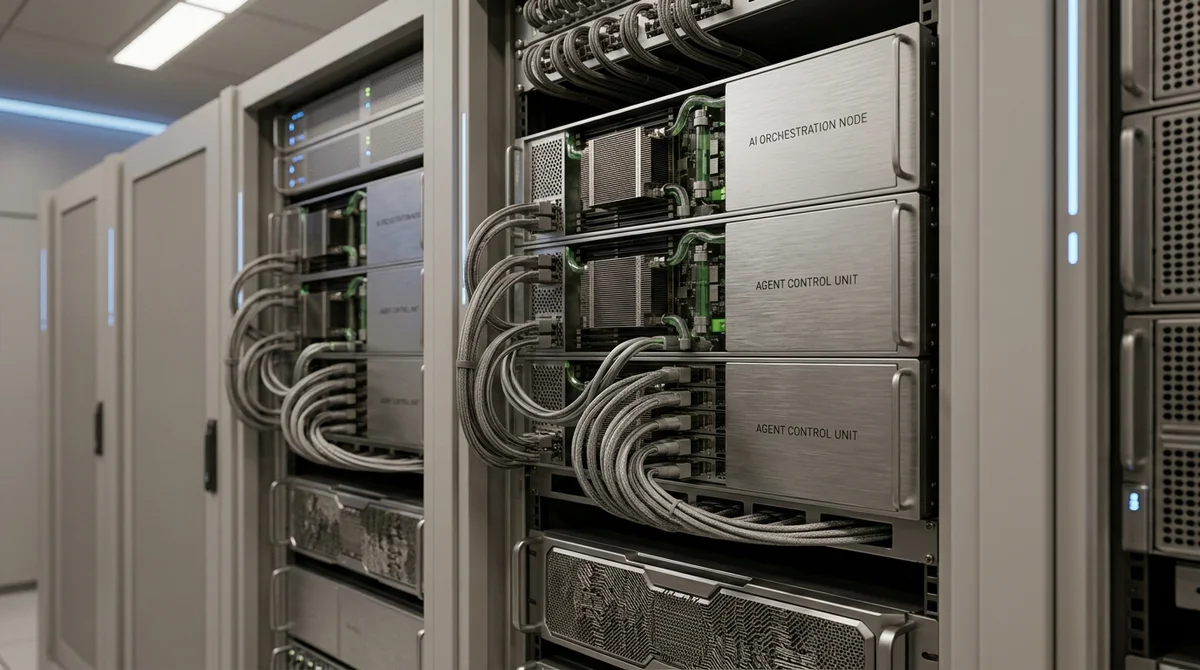
Jensen Huang's presentation at GTC 2026 turned out to be more than just a showcase of new NVIDIA chips. The main signal was different: for agentic AI, the company is redefining the very concept of infrastructure — from CPUs and racks to the orchestration layer, security policies, and data quality.
More Than Just GPU
The loudest figure from the conference — a target of $1 trillion for Blackwell and Vera Rubin by 2027. But there's something more important: NVIDIA is increasingly selling not individual accelerators, but a complete inference factory. In a world where one agent coordinates dozens of sub-agents, navigates tools, and maintains long context, the bottleneck is no longer just GPUs.
Critical are CPUs for coordination, networking, storage, and the speed of data movement between all these layers. The Vera Rubin platform precisely reflects this shift. NVIDIA speaks of a complete stack, where Vera CPUs, Rubin GPUs, network components, and memory are designed as a single system with lower token cost and higher inference efficiency.
For business, this is a significant pivot: you need to calculate not just the number of GPUs, but the entire economics of agentic workloads — from orchestration and context storage to contract flexibility and the price of each request.
- CPU racks for the orchestration layer
- GPU systems for massive inference
- a separate memory and context storage layer
- network fabric for continuous data exchange
- token cost as the new baseline KPI
OpenClaw and Control
The second strong signal — the bet on OpenClaw, an open-source platform for agentic AI. Huang essentially positioned it as the Linux for the agentic era: this is no longer just a library, but a foundational layer on which personal and corporate agents can be built, models connected, files, tools, and custom skills integrated. On top of it, NVIDIA launched NemoClaw and the OpenShell runtime — a toolkit for safer agent execution with access policies, privacy routing, and network restrictions.
Why this matters: most corporate AI rules were written under the old pattern "human asked a question — model answered." Agentic AI breaks this logic. Now the system needs to control who and when gets access to data, which tools an agent can invoke, whether it can spawn sub-agents, and how to reconstruct the chain of actions afterward.
If this layer isn't thought through in advance, companies will get not acceleration, but a new class of incidents.
Data Back in the Center
The third takeaway from GTC 2026 — structured data is becoming the core of enterprise AI again. This is clearly visible in the IBM and NVIDIA partnership: GPU acceleration came straight into the SQL layer of Presto within watsonx.data, to run large enterprise datasets faster and reduce analytics costs. That is, the conversation is shifting from abstract "smart models" to a very practical question: how quickly, cleanly, and manageably does a company's data reach agents.
"Data is the ground truth that gives AI context and meaning."
In this phrase there is both a compliment and a warning for data teams. If data is well-described, consistent, and accessible under clear rules, agentic AI becomes more reliable and useful. If it is scattered, contradictory, and poorly documented, agents will scale errors as confidently as they scale useful work today. That's why the main question after GTC sounds not "where to buy more GPUs," but "are the company's data ready to support autonomous systems."
What This Means
GTC 2026 showed that the next race in AI will go not only for chips, but for data quality, orchestration, and agent governance rules. Winners will not be those who try to catch hyperscalers in hardware, but those who are already now reconsidering infrastructure contracts, access policies, and data architecture for a world where agents work constantly and at scale.
Want to stop reading about AI and start using it?
AI News is a curated feed of AI/tech news. Hamidun Academy teaches you to use AI systematically in your work.