Hyundai brings Atlas to the assembly line: why it managed to turn a robot into a factory tool
Hyundai said Atlas will go onto the assembly line at its Georgia plant, with initial tasks focused on sorting parts and preparing workpiece kits. The main…
AI-processed from Habr AI; edited by Hamidun News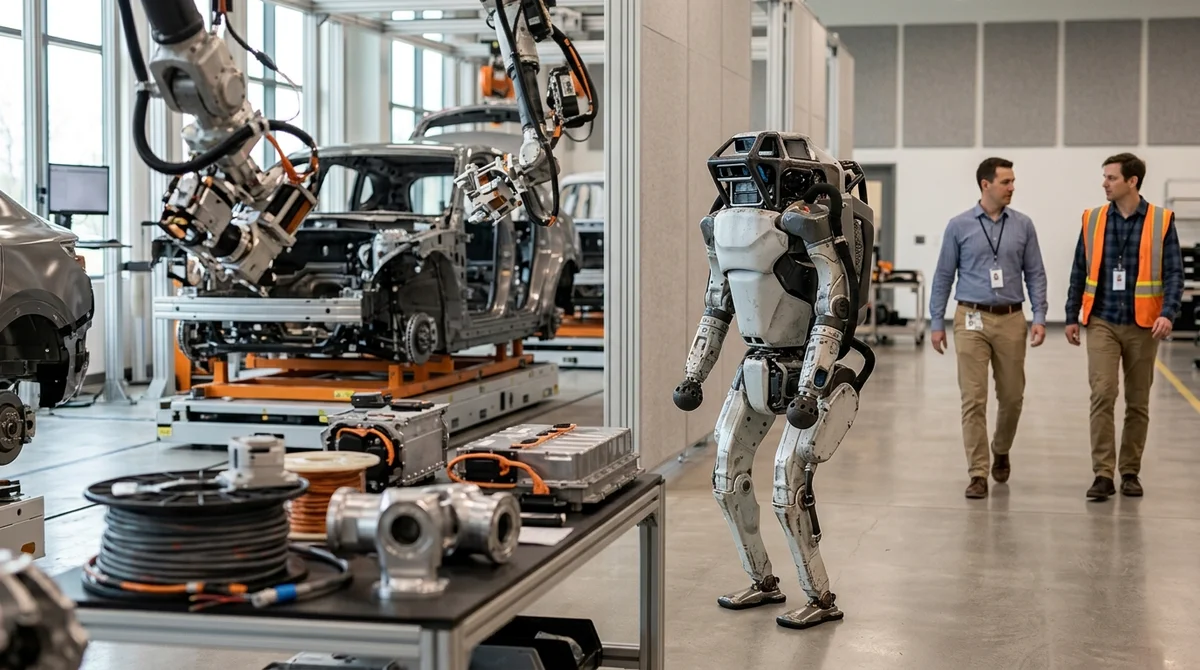
Hyundai became the first owner of Boston Dynamics to bring Atlas to real factory work. In January 2026, the company announced that the humanoid robot will go to the assembly line of Metaplant America in Savannah, Georgia, with initial tasks focused on part sorting and component assembly.
Why not sooner
Google acquired Boston Dynamics in 2013, but never answered the main question: exactly what business should a lab breakthrough become. The company actively accumulated robotics assets, yet it had no clear scenario for turning Atlas into an industrial product. SoftBank, which acquired Boston Dynamics in 2017, believed in the robot market and had access to significant capital, but it also lacked its own factories and the daily production challenges needed to develop a humanoid platform for.
The problem was not Atlas's spectacle, but the gap between demonstration and operation. The old hydraulic robot was excellent for research, parkour, and viral videos, but a factory operates by different rules: predictability, service, downtime, and maintenance costs are critical there. A machine that does backflips spectacularly doesn't yet become equipment capable of running eight hours straight without failure in sync with a production line without requiring a constant team of engineers nearby.
What Hyundai changed
When Hyundai entered Boston Dynamics' capital in 2021, it viewed the project not as a PR asset but as a future production equipment unit. Therefore, the goal became not a new demonstration of agility, but translating the robot into a format compatible with auto factory requirements for reliability, repair, and scaling. A key pivot occurred in April 2024 when Boston Dynamics unveiled the fully electric Atlas version, and at CES in January 2026 it already presented a production scenario for its application.
- Complete transition from hydraulics to electric actuators
- Increase in degrees of freedom to 56
- IP67 level body protection for a harsher environment
- Autonomous operation for about four hours with battery replacement
- Load capacity up to 50 kg briefly and up to 30 kg in continuous mode
No less important is the supply chain. Hyundai Mobis handles actuator production for Atlas, which means the robot begins relying not on one-off R&D components, but on automotive-grade infrastructure from a major auto conglomerate. In parallel, Hyundai is preparing a robot factory with capacity for up to 30,000 units annually and plans industrial deployment of Atlas by 2028. In other words, the company is changing not just the robot itself, but the entire system around it—from repair to scaling.
Economics matters more than "wow"
For Hyundai, the Atlas story is not just a technology experiment but an answer to cost pressure. By industry estimates, labor accounts for approximately 65–70% of car assembly costs. Meanwhile, traditional automakers have significantly higher average labor costs per vehicle than Chinese competitors.
Even a difference of several hundred dollars per vehicle in mass production translates into hundreds of millions of dollars and affects not the beauty of the report but the ability to maintain margins. Against this backdrop, a humanoid robot begins to look not exotic but like a financial instrument. If we assume an Atlas unit price around 150,000 dollars and a lifespan of at least five years, the annualized costs come out to 30–38 thousand dollars per year.
The average annual compensation for a Hyundai employee in South Korea already exceeds 84 thousand dollars and continues to rise. This mathematics has an important asymmetry: as robots scale, they become cheaper, while human labor in developed economies does not.
What this means
Atlas became a factory robot not the moment it learned to move more spectacularly than anyone else, but when it gained a tough internal customer with clear economics and a specific operating environment. If Hyundai truly brings the project to mass deployment, the market will get not another viral Boston Dynamics video, but one of the first examples of how a humanoid integrates into a real production line and begins to influence industrial production costs.
Want to stop reading about AI and start using it?
AI News is a curated feed of AI/tech news. Hamidun Academy teaches you to use AI systematically in your work.