Rosedale residents in Toronto argue over the AI system Flock for a "virtual neighborhood"
A dispute has flared in Toronto's upscale Rosedale neighborhood over the AI system Flock, which reads vehicle license plates at entrances to the area…
AI-processed from Guardian; edited by Hamidun News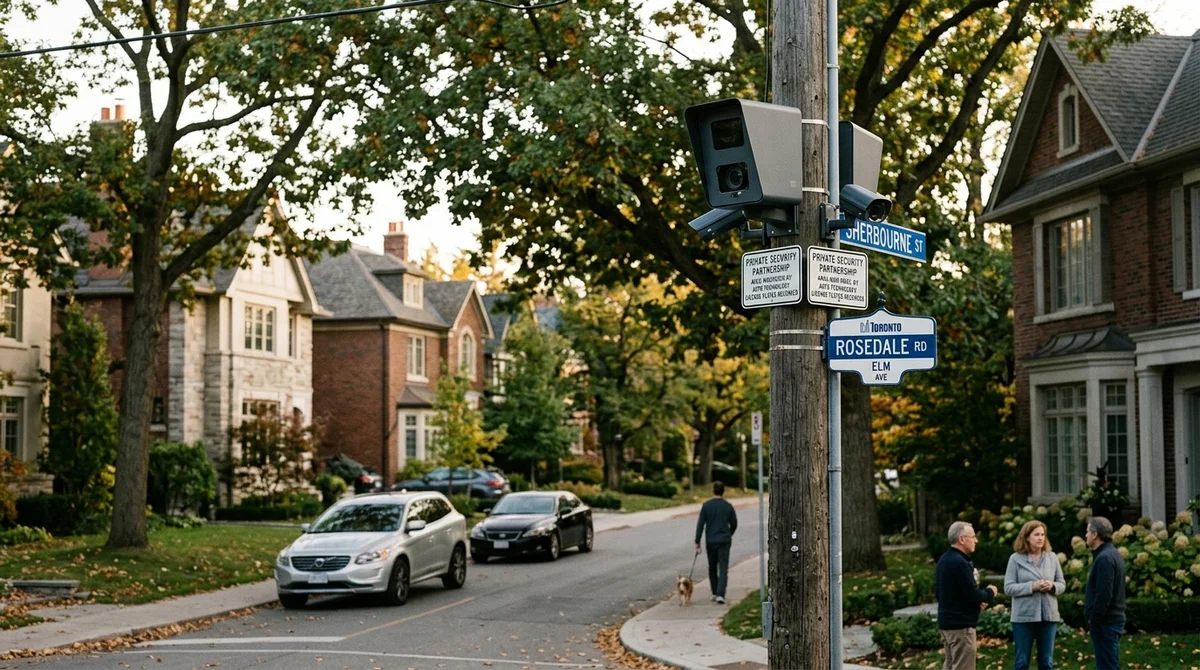
Residents of Rosedale in Toronto are disputing over the idea of implementing Flock, an AI system that reads vehicle license plates. Supporters see it as a way to contain a wave of home invasions, opponents view it as a step toward a "virtual gated community" with constant surveillance.
Why the dispute started
The reason for discussion is quite concrete: while crime levels are declining across Toronto overall, Rosedale residents live in a different reality. According to data cited by participants in the dispute, the number of home invasions in this neighborhood is steadily growing, and burglars target it more than twice as often as the city average. By the number of break-ins and thefts per capita, the neighborhood remains one of the most problematic in Toronto, despite its reputation as a quiet and very affluent place.
It is precisely this contradiction that pushes some residents toward a technological solution. When people see that beautiful streets and high levels of prosperity do not provide protection from raids, they begin to support tools that promise to at least partially restore control. But almost immediately, the conversation about security went beyond statistics: now it is a dispute about where neighborhood self-defense ends and the infrastructure of total surveillance begins.
How they want to implement the system
The idea is to use Flock as a digital perimeter without gates and security posts. Cameras with license plate recognition could be installed at key entry and exit points of the neighborhood to record traffic flow and help quickly find matches after thefts, break-ins, or home invasions. Formally, the streets remain public, but the neighborhood gains a tool that allows closer monitoring of who passes through its boundaries and when. Project supporters count on several immediate practical effects:
- get clues faster after thefts and break-ins
- track the routes of suspicious vehicles
- deter criminals by the very fact of observation
- collect data that can be shared with police
For some residents, this looks like a pragmatic compromise. Instead of gates, security guards, and restricted access, a digital layer of security is proposed that, in their view, does not interfere with normal life but makes the neighborhood a less convenient target for criminals. This forms the main argument of supporters: if burglars operate by car and disappear quickly, then vehicle license plates become one of the few real clues for investigation.
Why resistance emerged
Opponents see the same scheme quite differently. For them, the phrase "virtual gated community" sounds not like a metaphor but as an admission that a wealthy neighborhood wants to build a digital wall around itself without erecting physical gates. In such a scenario, surveillance covers not only potential criminals but also neighbors, guests, couriers, taxis, and random drivers who simply pass through ordinary city streets on a daily basis.
From this comes a broader set of questions than just the effectiveness of the technology. Who exactly will get access to the data? How long will license plate numbers be stored?
What errors are possible if suspicion falls on a vehicle that happened to be nearby by coincidence? And does such a project not create a precedent by which the most affluent neighborhoods are the first to transfer urban space into private digital control mode? Even if the system helps investigate crimes, opponents fear that the price will be too high for privacy and equal access to public space.
This conflict is intensified by the fact that the dispute is not about a hypothetical technology of the future but about a quite down-to-earth practical scenario: residents want to feel safe outside their own homes. Therefore, each side appeals to a strong argument. Some talk about protecting families against the backdrop of a series of painful episodes, others about the normalization of constant monitoring on streets that should still remain common to all.
What this means
The Rosedale story shows how AI surveillance is going beyond police pilots and becoming a tool at the level of individual neighborhoods. If such systems are promoted not by authorities but by residents themselves, the debate will shift from the question "does the technology work" to "who has the right to set digital boundaries in the city" — and by what rules the rest of Toronto will live. For cities, this is no longer a dispute about hardware but about power over data and the right of neighborhoods to set their own surveillance rules.
Want to stop reading about AI and start using it?
AI News is a curated feed of AI/tech news. Hamidun Academy teaches you to use AI systematically in your work.