Fujitsu to have Rapidus produce a 1.4 nm AI chip, aims to integrate it into servers by 2030
Fujitsu is preparing a 1.4 nm chip for AI infrastructure and wants Japan's Rapidus to manufacture it. The project centers on a server NPU focused on high…
AI-processed from 3DNews AI; edited by Hamidun News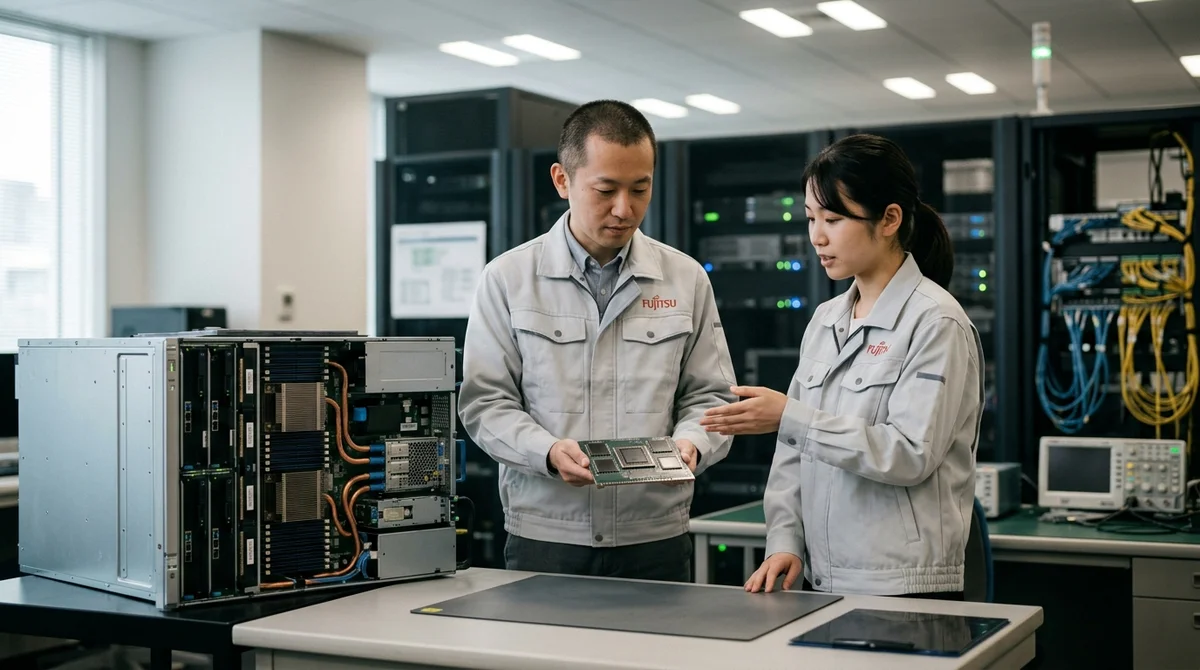
Fujitsu intends to develop a 1.4-nm chip for artificial intelligence infrastructure and entrust its production to Japan's Rapidus. If the project reaches production, it will become a rare case where both the design and advanced manufacturing of an AI chip are concentrated within Japan.
What Fujitsu Is Preparing
The company is betting not on a universal processor, but on a specialized neural accelerator for server systems. Such an NPU should deliver high performance in AI workloads with more moderate power consumption, which is particularly important for data centers, where the cost of power and cooling has already become one of the main constraints. The logic is clear: the market is gradually shifting from the race to train giant models to the stage of mass inference, where not only absolute speed wins, but also efficiency per watt.
- 1.4-nm process technology for the future AI chip
- Focus on server infrastructure rather than consumer devices
- Emphasis on high performance with low power consumption
- Hardware data encryption as part of the architecture
Separately, it's important that Fujitsu is not attempting to completely cut itself off from the American ecosystem. The company already works with AMD, and by 2030 it wants to integrate its own chips with NVIDIA graphics processors on a single substrate. This looks not like a course toward isolation, but as an attempt to secure a stronger position in the supply chain: retain a critically important component and embed it into familiar AI infrastructure, where GPUs still play a central role.
Where the Weak Points Are
For now, the project exists more as a strategic plan than as a product ready for launch. Fujitsu is only about to begin development, and the Rapidus enterprise, capable of producing 1.4-nm chips, has not even been built yet.
Moreover, Rapidus intends to begin construction of a second factory in Japan only in fiscal year 2027. This means that between today's announcements and actual deliveries lies a long chain of technical, financial, and organizational risks, at each of which timelines could slip. There is also the question of funding.
Just the first stage of developing a 1.4-nm chip for Fujitsu is estimated at approximately $363 million, and two-thirds of this sum Japanese authorities can cover through the NEDO program. Such support shows that this is not simply a commercial project of one company.
For the state, it is a question of technological sovereignty: if AI becomes new foundational infrastructure, then dependence on other chips, other factories, and other roadmaps becomes a strategic vulnerability.
Why This Matters for Rapidus
For Rapidus, the deal with Fujitsu is no less important than for the chip developer itself. The company was created as a national effort to return Japan to the circle of leaders in advanced semiconductor manufacturing, but any such ambitious plan runs into one simple question: who exactly will become the customer. Rapidus is already seeking orders among Japanese corporations connected to it through capital and industrial ecosystem.
Canon's interest in 2-nm process technology was the first signal, and the Fujitsu project could become a much more significant marker of confidence. The significance here is not only in loading the future factory. If Rapidus truly receives an order to produce 1.
4-nm AI chips, it will become evidence that within Japan a complete chain from customer, developer, manufacturer, and government funding is emerging. Against the backdrop of NVIDIA's dominance in AI infrastructure, such a bet looks pragmatic: competing directly in everything at once is too expensive, but one can create a narrowly specialized accelerator for inference, data security, and energy savings in server racks.
What This Means
Fujitsu and Rapidus are trying to play a long game: create not just another AI chip, but a Japanese production chain for the next generation of accelerators. If the plan works, the country will gain an important precedent in the era of AI infrastructure. If not, the market will still get a clear answer to how difficult it is to catch up with leaders even with state support and major corporations.
Want to stop reading about AI and start using it?
AI News is a curated feed of AI/tech news. Hamidun Academy teaches you to use AI systematically in your work.