Rivian spin-off Also valued at $1 billion after new DoorDash partnership
Also, an electric mobility spin-off from Rivian, raised a round at a $1 billion valuation and entered a partnership with DoorDash to work on autonomous…
AI-processed from Bloomberg Tech; edited by Hamidun News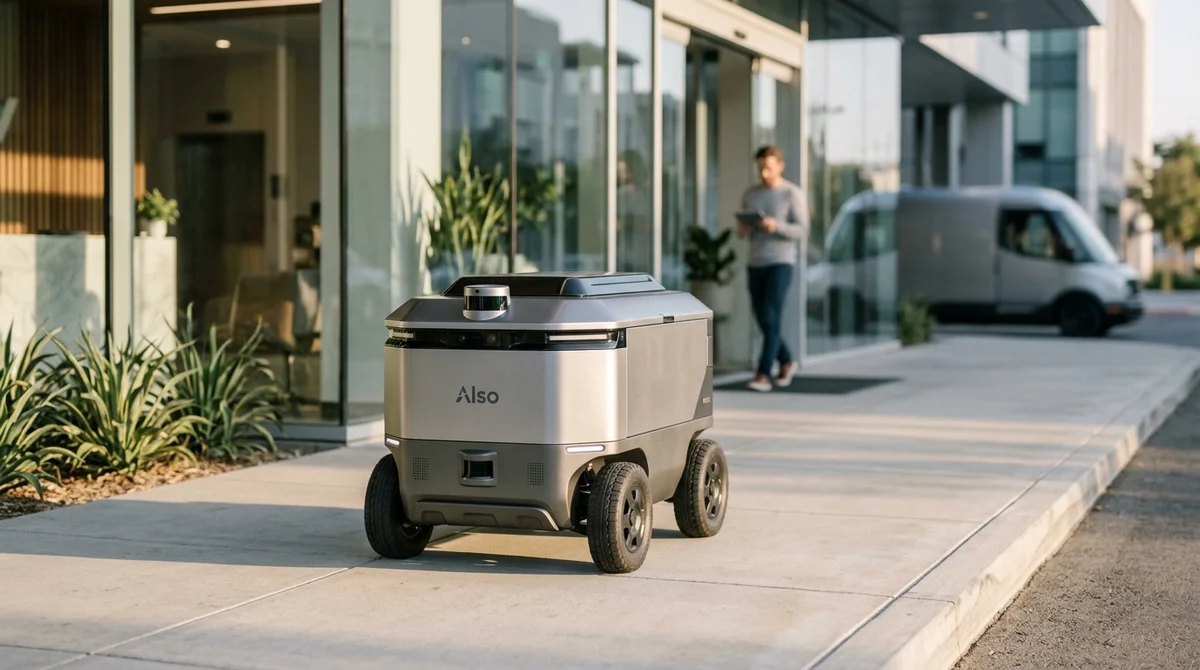
Also, a spinoff from Rivian, received a $1 billion valuation in a new funding round and simultaneously signed a partnership agreement with DoorDash for autonomous delivery operations. For the market, this signals that interest in AI logistics and compact electric transport is shifting from attractive concepts to applied services with clear economics.
Valuation and Round
A $1 billion valuation is a strong result for a young company that emerged from Rivian Automotive but is betting not on large electric vehicles but on more compact transportation solutions. Such a level typically means that investors see not just a promising product, but a platform capable of capturing a place in urban mobility, commercial logistics, or service transportation. In Also's case, the team's background is particularly important: a spinoff from an EV manufacturer automatically raises expectations regarding battery expertise, equipment reliability, and industrial engineering quality.
So far, the brief description of the deal does not disclose the investor composition, round conditions, or specific plans for commercial launch. But the figure itself explains a lot. The market is again willing to assign large valuations to transportation startups if they have a coherent B2B scenario and not just a consumer brand.
For Also, this means a rapid move to another league: now the company needs to prove production scalability, unit economics, fleet service support, and the ability to deliver on promises in real operations, not just at the prototype level.
Why DoorDash Matters
The partnership with DoorDash makes the story much more concrete. This is no longer just about electric transport as a category, but about one of the most common and commercially clear autonomous scenarios—last-mile delivery. For such projects, a partner with high order volume is often more important than an impressive technology presentation: it provides real routes, repeating scenarios, timing requirements, and data without which autonomous systems are almost impossible to bring to a working state.
If we look at the agreement as a product signal, it has several practical objectives right away. In autonomous delivery, success goes not to the most impressive demonstration, but to the system that reliably handles a dense urban schedule, weather constraints, and platform requirements.
- short routes with repeating geography
- delivery during peak demand hours
- reducing last-mile costs
- more predictable arrival time
- collecting operational data for scaling
For DoorDash, this is a way to test how autonomous transport solutions can fit into the existing logistics network without a complete business overhaul. For Also, it is a chance to get not an abstract showcase for investors, but a real environment where it can test reliability, safety, and unit economics. The brief description of the deal does not reveal what type of transport will be the basis for the pilots, but the focus on delivery itself suggests: the company is moving toward where innovation can be quickly verified in a repeating daily operation.
Where the Main Risks Are
The most difficult stage begins after the valuation and partnership announcement. Autonomous delivery requires solving engineering, regulatory, and operational challenges simultaneously. Even if the basic transport is ready, you need to ensure stable operation of sensors, navigation, remote monitoring, and fleet maintenance.
Plus, there is the classic last-mile problem: the system must work not in an ideal demo environment but among couriers, cars, pedestrians, bad weather, and unpredictable urban scenarios. There are also business risks. The high valuation accelerates market and partner expectations: from now on, the company will be judged not by its Rivian pedigree but by its ability to bring pilots into repeating commerce.
If DoorDash and Also can demonstrate that autonomous deliveries reduce costs or improve SLA without loss of quality, this will be a strong argument for scaling. If not, the story risks remaining yet another expensive experiment at the intersection of e-mobility and AI.
What This Means
The deal shows where the autonomous transport market is shifting: investors no longer want just "smart" hardware—they need a clear application channel. Also has gained two assets at once—unicorn status and access to a major logistics partner. If the company can quickly turn this into working pilots, the AI delivery segment will get a new benchmark: not a robot for robot's sake, but a concrete service embedded in daily commerce.
Want to stop reading about AI and start using it?
AI News is a curated feed of AI/tech news. Hamidun Academy teaches you to use AI systematically in your work.