How AI helped identify latent vertical phoria after a year of fruitless doctor visits
For nearly a year, the person tried to understand why white letters on a dark background seemed to “jump,” even though doctors said everything was normal. AI…
AI-processed from Habr AI; edited by Hamidun News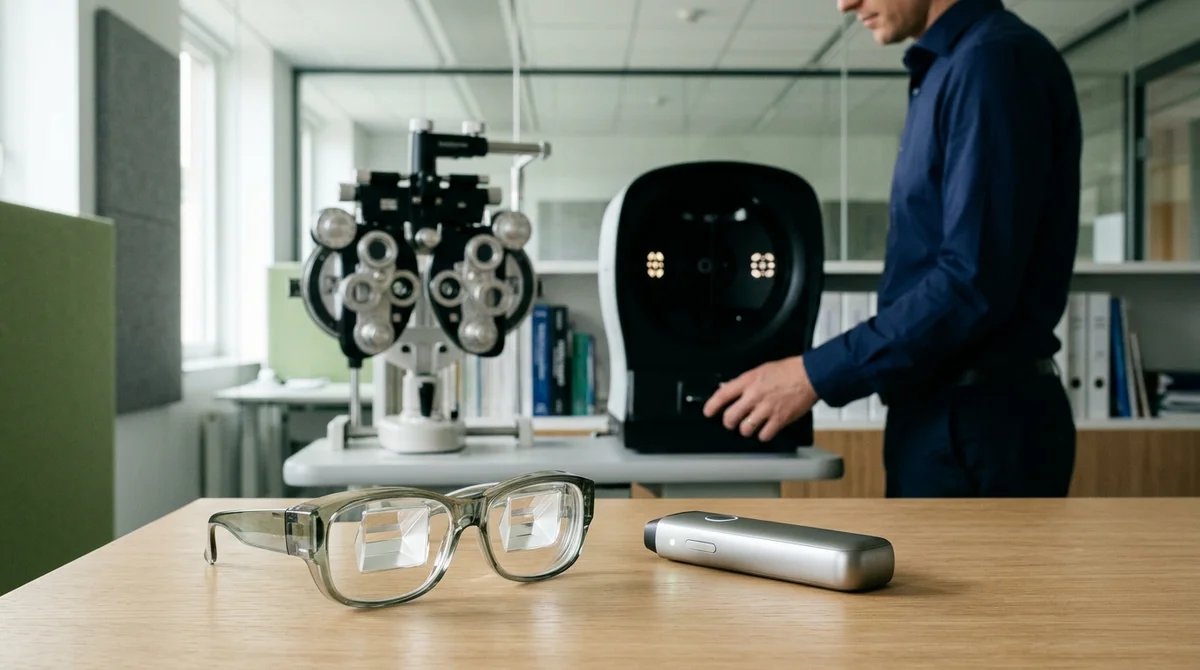
A personal case was published on Habr about how AI in 20 minutes guided the author to a diagnosis that three ophthalmologists and two neurologists could not name in almost a year. It was not about "eye fatigue," but about hidden vertical phoria — a minor binocular vision disorder due to which white letters on a dark background literally bounced.
A Year Without Answers
The story began with an effect that was difficult to explain clearly to a doctor: in the evening, in dark theme IDE, white text shifted by a couple of pixels, and geometric patterns on the wall sometimes seemed to twitch. The author spent several months visiting specialists, but standard tests showed nothing alarming. Blood pressure, fundus, autorefractometry, and the visual acuity chart all looked normal, so the complaints were interpreted as asthenopia, computer vision syndrome, or simple fatigue.
"Everything is fine."
That was the answer he heard again and again, even though the symptoms did not disappear. Only the third ophthalmologist noticed that in the binocular vision test, the figures shifted not where they should, but the appointment ended there. The author left without a diagnosis and with the feeling that the problem seemed to be noticed, but not named. Against the backdrop of prolonged uncertainty, he managed to visit two neurologists as well, but found no explanation there either.
How AI Helped
The breakthrough came after a conversation with AI. Instead of a general answer about fatigue, the system began asking clarifying details: in which direction the image shifts, whether the effect intensifies when tilting the head, whether there is pressure behind the eyes. After a series of such questions, AI put forward a hypothesis about vertical phoria — a hidden vertical misalignment between the eyes that can be missed in a routine exam. Essentially, it did what rarely has time in a streaming appointment: systematically narrowed the circle of causes by symptoms.
Next, AI helped not to treat the problem independently, but to narrow the search correctly. The author studied the topic, found a specialist in binocular vision, and came not with a vague description of "something is wrong," but with a request to perform specific tests. At the fourth appointment, the diagnosis was confirmed, and prismatic glasses relieved the symptom almost immediately. The key turned out to be not a miraculous explanation, but a more accurate route: the correct hypothesis, the correct doctor, and the correct tests.
- AI clarified the nature of the shift, rather than limiting itself to a general complaint about eye fatigue
- Suggested a hypothesis about vertical phoria
- Oriented toward which specialist to see next
- Highlighted the necessary tests: cover test, Maddox rod, and prism measurement
- Helped transform a vague symptom into a clear request for a doctor
Why the Diagnosis Eluded Everyone
The main problem is that vertical phoria may not manifest externally in any way. The eyes look straight, a person sees the line in the chart, and a standard adult appointment mainly checks the optics of the eye and the condition of its tissues, not how accurately both eyes work together. For this, separate binocular vision tests are needed, which take only a few minutes, but are often not part of the standard routine for an adult patient.
According to the author, a small vertical deviation is particularly insidious in that it does not produce pronounced double vision. The brain can still hold one image, but it does so at the limit, causing the image to become unstable. This is why white letters on a black background, thin lines, and geometric patterns are most noticeable: high-contrast objects instantly reveal the microshifts that the brain would smooth over in an ordinary scene. With a larger disorder, a doctor would quickly see the problem, but here the symptom is too strange and too "quiet."
Additional factors could be age and lifestyle. The author attributes the exacerbation to presbyopia around age 40, years of computer work, and neck tension, which can affect visual comfort. In such a combination, a hidden peculiarity that the body previously coped with no longer fits within the compensation range — and then strange symptoms begin despite formally normal vision. This is what makes such cases especially unpleasant: a person feels bad, but objective markers on a basic exam look almost perfect.
What This Means
This case is not about AI "replacing a doctor," but about a different role for such systems: they can more quickly transform a vague complaint into a working hypothesis, a list of necessary tests, and a search for an appropriate specialist. For people with similar symptoms, the main takeaway is simple: if a standard exam shows normal results, but the image still "drifts," it makes sense to discuss binocular vision specifically, rather than limiting yourself to fatigue drops.
Want to stop reading about AI and start using it?
AI News is a curated feed of AI/tech news. Hamidun Academy teaches you to use AI systematically in your work.