Valar Atomics raises $450 million for small nuclear reactors for AI data centers
Valar Atomics, founded by 27-year-old Isaiah Taylor, raised $450 million at a $2 billion valuation. The startup is betting on small nuclear reactors for AI…
AI-processed from TNW; edited by Hamidun News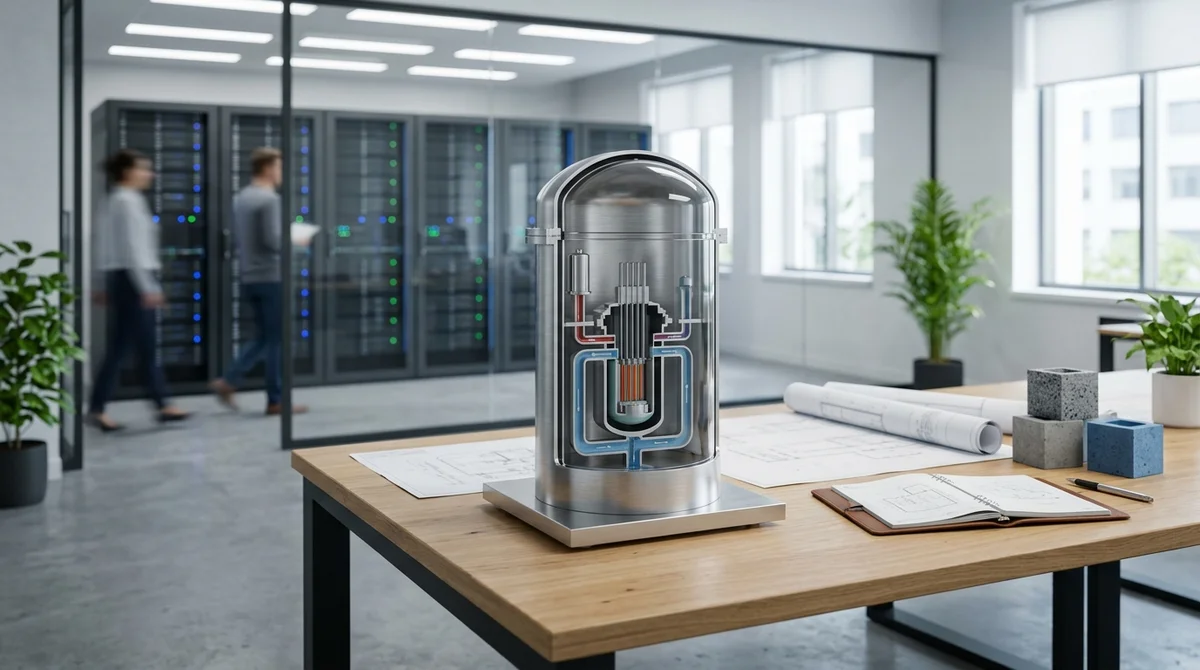
Valar Atomics, founded by 27-year-old Isaiah Taylor, raised $450 million at a $2 billion valuation. The startup wants to prove that the next wave of AI infrastructure will be powered not by the giant nuclear power plants of the past century, but by compact reactors standing next to data centers.
What Valar is betting on
The company's idea is quite straightforward: traditional nuclear energy was built for centralized grids and multi-year construction projects, while AI data centers need power faster, denser, and closer to computing. That's why Valar is pushing the model of so-called gigasites — large facilities where hundreds or even thousands of small high-temperature reactors operate simultaneously. Such clusters should provide stable carbon-free energy directly "at the fence" of a data center or industrial facility, without waiting for grid connections.
- Clusters of multiple small reactors instead of a single large station
- Helium cooling and TRISO fuel in graphite shells
- Direct power supply for AI data centers, industry, and regions with network deficits
- Betting on serial production of standard modules rather than unique megaprojects
The new round includes $340 million in equity capital and $110 million in debt. For Valar, this is a sharp jump: just five months earlier, the startup had raised $130 million, and now it's valued at $2 billion. Among the investors are Palmer Luckey from Anduril and Shyam Sankar from Palantir — meaning the money is coming not just from energy, but also from the defense-tech sphere, which has long viewed energy as part of computing and military infrastructure.
What they've already shown
Valar's main argument isn't just presentations, but several technical milestones. In November 2025, the company announced that its NOVA Core reactor assembly achieved zero-power criticality at the NCERC facility in Nevada, managed by Los Alamos National Laboratory. This doesn't mean power generation: it's about a self-sustaining chain reaction without reaching operating temperatures. But for a young nuclear company, this stage is important because it confirms calculations on fuel, neutron physics, and reactor control.
"Zero power is the first heartbeat of the reactor: it means the physics works."
The next step is the Ward250 demonstration reactor in Utah. In February 2026, it was transported from California on three military C-17 cargo aircraft to the Utah San Rafael Energy Research Center — without fuel. The fact of such transportation itself became a separate demonstration: Valar is showing that its installations can be quickly delivered and deployed wherever power is needed. The company's goal is to bring the reactor to operational stage by July 4, 2026, in line with the deadline of the U.S. Department of Energy's pilot program.
Why the market believed
Investor confidence is understandable: electricity has become one of the main constraints for the AI boom. The International Energy Agency previously forecast that data center energy consumption could double by 2026. Against this backdrop, Microsoft, Amazon, and Google are already signing agreements related to nuclear generation. The problem is that there are almost no commercial next-generation reactors that can be quickly deployed next to computing clusters. Valar is selling exactly the promise of closing this gap. But the risk here is enormous.
The company has competitors with no less ambitious plans — TerraPower, Kairos Power, X-energy, and Oklo — and none of them have yet brought advanced reactor architecture to mass commercial deployment. Moreover, Valar has taken an aggressive stance on regulation: in April 2025, the startup joined a lawsuit against the Nuclear Regulatory Commission, arguing that the same licensing framework used for full-size commercial plants cannot be applied to small test reactors. In other words, the company is arguing not just with physics and manufacturing, but with the very structure of the industry itself.
Even if the summer tests in Utah go successfully, it won't prove that the gigasites model is economically and regulatorily scalable. It's one thing to demonstrate a working prototype; it's another to deploy hundreds of modules next to data centers and ensure safe, cheap, and predictable operation for years to come. For investors, the real next test is not the launch itself, but the ability to turn a pilot project into a repeatable industrial product with clear economics.
What this means
The AI race is increasingly running up against not models or chips, but basic power infrastructure. The story of Valar Atomics shows that investors are ready to place hundreds-of-millions-of-dollars bets not only on AI creators, but also on those promising to power them. If the company reaches the next milestone, the market for microreactors for data centers will accelerate sharply; if not, it will be a reminder that venture capital cannot shortcut nuclear physics or regulatory timelines.
Want to stop reading about AI and start using it?
AI News is a curated feed of AI/tech news. Hamidun Academy teaches you to use AI systematically in your work.