Es Devlin gathered artists and AI researchers for a conversation about ethics through ceramics
Es Devlin devised an unusual format for a conversation about AI: instead of a stage and slides, a pottery workshop at Oxford Kilns. At the AI and Earth…
AI-processed from Guardian; edited by Hamidun News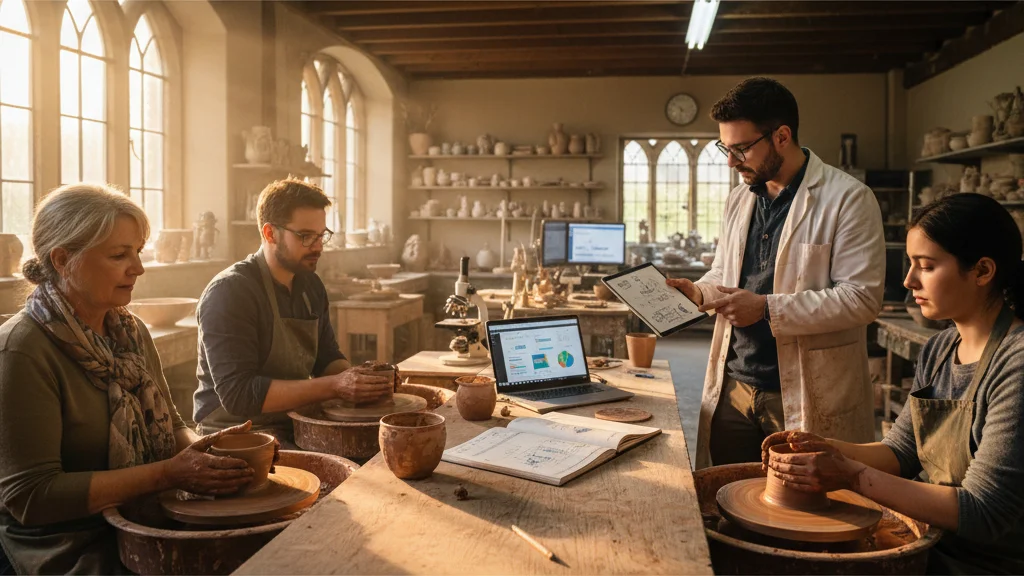
British artist and stage designer Es Devlin gathered an unusual group at Oxford Kilns — from AI researchers to spiritual leaders — to discuss the ethics of artificial intelligence not in an auditorium, but at a potter's wheel. Instead of the usual panel discussion about technology risks, participants were asked to work with Jurassic clay roughly 160 million years old while simultaneously debating where the tech industry is leading humanity.
An Unusual Format for Conversation
The meeting took place as part of the AI and Earth conference organized by Devlin herself. The workshop brought together artists, AI researchers, academics, spiritual leaders, and representatives of the global tech industry. This composition is important in itself: typically, conversations about AI ethics remain confined among engineers, lawyers, and investors, but here people with different perspectives on creativity, consciousness, responsibility, and the pace of change found themselves in one room.
The ceramic format eliminated the familiar hierarchy of the stage, where one person speaks and others listen. One detail of the meeting was a singing bowl, which Devlin literally used to create silence in the room. The sound, familiar from Buddhist practices and modern yoga studios, became a signal to begin discussion.
This is not a decorative gesture, but part of the overall logic of the event: before talking about systems that accelerate the production of text, solutions, and images, participants are first taken out of constant reaction mode. This attitude makes the conversation no less sharp, but noticeably less automatic.
Why Clay Here
The central material of the meeting is Jurassic clay roughly 160 million years old. Devlin brought forward not a digital interface, but a substance older than any platform, corporation, or computing stack. There is a powerful contrast in this: AI technologies unfold in the logic of speed, scaling, and updates, while clay requires slow physical contact, patience, and attention to limitations. A mistake cannot be instantly hidden with a new prompt — it must be literally felt in your hands.
"This is 160-million-year-old Jurassic clay."
It is through this material experience that Devlin seeks to reformat the conversation about AI ethics itself. Instead of abstract principles and general declarations, participants are asked to do something with their hands while simultaneously discussing how technologies are changing humans. Ceramics works here as grounding: it returns the discussion to the body, time, resources, and consequences. When people simultaneously argue and sculpt, there is less chance of hiding behind ready-made positions, corporate language, or overly polished formulations.
What the Participants Argue About
Judging by the intent of the meeting, Devlin brought together people not for the sake of a beautiful performance, but for the sake of a clash of different viewpoints. Among the participants were artists, AI researchers, academics, spiritual leaders, and experts from big tech. This means that in one room there were different ways of answering the same question: does AI make humans freer, more productive, and more attentive — or, conversely, does it accelerate alienation, standardize thinking, and erode personal responsibility?
Against this backdrop, the conversation inevitably revolves around several lines of tension:
- how AI changes authorship and creative labor
- what pace of technology adoption society is actually prepared to handle
- whether spiritual and humanistic traditions should participate in designing AI systems
- what happens to human attention when more and more decisions are automated
- how the conversation about the future of AI is connected to the material limits of Earth, not just computational power
It is important that this dispute is taken out of the familiar language of presentations and press releases. Clay resists, dirties your hands, requires time, and doesn't allow you to skip to a conclusion in a couple of seconds. This is Devlin's main technique: if AI increasingly compresses the distance between request and result, then the ethical conversation, perhaps, should be intentionally slowed down instead. Not to romanticize craft, but to once again distinguish the cost of decisions that are then scaled to millions of people.
What It Means
Devlin's idea shows that the debate about AI goes beyond laboratories, parliaments, and product teams. More and more people are trying to discuss technology not only as a question of efficiency, but also as a question of rhythm, attention, power, and connection to the material world. For the industry, this is an uncomfortable but useful reminder: AI ethics cannot be reduced to a checklist if the very conditions of the conversation push everyone toward answers that are too quick and too convenient.
Want to stop reading about AI and start using it?
AI News is a curated feed of AI/tech news. Hamidun Academy teaches you to use AI systematically in your work.