Palantir and Project Maven: How AI Helps the US Select Targets for Strikes on Iran
Palantir has found itself at the center of a new debate over military AI: the Project Maven system helps the US military select targets for strikes on Iran…
AI-processed from Habr AI; edited by Hamidun News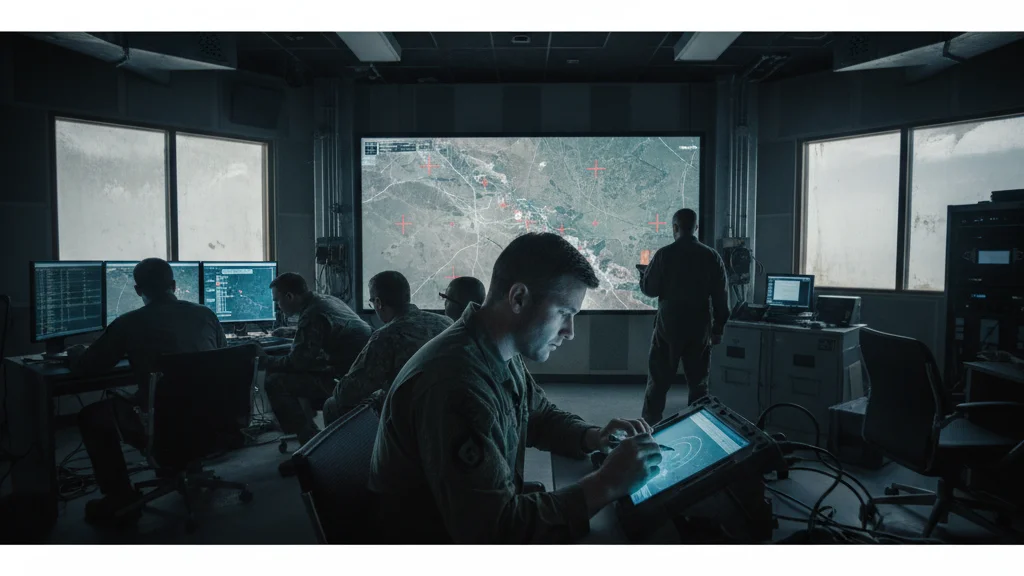
Project Maven, connected to Palantir, found itself at the center of discussion following claims that the U.S. Army uses AI to accelerate target selection in the war with Iran. The main question here is not how fast the system works, but how much human control remains in the decision-making chain.
Campaign Scale
The context of the news—the 32nd day of the U.S.-Iran war.
According to statements from Donald Trump's administration, in a single day, the military struck approximately a thousand targets, and over the course of a month, the number of destroyed objects reached 11 thousand. Such figures are important not only as an indicator of campaign intensity. They demonstrate that the previous manual intelligence cycle—coordinate verification and target status confirmation—can no longer keep pace with operational tempo.
When the count reaches hundreds and thousands of objects per day, the military inevitably relies on automation. This is precisely why Project Maven became the focus of attention—a military analytical loop described in the material as "Google Earth for war." On the map, each point contains not simply a geotag, but a set of characteristics: coordinates, elevation, object type, and labels like "friendly" or "hostile."
Essentially, it is an interface through which an operator receives an already sorted and prioritized picture of the battlefield, rather than raw data from dozens of independent sources.
How Maven Works
The essence of Maven is not that it presses the strike button itself, but that it drastically reduces the time between observation and decision. What previously took weeks or months of analyst work, the system converts into a compressed cycle: collect signals, correlate objects, identify suspicious targets, present them to a human in an understandable format. This is where Palantir's role becomes key: the company has long been building platforms that connect intelligence data, maps, logs, images, and reports into a single operational screen for the military and intelligence services.
- Coordinates and elevation of the object
- Target type and its possible role
- "Friendly" or "hostile" marking
- Priority for verification and strike
- A single map instead of fragmented tables and briefs
Palantir's Chief Technology Officer Shyam Sankar described the effect in pragmatic terms: the system allows one person in two weeks to accomplish the volume of work that previously required the efforts of 50–100 specialists over six months. This sounds like a productivity gain, and this is how such platforms are typically sold to clients—as an "Iron Man suit" for a soldier or analyst. But in military settings, acceleration is not a neutral metric. The shorter the target selection cycle, the less time remains for doubt, additional verification, and correction of errors.
"What required the efforts of 50–100 people for six months, today one
person accomplishes in two weeks."
Where the Main Risk Lies
The main concern is not that the algorithm became fast, but that it can lend an error the appearance of confident decision-making. If the system incorrectly classifies an object, confuses context, or relies on incomplete data, the operator sees on the screen an already formulated recommendation. In such an interface, error does not arrive as chaos, but as a neatly packaged suggestion with coordinates and labels.
Psychologically, it is harder for a person to disagree with a machine when it shows a target on the map, assigns it a status, and embeds it in the overall operational rhythm. There is a second risk as well: diffusion of responsibility. When a strike on a target passes through a long digital chain—sensors, models, databases, interfaces, and final confirmation—it later becomes difficult to pinpoint exactly where the failure occurred.
Did the analyst err, the satellite image, the classifier, the intelligence data source, or the person who assigned too high a priority? The more the military relies on such systems, the more important it becomes not only to ensure their accuracy but also their transparency: who made the decision, on what data, and with what level of confidence.
What This Means
The story around Project Maven shows that military AI has ceased to be an experiment on the periphery of the defense industry and has become part of a real decision-making loop. For the industry, this is a signal: the main debate is no longer about whether target selection can be automated, but about who is responsible for the consequences when algorithm speed begins to set the pace of war itself.
Want to stop reading about AI and start using it?
AI News is a curated feed of AI/tech news. Hamidun Academy teaches you to use AI systematically in your work.