WACV 2026 in Tucson showed Computer Vision's shift toward multimodality and synthetic data
WACV 2026 in Tucson showed where applied computer vision is heading: multimodality has become the norm, synthetic data is moving to the center of the…
AI-processed from Habr AI; edited by Hamidun News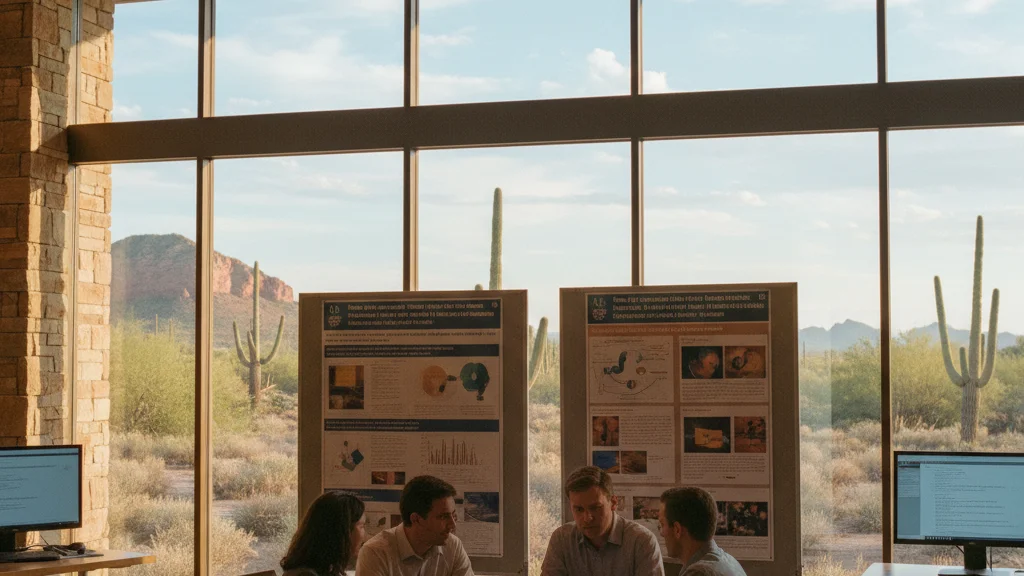
WACV 2026 in Tucson confirmed that computer vision is rapidly shifting toward multimodal models, synthetic data, and more efficient computation. In a report from a FusionBrain AIRI participant, these trends combine with two of the laboratory's own works — on key frame selection for long videos and on analyzing what vision encoders actually preserve.
Format and Scale
WACV is traditionally considered the more applied cousin of CVPR: here there is less theory for theory's sake and more systems, datasets, and engineering solutions that can be transferred to real products. According to the participant's account, acceptance at the 25–30% level makes the conference competitive but not overwhelming, and the format with 200–300 people is noticeably different from giant events like NeurIPS or ICCV. All activities took place in one location — the JW Marriott Starr Pass Resort in the middle of the Sonoran Desert near Tucson.
WACV is a "conference of the right size."
It is precisely this intimacy that became one of the main strengths of the event. At such a venue it is easier to approach a poster author, discuss model architecture, or compare results without long queues and the noise of a large event. The location also played its role: a resort complex in the desert turned out to be beautiful but isolated, so almost all participants got there by taxi or Uber. In return, they received a rare combination of a dense scientific program and an almost laboratory-like atmosphere for conversations.
Main Scientific Topics
If you combine presentations and posters into one picture, WACV 2026 showed a fairly clear set of priorities for Computer Vision. The focus is shifting from simply increasing data volume to improving sampling efficiency, to generating training examples through diffusion models, and to dynamic computation management within transformers. This is no longer a set of separate experiments, but a general direction that was repeated in works from different subdomains — from medicine to video analytics.
- Multimodality has become the default mode, not an exotic feature for individual labs.
- Synthetic data is increasingly used as the foundation for cold start scenarios without real annotations.
- Model efficiency is moving beyond quantization toward token pruning, token merging, and adaptive patch sizes.
- Video understanding remains an open challenge despite the growth in models and benchmarks.
The shift toward synthetic-only and hybrid pipelines is particularly notable. The conference discussed cases where artificially generated data already surpasses real datasets in narrow domains like medicine, satellite imagery, and industrial quality control. At the same time, approaches to accelerating ViT models have matured: instead of simple compression, methods are increasingly applied that change computation density depending on frame content. However, video remains a challenging area: there is more data, but full machine "understanding" of long video context is still far from a solved problem.
AIRI FusionBrain's Work
AIRI FusionBrain brought two works to WACV, both in poster format. The first, MaxInfo, proposes a training-free method for selecting key frames in long videos for Video Large Language Models. Instead of uniform selection of every N-th frame, the method first obtains embeddings through a ViT encoder, then compresses the representation through SVD, and then applies the rect_maxvol algorithm to select the most diverse and informative frames. According to the authors, such a plug-and-play module gives an improvement of approximately 3–5% on LongVideoBench for LLaVA-Video and Qwen2-VL without changing the architecture.
The second work, Feature Inversion as a Lens on Vision Encoders, answers a more fundamental question: what exactly does a vision encoder store. Researchers show that original images can be reconstructed from frozen ViT features, and simple linear transformations in feature space lead to predictable changes in pixel space, such as controllable color shifts. This result is important not only as a beautiful demonstration of feature space geometry, but also as a practical guide when choosing encoders: models with image-centric objectives preserve more visual information.
Interest in these posters was notable, according to the report: people approached the stands, discussed details, and scanned QR codes with materials. This well illustrates the spirit of WACV itself: here value is placed not only on the prestigious name of a laboratory, but also on the opportunity to calmly examine an idea with the author on site. For small research teams, such a format is often more useful than presenting at a very large venue where contact with the audience quickly dissolves in scale.
What This Means
WACV 2026 showed that applied computer vision is entering a phase where the winners are not the heaviest models, but those that best combine multimodality, synthetic data, and adaptive computation. For teams building products on CV and video AI, this is a signal to look not only at benchmark quality, but also at how a model works with long context, lack of annotations, and real resource constraints.
Want to stop reading about AI and start using it?
AI News is a curated feed of AI/tech news. Hamidun Academy teaches you to use AI systematically in your work.