In the US, investment is shifting from offices to data centers amid tech giants’ demand for AI
A quiet reshaping of the real estate market is beginning in the US: money is increasingly going not into office towers, but into data centers. In July 2025…
AI-processed from Habr AI; edited by Hamidun News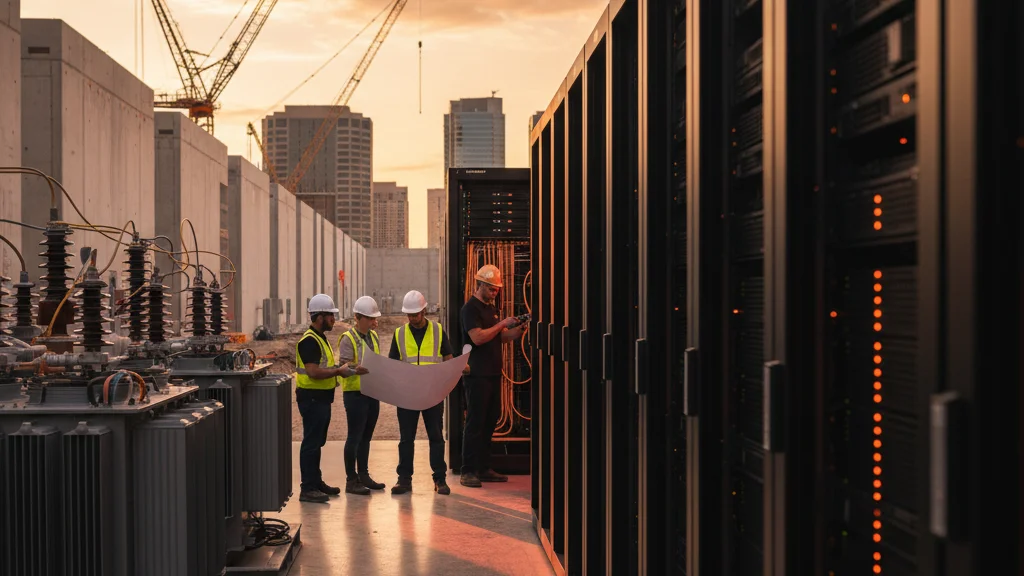
The American commercial real estate market is quietly changing priorities. If office towers used to be the main symbol of growth—concentrating teams in one place—now increasingly more capital is flowing into data centers—the physical foundation of clouds, AI services, and digital platforms.
Where Capital Is Shifting
The shift is clearly visible in the numbers. According to data cited in reports, seasonally adjusted annual spending on office building construction in the USA in July 2025 was around $105.5 billion. This remains an enormous market, but alongside it, a new category has grown rapidly: already in June 2025, annual data center construction spending reached $40 billion. For a segment that was recently perceived as a niche engineering infrastructure, this is not just growth—it's a transition into the category of strategic assets.
This is not to say that offices are disappearing or becoming unnecessary. Rather, the logic of investments is changing: investors increasingly look not at square meters for employees, but at facilities that serve the digital economy. It is telling that the U.S. Census Bureau now lists data center as a separate line item within office construction. The fact of such detailed accounting shows that the sector has ceased to be a statistical footnote and has become a notable part of the construction and investment landscape.
"Invisible but critically important data centers—the core of digital
infrastructure."
Why Data Centers Are Growing
The main driver is a sharp increase in demand for computing power. Clouds, generative AI, corporate analytics, video services, and endless online products depend not only on models and software, but on hardware. To run model training, inference, and data storage, you need not abstract "capacity," but concrete buildings with servers, cooling systems, backup power, network infrastructure, and access to stable electricity. This is why the AI boom almost automatically becomes a data center construction boom.
- Growth of cloud services and AI workloads
- Business and government digitization
- Hybrid and remote work, which increased dependence on online infrastructure
- Large-scale investments from AWS, Google, Meta, and Microsoft
The second reason is a change in how companies understand infrastructure. Previously, competitive advantage was thought to come from headquarters in the right location and a large office portfolio. Now, what matters is access to computing resources, speed of service deployment, and control over data processing costs. For the largest tech companies, a data center has become as fundamental an asset as a campus or regional office used to be. The more a business relies on AI, the closer infrastructure moves to the center of corporate strategy.
What Changes in the Market
For the real estate market, this is not a cosmetic trend but a shift in priorities. Office real estate remains a large category, but its role no longer seems unconditional: the hybrid work format has reduced the previous emphasis on concentrating people in one place, and digital processes have become more important than a prestigious address. A data center, by contrast, is almost invisible to the end user, but it is precisely what powers search, text generation, corporate SaaS systems, video calls, file storage, and hundreds of other services that employees use every day.
The structure of capital expenditures itself is changing. Investments are flowing out of facilities where the primary value comes from the physical presence of people, into facilities where value is created through continuous data processing. This drives demand for energy, cooling, telecom channels, land parcels near network nodes, and long-term contracts with equipment providers. In other words, the center of gravity is shifting from familiar office logic to infrastructure logic: less showiness, more engineering, energy consumption, and planning for machine workloads.
What It Means
The AI economy is increasingly materializing not in chatbots and interfaces, but in concrete, cables, substations, and server rooms. For business, this is a signal: winners will not only be model developers, but those who control computing infrastructure, energy resources, and platforms for scaling.
Want to stop reading about AI and start using it?
AI News is a curated feed of AI/tech news. Hamidun Academy teaches you to use AI systematically in your work.