Russians are building home supercomputers en masse to work with neural networks
A home supercomputer for AI is no longer a rarity. Russians are buying powerful GPUs, large amounts of RAM, and fast NVMe drives in large numbers to run and train neural networks locally, without depending on cloud services. The trend is gaining momentum amid the availability of open models such as LLaMA, Mistral, and DeepSeek, which can already be deployed directly on a home server.
AI-processed from CNews AI; edited by Hamidun News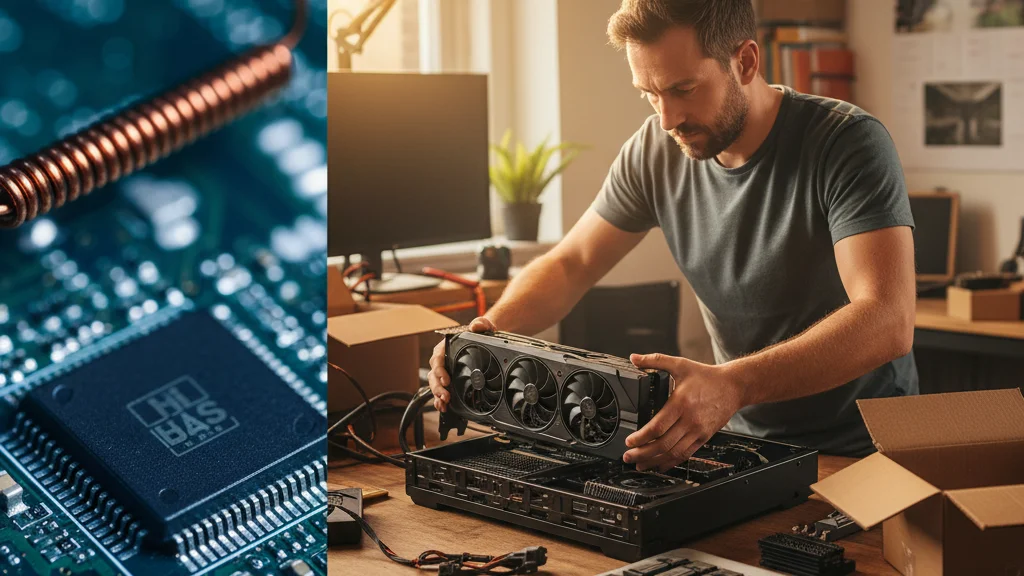
In 2026, a home supercomputer for AI has ceased to be a rarity and has become a professional's working tool. According to CNews, Russians are actively purchasing high-performance GPUs, capacious NVMe storage, and server RAM — to run and train neural networks at home, without dependence on cloud services and foreign providers.
Not a gaming PC, but AI infrastructure
The assembled machines are fundamentally different from ordinary gaming stations. This is specialized infrastructure where each component is selected for inference and fine-tuning tasks of language models. A typical configuration of a home AI server in 2026:
- One or two GPU accelerators with 24–80 GB of video memory (NVIDIA A/L series or consumer RTX 4090/5090)
- RAM from 128 to 384 GB with ECC support — for working with large context windows of language models
- NVMe array of 4–16 TB for storing model weights, checkpoints, and training datasets
- Motherboard with PCIe 5.0 support and multiple expansion slots for accelerators
- Power supply of 1600–2000 W for stable long-term load in training mode
The budget for such an assembly varies from 500 thousand rubles to several million depending on configuration. At the same time, demand for corresponding components in retail and wholesale channels continues to grow confidently.
Why the trend gained momentum now
The current wave of interest in home AI hardware is explained by a coincidence of several independent factors.
Open models reached the level of practical applicability. The LLaMA 4, Mistral Large 2, Qwen 2.5, and DeepSeek R2 families today are comparable to commercial GPT services across a wide range of tasks. All of them are available openly and deployed locally through llama.cpp, vLLM, or Ollama — without API keys, subscriptions, and token limits.
Access to Western clouds has become complicated. For Russian users and companies, direct work with Azure OpenAI Service, AWS Bedrock, or Google Vertex AI requires non-trivial payment schemes and often — additional workarounds. Your own server eliminates this dependency completely.
Requirements for data privacy have become stricter. Companies working with personal customer data or confidential corporate documents cannot send them to third-party clouds. A local model solves the problem architecturally — information never leaves the corporate perimeter.
"A home supercomputer ceases to be exotic in 2026 and turns into a
tool for those who work with AI technologies at a professional level," — CNews notes.
Who buys and why
The audience of home AI builders in Russia is heterogeneous.
Developers use local hardware for fine-tuning open models for specific business tasks: training on internal company documents, creating specialized assistants, building custom RAG systems with a corporate knowledge base.
Researchers and students get the ability to conduct experiments without budget constraints — without a token counter and monthly payments to the provider. This is especially important when iteratively selecting hyperparameters or working with non-standard architectures.
Small and medium business deploys private AI assistants for the team instead of expensive SaaS licenses. With intensive use, ROI from your own server often pays for itself faster than a year.
What this means
The mass growth of home AI assemblies is a measurable signal of technology maturity. When thousands of specialists are ready to independently design and assemble complex computing installations, it means that local AI has gone beyond the data centers of large corporations and has become available to a wide range of professionals. For the Russian market, this shift is especially significant: dependence on Western infrastructure decreases and conditions are formed for the development of its own AI products based on open models.
Want to stop reading about AI and start using it?
AI News is a curated feed of AI/tech news. Hamidun Academy teaches you to use AI systematically in your work.
The AI world, distilled — once a week
Seven stories that actually mattered, hand-picked. No noise, no reposts, no press releases.
Done! Check your inbox for a confirmation.