Surf’s Head of Frontend built a game with AI without animation experience — and nearly broke down
Andrey Makar-Uvarov, Head of Frontend at Surf, decided to test AI in an area where he was a complete novice — and chose animation for an indie game. The…
AI-processed from Habr AI; edited by Hamidun News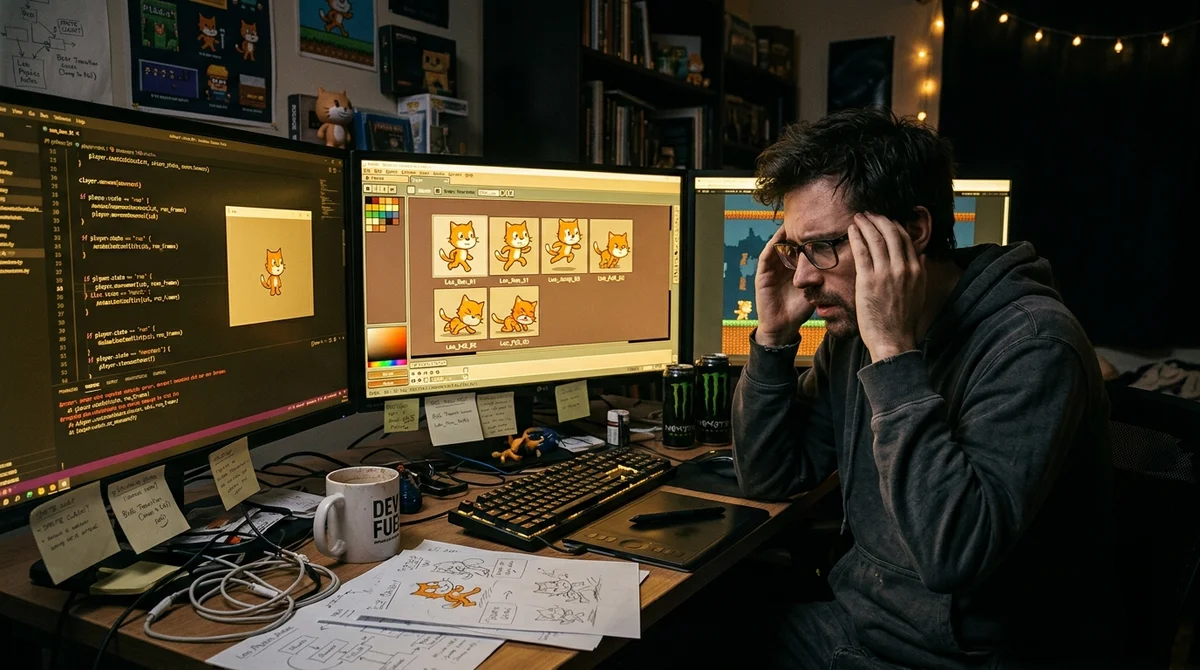
Andrey Makar-Uvarov, Head of Frontend at Surf, set himself an honest experiment: take a task from a field where he's a complete beginner and try to see it through using AI. His choice fell on an indie game with animation. The result — a prototype is ready, nerves are frayed.
Game: a cat, a maze, and a light resource
The concept is more thoughtful than you'd usually expect from a test project: an orange cat with a flashlight walks through a dark maze and searches for other animals. The key mechanic — managing light as a limited resource. The logic of choice is simple but has depth:
- Give the light to the rabbit — it will illuminate the passage and help you progress further
- Take it back and strengthen your own flashlight
- Balance between your own lighting and helping other characters
- Reach the end by correctly distributing the resource
The task wasn't reduced to a standard tutorial — it's not a CRUD app and not hello world. You need to create something that requires both technical and artistic solutions. This is what made the experiment an honest test of AI-assisted development.
Where the chaos began
Andrey is good with code. But creating game animation is a separate discipline: sprites, timings, acceleration curves, export formats. All of this is unfamiliar.
This is where AI was supposed to be a navigator in unfamiliar waters. At first the process went smoothly: AI suggested libraries, explained approaches, generated code examples. The problem appeared where it always does in a foreign domain: how do you verify that the result is correct?
Animation is visual and intuitive. To assess whether a character moves correctly, you need visual literacy. To precisely task the AI — you need specialized vocabulary.
To figure out the error — you need understanding of basic principles. Without this, the cycle of "ask → get answer → break something → ask again" starts spinning endlessly.
"Almost vibe-coded myself into a nervous breakdown" — this is exactly
how the author describes the final phase of working with animations.
Structural problem of vibe-coding
The case well illustrates the boundaries of AI-assisted possibilities. AI works as a multiplier: it increases speed where a person already has competence. Where there's no competence — there's nothing to multiply, and the process turns into a series of intuitive trials. Specifically for animation without basic knowledge, this meant:
- Impossible to assess result quality without visual literacy
- Hard to precisely formulate a task without the right vocabulary
- Difficult to diagnose errors without domain understanding
- AI confidently generates options, but you can't critically evaluate them
Despite this, the prototype came out. The game with the cat and maze worked. This is an important nuance: AI allows you to reach a working result even without expertise, but at the cost of significantly more iterations and stress than seemed likely at the start.
What does this mean
Vibe-coding in an unfamiliar domain is not a shortcut, but a marathon with an unknown route. AI lowers the barrier to entry but doesn't eliminate it: the further the task from your comfort zone, the more the result is determined by randomness rather than tool speed. Andrey's experiment is one of the most honest cases about this.
Want to stop reading about AI and start using it?
AI News is a curated feed of AI/tech news. Hamidun Academy teaches you to use AI systematically in your work.