Habr AI published the Rozitta Parser case study: how vibe coding eats up sleep and time
An architect with no development experience explained how she used DeepSeek, Gemini and Claude to turn a simple Telegram parser into her own app, Rozitta…
AI-processed from Habr AI; edited by Hamidun News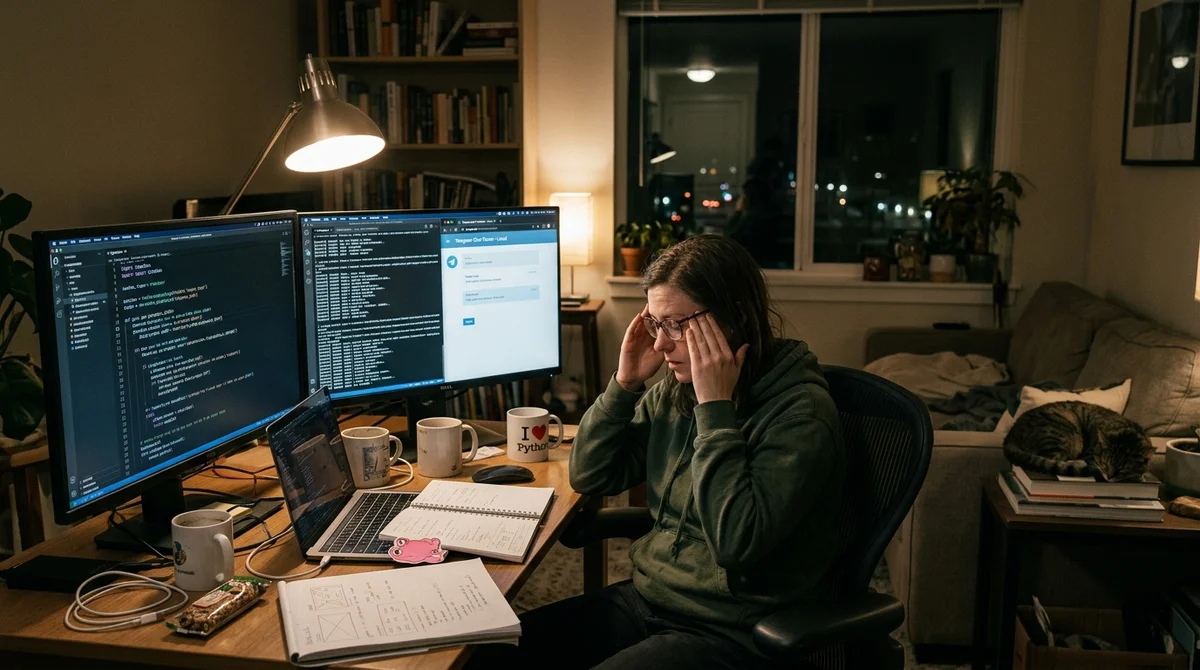
Habr AI published a personal case study about how an attempt to preserve an important Telegram chat turned into a six-month development of a custom application. An architect with no programming experience built Rozitta Parser with the help of several neural networks and honestly described how much time, effort, and personal resources are consumed by such vibe coding.
How the project appeared
The story began with a simple task: the author needed to export the contents of a Telegram group where old information was supposed to disappear with the start of a new stream. To do this, she asked a neural network to write a parser, even though she had recently not known what Telethon, API keys, and `pip install` were. A quick script solved the local problem, but almost immediately started accumulating new requirements: message filtering, file downloading, support for different chats, and a more convenient launch form.
From there, the project followed a typical vibe coding scenario: one AI model wrote code, another helped structure requests, a third searched for alternative tools and explained why one stack was better than another. DeepSeek was used for early versions and HTML prototypes, NotebookLM served as auxiliary knowledge base, Gemini for formulating prompts, and Claude for heavier assembly and refactoring. From a one-off script grew a full-fledged desktop application with its own name and mascot — a pink robot fly named Rozitta.
What the parser became
Over six months, Rozitta Parser transformed into a multi-module Python application with a GUI, data export, and local media processing. The author specifically emphasizes that the project has moved far from the original idea of "preserving correspondence": now it's a tool that attempts to collect from Telegram not just an archive, but a convenient knowledge base for further work, reading, and uploading to AI services like NotebookLM. Essentially, this is already a personal pipeline that connects the messenger, file archive, and data preparation for subsequent analysis.
- Export conversations to DOCX, JSON, Markdown, and HTML
- Download files, images, and voice messages from chats
- Local audio recognition via faster-whisper without the cloud
- Splitting large exports into chunks for uploading to AI services
The current stack already looks quite mature: Python 3.11, PySide6 for the interface, Telethon for working with the MTProto API, SQLite for data storage, python-docx for export, and faster-whisper for local voice message recognition without the cloud. The application can work with SOCKS5 and MTProto proxies, and can also slice large exports into chunks of 150 thousand words to circumvent third-party service limitations. In essence, this is no longer a "script for myself," but a complex product that has to be maintained like real software.
Price and help
The strongest part of the text is not technical, but human. The author calls taxi rides to work her "fatigue tax": due to late-night coding sessions, she began to be late, lose sleep, spend money on food away from home, and withdraw from family life. There is no romanticization of endless building in the article. On the contrary, it's a story about how creative fervor in AI development easily turns into a mode of "either code or sleep," especially if the project grows faster than your understanding of architecture, Git, and the boundaries of your own time.
"Fatigue tax" is not a metaphor.
A turning point came when the project was released on GitHub and the author reached out to the community for help. After a question on Habr Q&A, the application gained a live helper who dealt with bugs, interface, proxies, builds, and explanation of basic processes like GitHub Actions. At the same time, an interactive map of module dependencies and clearer documentation appeared. One of the author's main conclusions sounds harsh: AI accelerates the start, but over the long distance does not eliminate the need for documentation, understanding of language, and the participation of real developers.
What this means
The Rozitta Parser case study well illustrates the current limit of vibe coding: entering development has become easier than ever, but the cost of errors has also increased. Neural networks already help beginners assemble a working product, however without structure, rest, and human support, such a project quickly begins to consume not only time, but all of the rest of life as well.
Want to stop reading about AI and start using it?
AI News is a curated feed of AI/tech news. Hamidun Academy teaches you to use AI systematically in your work.