Tesla gets Europe's first approval for FSD Supervised — launch begins in the Netherlands
The Netherlands became the first country in Europe to allow Tesla to launch FSD Supervised on public roads. RDW granted approval on April 10, 2026, after 18…
AI-processed from TNW; edited by Hamidun News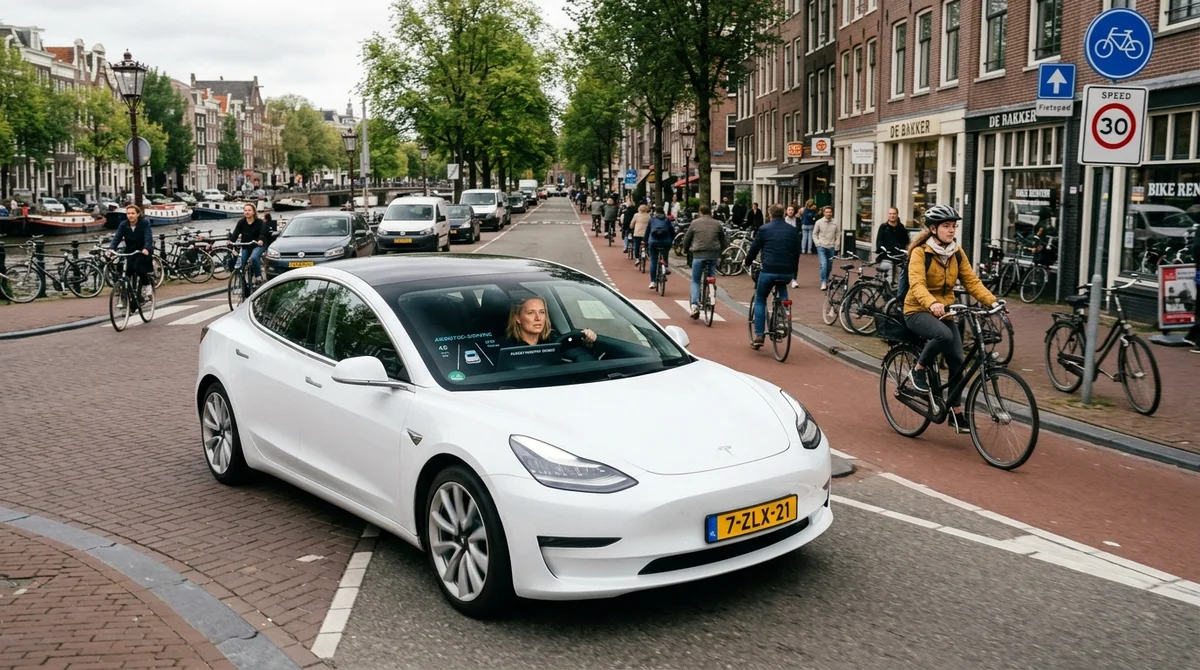
Netherlands becomes the first European country to allow Tesla's Full Self-Driving (Supervised) on public roads. The RDW decision from April 10, 2026 opens the path for the company not only to the Dutch market but also to broader recognition of the system within the European Union.
What exactly was approved
The issue is not about fully autonomous driving, but about a Level 2 class system, which under European regulations falls under Driver Control Assistance Systems. In the approved version 2026.3.6, Tesla can control the vehicle through almost the entire route: change lanes, navigate intersections, enter and exit highways, overtake vehicles and other objects. But legally and practically, the responsibility remains with the human driver.
RDW specifically emphasizes that FSD Supervised does not make the car autonomous. The driver is allowed to take his hands off the wheel under appropriate conditions, but he must continuously monitor the road and be ready to immediately take control. His attention is monitored by cameras and other sensors: if the system detects that the person is distracted, it first warns him, then disables itself, and in extreme cases transitions the car to a controlled stop.
"A vehicle with FSD Supervised is not self-driving,"
RDW emphasizes.
How Tesla passed the test
The approval was no formality. Tesla worked toward it for about 18 months, and the procedure itself became one of the largest of its kind for such systems in the Netherlands. The company compiled a large array of European data and went through a long chain of tests before receiving permission.
- 1.6 million kilometers of road data from Europe
- 4,500 tests on closed ranges
- 13,000 rides with observers
- Over 400 individual compliance requirements
- Before the first launch, the driver must complete mandatory training and pass a test
It is also important to note that in Europe, certification is structured differently than in the US. There, many decisions go through self-certification, and oversight is engaged later. In the EU, the system first receives approval from a national authority like RDW, and only after that can it legally appear on the road. RDW itself emphasizes that the European version of FSD Supervised is not a one-to-one match with the American version: the software, features, and set of limitations differ.
Why this matters for Europe
The main result of this decision is not only the launch of the feature in the Netherlands, but also the emergence of one of the first major practical use cases of UN Regulation 171 applied to a mass driver assistance system in the EU. This regulation describes technologies that help the driver control the vehicle longitudinally and laterally, but do not relieve him of responsibility for the entire trip. In other words, Europe has fixed a working framework in which such products can legally be brought to market.
For now, the permission only applies in the Netherlands. For full rollout across the entire European Union, RDW must submit a request to the European Commission, and member states must vote on it. If the vote is successful, the system can be applied across the entire EU market.
In parallel, Tesla hopes that individual national regulators will be able to recognize the Dutch decision more quickly and accelerate local launches. For Tesla itself, the moment is also strategic. In Europe, the company entered 2026 under pressure from competitors, primarily Chinese manufacturers, and amid slowing sales.
FSD Supervised is one of the few products that allows Tesla to sell not just a car, but also a regularly monetizable software feature. In the Netherlands, the subscription costs 99 euros per month, and the capability itself becomes a notable distinction of Tesla from most competitors in the mass market segment.
What this means
Europe has taken the first practical step toward a wider market for advanced human-controlled driving systems. For Tesla, this is an important commercial precedent, and for other automakers, it's a signal that the path through UN R171 and national regulators is no longer theoretical but operational.
Want to stop reading about AI and start using it?
AI News is a curated feed of AI/tech news. Hamidun Academy teaches you to use AI systematically in your work.