Glydways raised $170 million for autonomous car networks backed by Sam Altman
Glydways, an autonomous transport startup backed by Sam Altman, raised about $170 million in a Series C round. Almost immediately after the round, the…
AI-processed from Bloomberg Tech; edited by Hamidun News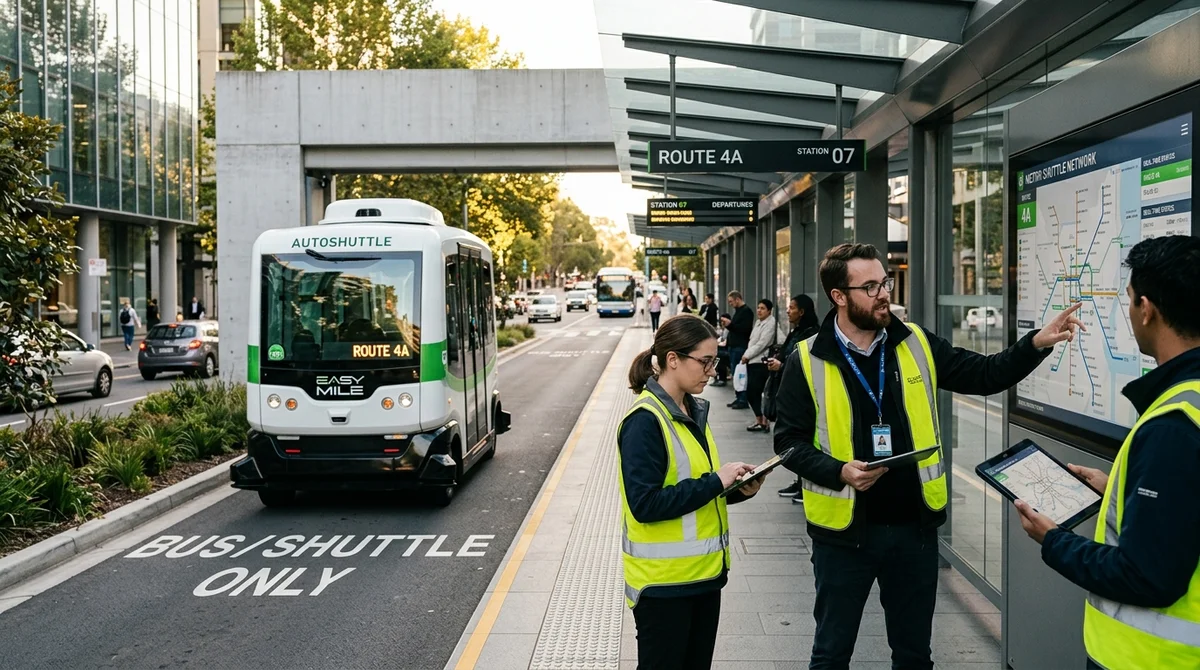
Glydways, an autonomous transportation startup, has raised approximately $170 million in Series C and is already discussing an additional $250 million. Investors are betting on the idea of closed robotic vehicle networks, although the path to scaling such systems remains expensive and complex.
Glydways' New Round
The Series C round of approximately $170 million shows that the market is still willing to finance transportation projects with a long payback horizon. For Glydways, this is not just a balance sheet boost, but a signal that investors believe in a model where autonomous vehicles operate not across an entire city at once, but within a specially designed network. The fact that the company is already negotiating for another $250 million shortly after closing this round speaks to two things simultaneously: ambitions are growing sharply, and capital requirements for this business are substantially higher than for a typical software startup.
Sam Altman's support adds weight to the project, but it doesn't resolve the main question: can the company bring the idea to a sustainable commercial model? In the autonomous transportation segment, money alone does not guarantee a breakthrough. The company must simultaneously build technology, infrastructure, operational models, and relationships with cities or private partners.
This is precisely why, even after a major round, the company is already seeking the next one — the window for launch and scaling may be short, and the cost of mistakes very high.
Betting on Closed Routes
Glydways' main idea is not to release robovehicles into chaotic city traffic, but to build closed or semi-isolated transportation circuits where the environment is known and controllable in advance. This approach is considered more realistic than attempting to immediately solve the entire autonomous driving problem in an open city. When the route, traffic rules, pickup points, and logistics are predetermined, the system finds it easier to ensure predictability, safety, and economics.
For investors, this looks like a compromise between a futuristic idea and engineering discipline. But even a closed network remains a very complex product. One must not only create an autonomous vehicle, but also integrate it with the road, dispatch systems, flow management systems, maintenance, charging, and customer service.
An error in one link impacts the entire model. Furthermore, such networks must be designed for specific territories, which means scaling doesn't happen as quickly as with purely digital platforms.
- Dedicated routes and controlled environment
- More understandable safety and operational requirements
- High infrastructure costs before launch
- Slow scaling from city to city
Why More Capital Is Needed
The additional $250 million that the company is discussing after Series C makes logical sense for this type of business. In autonomous transportation, capital goes not only to software and model development, but also to hardware, manufacturing, testing, certification, operations teams, and launching initial routes. Essentially, Glydways is not building one application or one vehicle, but an entire transportation system where each new location requires integration, local adaptation, and lengthy preparation before commercial launch.
For the market, this is also a reminder that the next wave of AI companies will not be just chatbots and APIs. The closer a project gets to the physical world, the more expensive the path from demo to actual revenue becomes. Robotaxis, autonomous shuttles, and closed transport networks promise significant impact, but investors must pay for a long period of uncertainty.
This is precisely why major rounds in such companies look simultaneously as a sign of trust and as an indicator of how difficult it is to bring technology to working scale.
What This Means
The Glydways story shows where capital interest is shifting: from pure AI software to systems where artificial intelligence is embedded in real infrastructure. If the company can prove the viability of closed robotic vehicle networks, the market will get a more pragmatic scenario for autonomous transportation — not for all roads at once, but for specific, managed routes.
Want to stop reading about AI and start using it?
AI News is a curated feed of AI/tech news. Hamidun Academy teaches you to use AI systematically in your work.