Apple raised Mac mini starting price to $799 due to demand for local AI tools
Apple quietly pulled the $599 Mac mini from sale, and the model now starts at $799. The reason is strong demand from developers, who use the compact desktop…
AI-processed from TNW; edited by Hamidun News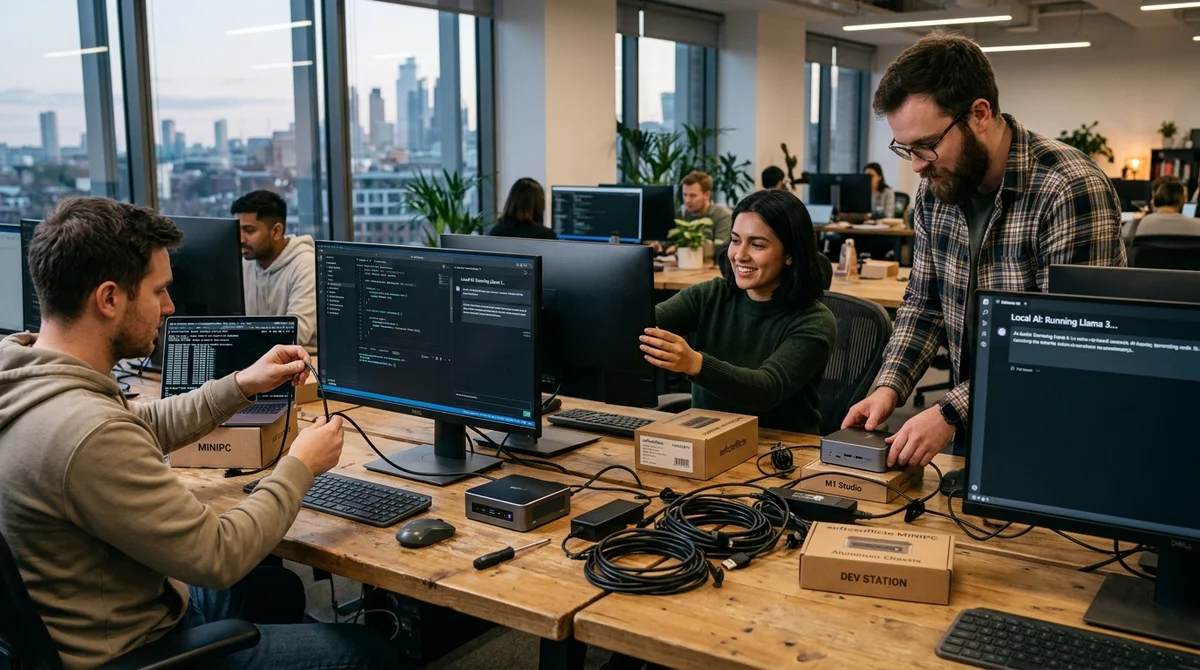
Apple removed the $599 Mac mini from sale and raised the minimum entry point for the desktop line to $799. The reason turned out not to be a new redesign or another hardware update, but unexpectedly high demand from developers who use the compact Mac for local AI tools and agent scenarios.
Why the base model disappeared
For several years, Mac mini remained the cheapest way to enter Apple's desktop ecosystem. After the M4 update in late 2024, this model became especially attractive to those who wanted to run models locally: a compact case, quiet operation, energy-efficient chip, and decent performance without a separate graphics card. As a result, the device transformed from just a home computer into a convenient work machine for developers testing AI features on their desktop, in the office, or in small internal infrastructure.
According to TNW, it was exactly this demand that quickly cleared out the supplies of the lower-tier configuration. Apple didn't make a separate announcement, but effectively shifted the starting price of Mac mini from $599 to $799, since the most affordable version disappeared from sale. For the buyer, this looks like a quiet price increase, although formally the company simply removed the lower tier of the lineup.
The difference is more than just accounting: a configuration that had been the main argument in favor of Mac mini for students, indie developers, and small teams disappeared.
Why AI chose Mac mini
The growth in interest in local AI currently looks logical. Developers increasingly want to run models and agents without the cloud to test scenarios faster, avoid paying for each request, and not send sensitive data to external providers. For such tasks, you need a computer that can be placed next to a workspace, used as a personal inference station, or turned into a small server for internal experiments. Mac mini fit neatly into this niche thanks to a combination of price, size, and performance.
Mac mini turned out to be a convenient option not for one reason, but because of a fortunate combination of practical qualities. Here, size, power consumption, quiet operation, and a familiar development environment came together. For a team that wants to quickly set up local AI scenarios without separate server infrastructure, exactly such a combination often turns out to be more important than theoretical maximum performance. This is especially important where time matters, not perfect configuration.
In practical terms, this looks like:
- compact case that's easy to keep on a desk or in a rack
- Apple Silicon chips with good balance of power and energy consumption
- quiet operation, important for constant local runs
- macOS as a familiar environment for developing and testing applications
- lower price threshold compared to other desktop Macs
This doesn't make Mac mini a universal machine for any resource-intensive AI scenario. For training large models, heavy GPU tasks, and complex pipelines, you still need completely different budgets and hardware. But for prototypes, agent orchestration, local inference, and desktop applications, such a configuration proved very practical.
When the market finds such a clear use case, even an affordable model quickly transforms from a mass-market product into a scarce tool for a specific professional audience.
What's changing now
The shift of the starting price from $599 to $799 noticeably changes the positioning of the entire lineup. Previously, Mac mini was almost an automatic choice for those who needed an inexpensive desktop Mac without overpaying for iMac, Mac Studio, or Mac Pro. Now the price difference is already noticeable, and part of the audience will start comparing the purchase not only with other Apple computers, but also with compact Windows machines, mini-PCs, or custom-built Linux boxes for local AI tasks. That is, Mac mini is losing some of its status as an "obvious recommendation."
The shortage reinforces the situation. According to Tim Cook, Apple may need several months to catch up with demand. This looks not like a random spike, but like a more sustained shift: developers have begun to massively perceive an ordinary desktop computer as a convenient platform for local AI experiments. If this trend continues, similar price and availability imbalances could appear with other manufacturers, especially in the segment of compact, quiet, and energy-efficient machines.
What this means
The Mac mini story shows that AI is already affecting not only the market for cloud GPUs and data centers, but also the demand for ordinary work computers. When developers en masse transfer experiments with agents and local models to their own hardware, even a basic desktop Mac ceases to be just a budget entry into the ecosystem and becomes a scarce AI tool. For the market, this is a direct signal: the next wave of AI demand will be noticeable not only in the cloud, but also on the shelves with ordinary computers.
Want to stop reading about AI and start using it?
AI News is a curated feed of AI/tech news. Hamidun Academy teaches you to use AI systematically in your work.