SD Studio turns local Stable Diffusion into “its own Midjourney” with an LLM assistant
SD Studio is an attempt to turn local Stable Diffusion into a practical work tool rather than a set of manual settings. The author connected the generator to…
AI-processed from Habr AI; edited by Hamidun News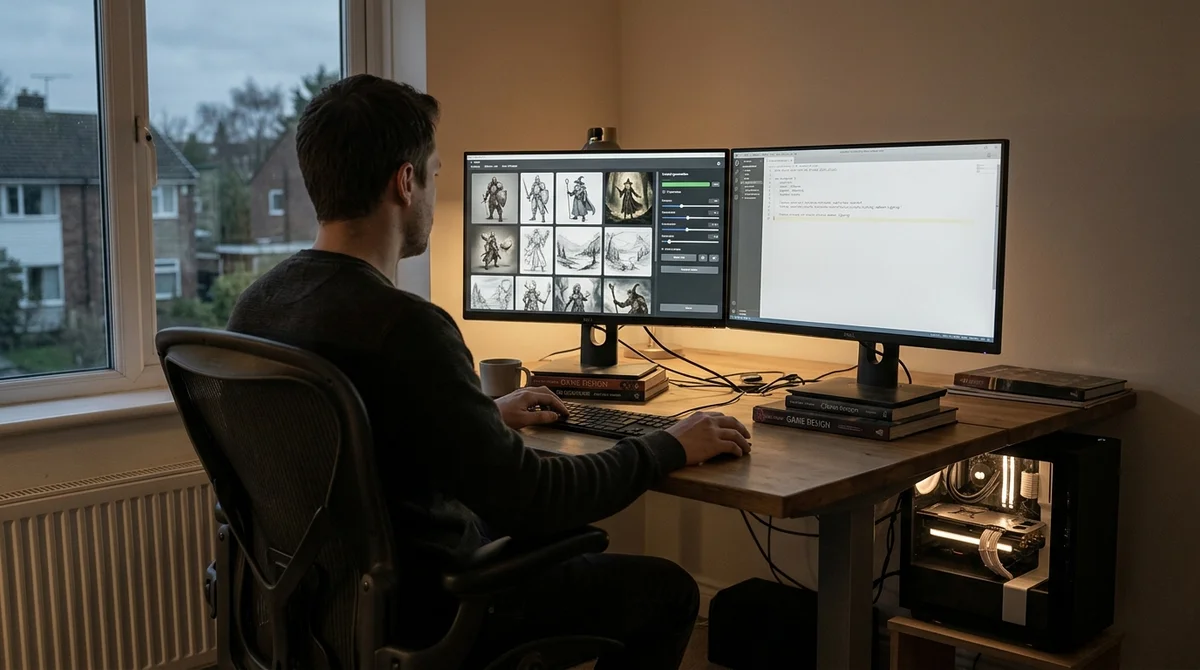
SD Studio offers a practical way to turn local Stable Diffusion into almost your own Midjourney without constant payments to external services. At its core is a combination of SD Studio, a local LLM, and a pre-configured pipeline that automatically assembles the prompt and sends the generation task.
Why This Was Needed
The story started with a very everyday problem: a text fantasy game needed illustrations, but nobody on the team could draw. Paid image generators solve the problem quickly, but for a pet project the costs start to hurt already at the trial-and-error stage. So the choice fell on local Stable Diffusion: if you have your own graphics card, you can generate as much as you want and not count each attempt as a separate purchase.
The first tool was Automatic1111, a popular interface for working with local SD. But getting started turned out to be far from magic: the first results were weak and poorly matched expectations. From there, the author went down the typical path of any Stable Diffusion user: figuring out ready-made models, connecting LoRAs, and watching which combinations work best for a specific task. Even at this stage, quality noticeably improved, but complexity grew alongside it.
Why Manual Selection
In practice, the problem turned out to be not in the generation itself, but in preparing the input data. To get an image, it's not enough to write a couple of words and wait for a miracle: you need to describe the scene precisely, the style, character details, and important constraints. You also have to pick the sampler, number of steps, and other parameters separately. Each iteration gives a new result, but takes time, and when you have dozens of such scenes in a game, manual mode becomes a bottleneck.
"The model doesn't read the user's mind."
This is where the main thesis of the article emerges: a local generator is cheaper than SaaS services, but you pay with user time instead. If each illustration requires rewriting the prompt several times, changing the model, trying different LoRAs, and then selecting a successful frame, the cost savings quickly gets eaten up by complexity. For a developer, this is no longer just a creative tool, but a set of operations you want to turn into a repeatable pipeline.
How SD Studio Works
To eliminate the routine, the author built generation into the existing admin panel in Symfony, through which game content is filled in anyway. Additionally, a folder with lore sits nearby — descriptions of the world, characters, and universe details. Based on this, he assembled two providers: one works with a local LLM and prepares a correct prompt based on lore data, the other communicates with Stable Diffusion and sends the task already with the right settings.
- local LLM pulls the needed context from lore files
- based on it, a more accurate prompt for generation is formed
- the SD provider substitutes the model, LoRA, and preset parameters
- the system runs several attempts to increase the chance of a successful result
This approach doesn't make the process fully automatic, but significantly reduces the amount of manual work at the most expensive place — at the start of each generation. The user no longer figures out from scratch how to describe a scene and which settings to choose, but gets a prepared pipeline with a clear input. The final stage still remains with the human: a successful image needs to be cleaned up in Photoshop, remove unnecessary artifacts, and prepare the file for use in the game.
What This Means
SD Studio demonstrates a clear scenario for a local AI tool: value lies not only in the model, but in the wrapper around it. If an LLM can take context from working materials and assemble prompts automatically, Stable Diffusion on a home graphics card becomes not a toy for an enthusiast, but a working tool for small teams and pet projects.
Want to stop reading about AI and start using it?
AI News is a curated feed of AI/tech news. Hamidun Academy teaches you to use AI systematically in your work.