DroneDash and Geodnet build an agricultural drone for large farms without remapping the field
DroneDash and Geodnet have formed the joint venture Geodash Aerosystems to produce an agricultural drone for large farming operations. The main idea is to…
AI-processed from AI News; edited by Hamidun News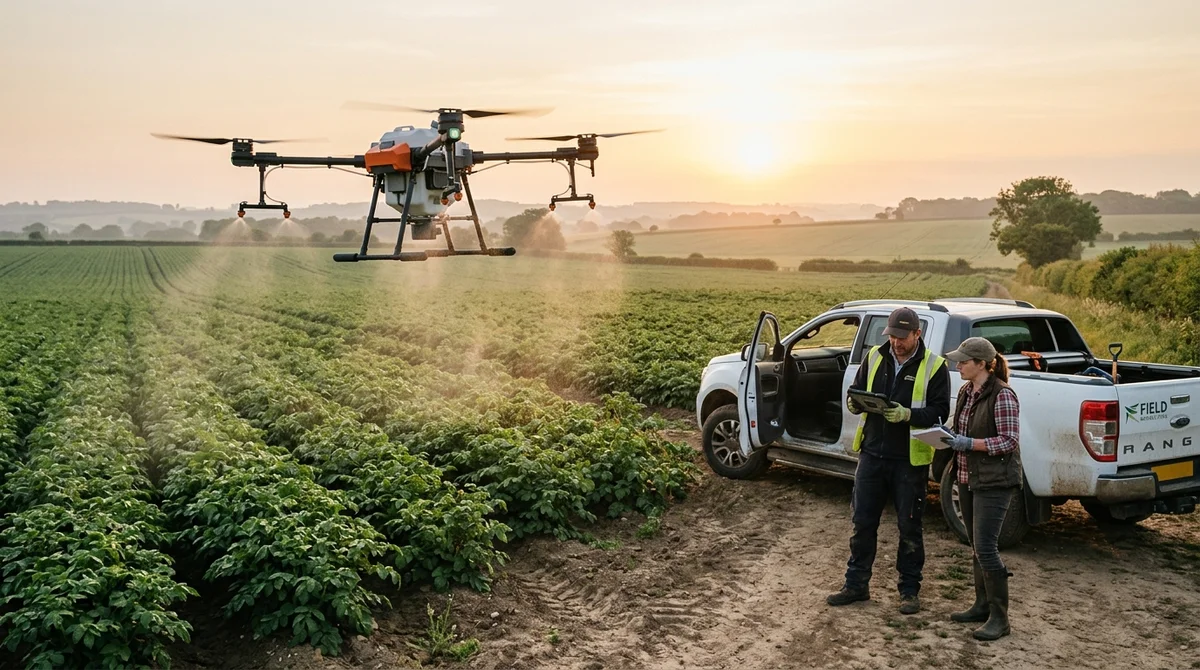
DroneDash Technologies from Singapore and Geodnet announced the launch of a joint venture, Geodash Aerosystems. The companies are developing an agricultural spray drone that is nearly ready for production, intended for large farms and designed to reduce flight preparation time and eliminate some manual routine work.
Why a new drone
For large industrial farms, the main challenge often isn't the flight itself but the preparation for it. Before field treatment, operators frequently have to re-map the area, verify field boundaries, and rebuild the route for the specific task. When dealing with large areas and frequent flights, such actions become constant time expenses, and any delay postpones the actual spraying and adds extra burden to the team.
This is exactly where DroneDash and Geodnet are targeting. Their joint venture Geodash Aerosystems is being created to develop an agricultural drone designed for large industrial farms. The key promise sounds pragmatic: eliminate the need to rebuild the field map each time before takeoff and free operators from rebuilding the flight plan.
For the market, this matters more than another abstract statement about smart AI, because savings in agriculture often start not with new features but with reducing repetitive operations.
What changes in workflow
If the technology truly works as the companies describe, it changes not the core idea of aerial surveying or spraying, but the daily work routine. Preparation becomes shorter, and the drone moves closer to the format of a tool that can be quickly deployed without a separate lengthy setup cycle before each launch. For large farms, this is especially important during periods when the treatment window is short and decisions need to be made quickly.
- No need to re-map the field before each flight
- No need to rebuild the flight route each time
- Easier to resume treatment of large areas after a pause
- Less manual preparation before a series of flights
From the initial description, it remains unclear what exact technical solutions lie under the hood and what equipment set the drone is built on. But even without these details, it's clear that Geodash Aerosystems is betting on reducing operational friction. For agribusiness, this is often the main criterion of value: technology should not impress in a presentation but save hours of work in the field.
Why the bet on holdings
The phrase about large farm holdings shows that the project is initially aimed not at small farms or experimental markets. Large farms feel the cost of each extra operation more acutely, because scale quickly turns minutes into hours and hours into money. If before each flight you need to repeat the same mapping and rebuild the route, costs accumulate faster than on a small farm with a few plots.
At the same time, this isn't a distant concept but near-production technology—development close to the production stage. This is an important nuance: the companies are not just describing an idea but presenting it as a solution that is already approaching practical application. For now, there is no data on price, delivery timelines, tank capacity, treatment width, or launch markets.
But even in this form, the news shows the direction the agricultural drone segment is moving: toward more autonomous preparation and less dependence on manual replanning.
What it means
The agricultural drone market is gradually shifting from the simple fact of automation to competition for efficiency of the complete work cycle. If Geodash Aerosystems brings the idea to a serial product, large farms will get not just another drone, but a faster and more predictable field treatment process.
Want to stop reading about AI and start using it?
AI News is a curated feed of AI/tech news. Hamidun Academy teaches you to use AI systematically in your work.