SpaceX, Google, and Starcloud eye orbital data centers for AI
Orbital data centers for AI are no longer being discussed as science fiction, but as the next infrastructure step. SpaceX, Google, and Starcloud are testing…
AI-processed from 3DNews AI; edited by Hamidun News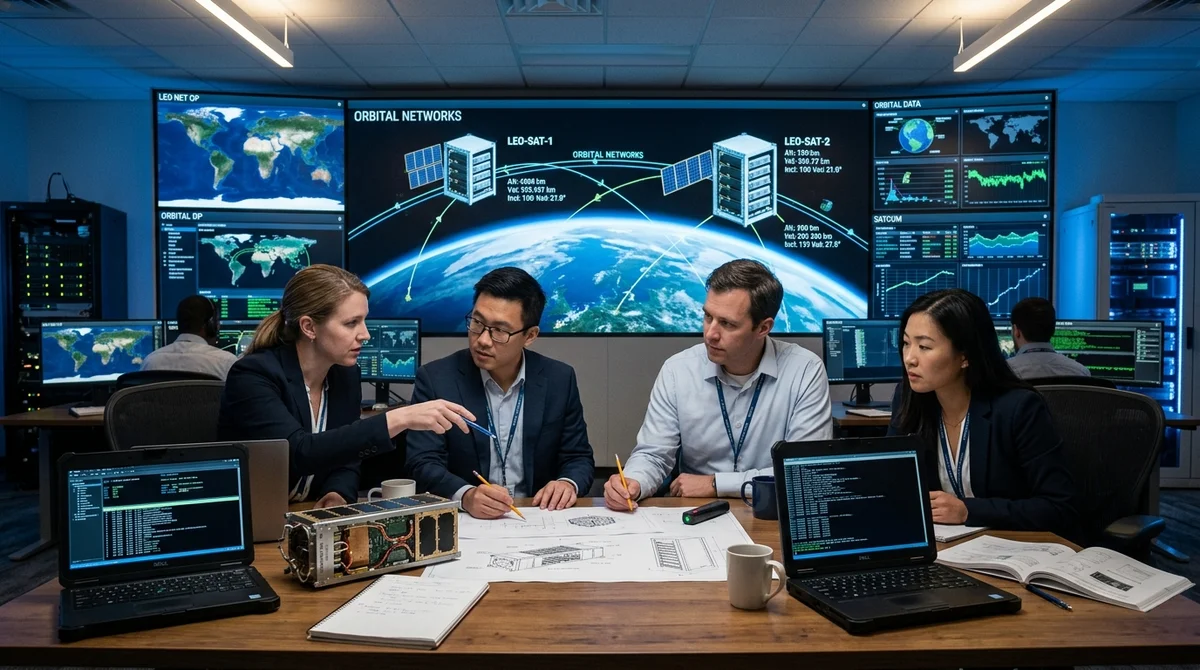
Orbital data centers for AI are rapidly transitioning from futuristic ideas into the subject of real investments. SpaceX, Google, Starcloud and other players believe that space can provide cheap energy and relieve some of the burden from terrestrial infrastructure, but launch costs, repairs, and orbital physics remain hard constraints.
Why This is Being Discussed
The main argument from supporters is simple: AI computations need ever more electricity, land, and cooling, while in orbit there is simultaneous access to near-constant sunlight and the natural cold of vacuum. In theory, this allows building nodes that are powered by their own panels and dissipate heat through radiators into open space. On Earth, each new major data center increasingly faces constraints in network access, water, land availability, and permits, which makes expansion both more expensive and slower.
Pressure from generative AI only intensifies interest in such schemes. By estimates, data center energy consumption could more than double by 2030, and training the next generation of models will require infrastructure that today seems excessive even for the largest clouds. Against this backdrop, the idea of offloading some computations beyond the atmosphere ceases to be mere engineering exotica.
For orbital data center advocates, this is an attempt to find new capacity headroom before terrestrial constraints become truly painful.
Who's Already in the Race
The race has already begun, and it involves not just space startups. SpaceX links the economics of orbital computing to future Starship launch cost reductions. Startup Starcloud has already deployed a test satellite with an Nvidia H100 accelerator and demonstrated that in orbit one can not only run inference but also train compact models. Google is advancing its Suncatcher project, while in parallel similar initiatives are being prepared by China, European consortiums, and other companies that don't want to depend solely on terrestrial power generation.
- SpaceX is planning a distributed orbital data center that could eventually include up to a million satellites.
- Starcloud tested training NanoGPT and inference of Google Gemma directly on the satellite.
- Google is preparing Suncatcher with solar panels, optical inter-satellite links, and TPU.
- Chinese and European projects aim to demonstrate orbital computing platforms by 2030.
"Greetings, earthlings!" — that's how, according to
Starcloud, the model responded when launched on the test satellite.
Interest is also fueled by money. Following its successful test, Starcloud attracted a major funding round and is now preparing heavier spacecraft with multiple GPUs and specialized chips. Nvidia for its part has already shown the Space-1 Vera Rubin module for orbital data centers. The idea is not to wait for the perfect moment: first prove viability on small missions, then scale up if the cost of launching payload really does start to drop rapidly.
Main Project Barriers
For now, all this economics rests on a very bold assumption: launches must become several times cheaper and significantly more frequent. Today, delivering a kilogram to low Earth orbit still costs around $1,500, whereas optimists model scenarios at levels of $500, $200, and even $100 per kilogram. Without such a cost drop, an orbital data center remains far more expensive than a terrestrial one.
The problem is that Starship is far from routine, frequent, and completely predictable operation, and almost all attractive calculations hinge on it. Even if the transportation side improves, questions remain for which there are no simple answers. An orbital server is nearly impossible to repair: it's often cheaper to launch a new spacecraft than to fix the old one.
Heat dissipation in vacuum is more difficult than on Earth, radiation shielding increases mass, and the low orbit itself has finite capacity. The more satellites there are, the higher the risk of evasive maneuvers, accidents, and cascading collisions under a Kessler syndrome scenario. Therefore, skeptics like Sam Altman don't dispute the dream itself, but rather how quickly it can be transformed into a sustainable industry.
What This Means
Orbital data centers have already moved beyond pure fantasy, but they're far from mass-market economics. If SpaceX and partners truly reduce launch costs, space will become another platform for AI infrastructure. If not, the industry will continue seeking more grounded alternatives — from northern sites to underwater and energy-autonomous data centers.
Want to stop reading about AI and start using it?
AI News is a curated feed of AI/tech news. Hamidun Academy teaches you to use AI systematically in your work.