Elon Musk's team speeds up Terafab and holds talks with suppliers on chip production
Elon Musk's team has started discussing the Terafab project with Applied Materials, Tokyo Electron and Lam Research — a potential fab for producing advanced…
AI-processed from Bloomberg Tech; edited by Hamidun News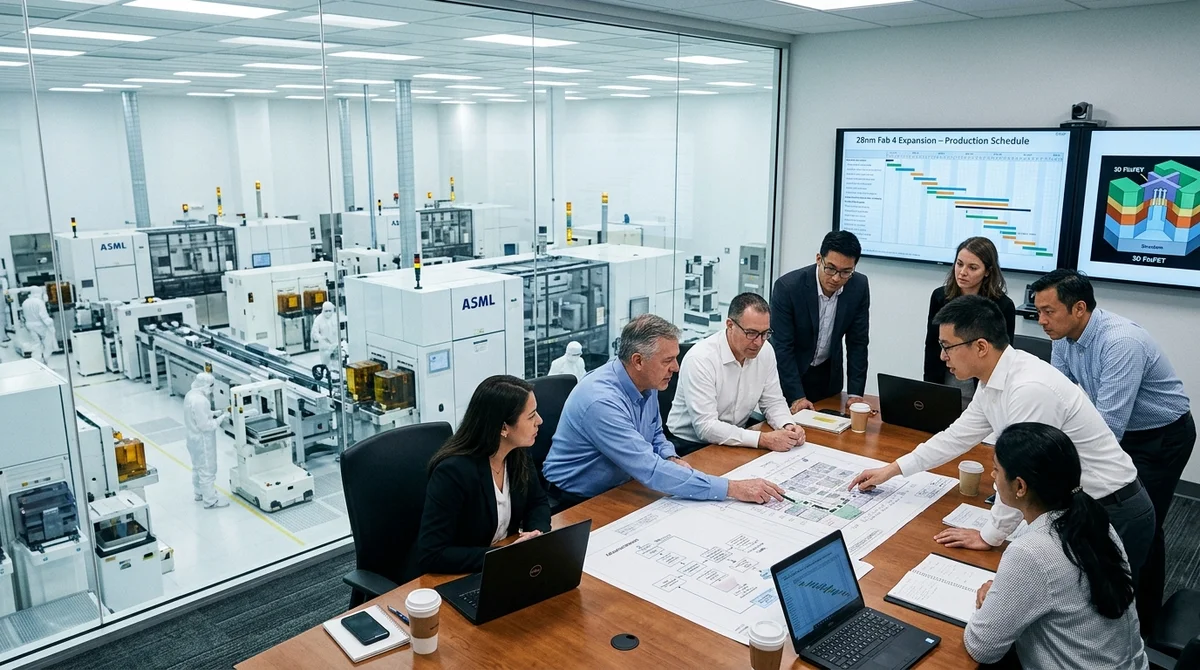
Musk's team has begun negotiations with the largest equipment suppliers for the semiconductor industry on the Terafab project. This is one of the first clear signals that the entrepreneur may attempt to enter not only the development of AI systems and servers, but also the production of the most complex chips.
Early entry into chips
Musk's lieutenants have contacted Applied Materials, Tokyo Electron, and Lam Research — companies without which it is almost impossible today to imagine launching a modern semiconductor manufacturing facility. The discussion is not yet about a finished plant or a confirmed construction project, but about an early outline of a future project. But the very choice of interlocutors shows the scale of the idea: Terafab is conceived not as an experimental line, but as an attempt to enter the segment of advanced manufacturing, where the barrier to entry is measured not only by money, but also by access to rare engineering expertise.
The Terafab name sounds in the logic of Musk's other projects: first set ambition at the limit of the industry, then assemble a chain of partners, suppliers, and a team under it. If such negotiations transition into a practical phase, it could mean a new point of control over a critically important resource for AI — computing chips. For companies building large models, this is no longer just a component, but a constraint on the pace of growth.
"We must move at the speed of light."
Why this is difficult
Advanced chips are manufactured in factories that cost tens of billions of dollars and require synchronization of hundreds of processes: material deposition, etching, cleaning, defect control, packaging and testing. Even with capital, this is not enough. Years are needed to adjust the technology chain, assemble specialists, and achieve acceptable yield — the share of usable crystals, without which the factory's economics simply doesn't work.
That's why early contact with suppliers is an important step, but still very far from serial production. The problem is also that the market for advanced processes has long been far from empty. It is dominated by players who have accumulated experience for decades, built relationships with suppliers, and learned to increase the output of usable products step by step.
Any new participant must not only buy equipment, but also integrate into a complex global system of materials, service maintenance, design, and logistics. For Musk, this would mean entering one of the most capital-intensive and technologically demanding industries in the world.
Why suppliers are needed
The companies that Musk's people contacted occupy key positions in the equipment supply chain for factories. Without such partners, it is impossible to assemble a production line even on paper, let alone launch a real plant. At an early stage, their participation is needed not only to assess prices and timelines, but also to understand which technological routes are even achievable within a reasonable horizon.
- Applied Materials — one of the main suppliers of equipment for applying and processing materials on wafers.
- Tokyo Electron — an important player in the deposition, etching, and cleaning processes at various stages of production.
- Lam Research — one of the key suppliers of etching systems and wafer preparation.
- Working together with such vendors helps assess the cost of a line, delivery times, and integration complexity in advance.
For Musk, the meaning of such a move may be broader than just a new business. His companies already depend on access to powerful accelerators and server infrastructure, and demand for AI computing continues to grow faster than supply. If Terafab is designed as vertical integration, then the goal is clear: reduce dependence on others' roadmaps, better control supplies, and possibly, over time, design and produce critical components for its own needs.
What this means
Even if Terafab remains a long and difficult project, the very fact of negotiations shows a shift: the largest AI players no longer want to limit themselves to buying chips on the market. The next stage of competition may already not be only about models and data centers, but about control over factories, equipment, and the entire production chain.
Want to stop reading about AI and start using it?
AI News is a curated feed of AI/tech news. Hamidun Academy teaches you to use AI systematically in your work.