Nano Banana, Qwen, and ChatGPT compared on image generation quality
A review of four image generators has been published, comparing Nano Banana, Qwen, and ChatGPT on the same prompts. The focus is not only on “beauty,” but also on how well the models maintain composition, detail, style, and control over the output. This kind of test is useful not only for designers, but also for editorial teams, marketers, and authors choosing a tool for covers, avatars, memes, and commercial content.
AI-processed from Habr AI; edited by Hamidun News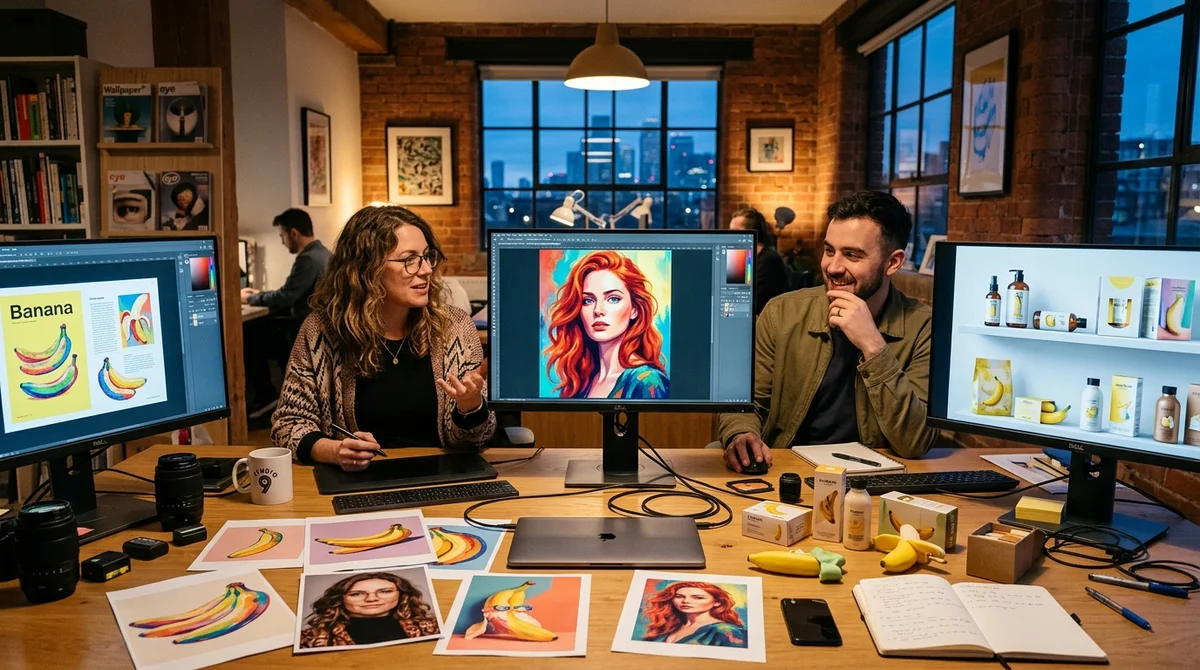
Comparing image generators has stopped being a hobby for enthusiasts: such models already influence how videos, covers, product cards, and AI avatars look. In a new breakdown, the authors compared four neural networks, including Nano Banana, Qwen, and ChatGPT, to check which one handles visual tasks best in practical scenarios.
Why this matters
The reason for interest is clear: image generation has long moved beyond "playing with prompts." Synthetic faces, advertising scenes, stylized illustrations, and short video clips already regularly appear in social media feeds. Increasingly, viewers cannot tell at first glance where a designer's work ends and a model's output begins.
For business, this is also a practical matter: the speed of creative generation affects content cost, while quality determines conversion, trust, and how noticeable the material itself becomes. That's why models need to be compared not just by the principle of "like it or not." It's more important to look at how accurately they understand the request, maintain composition, work with lighting, don't break anatomy, and preserve scene logic.
Another critical parameter is predictability. If a tool produces a good frame only one time out of ten, it's hard to use in editorial, marketing, or production environments, where results are needed quickly and without dozens of retry attempts.
How models were compared
Usually, such tests are built on identical prompts: all models are given the same task and the results are compared. This is an important format because it removes some subjectivity and reveals the strengths and weaknesses of systems under equal conditions. In practice, what matters is not just beautiful pictures, but resistance to complex instructions, detail quality, and how well the model can combine multiple requirements in a single frame.
- Understanding complex scenes and multiple objects at once
- Working with texture, light, and fine details
- Stylization without losing image readability
- Quality of faces, hands, objects, and backgrounds
- Reproducibility of results with similar prompts
Even a lighthearted banana test doesn't look accidental here. A simple object quickly reveals the basic problems of generators: incorrect proportions, strange shadows, unnatural surfaces, extraneous details, or weak connection between the object and its environment. If a model confidently handles such a request in different styles—from photorealism to advertising illustration—that's already a good sign. And if the prompt becomes more complex with a scene, text, or multiple objects, the differences between systems become even more noticeable.
Where differences emerge
The most interesting aspect of such comparisons is not finding an absolute winner, but mapping scenarios where each model performs better. Some systems deliver more careful and stable results, but sometimes look too "safe." Others, conversely, produce bright stylization and bolder solutions, but may lose accuracy in details or worse at respecting prompt constraints.
The Nano Banana, Qwen, and ChatGPT highlighted in the title are particularly interesting because they represent different product ecosystems and different compromises between control, expressiveness, and universality. The difference is especially noticeable where the model is expected to deliver not just a beautiful picture, but a useful working result. For example, for an article cover, composition and clean focus on the main object matter; for an AI avatar, face realism and style consistency matter; for meme or viral content, unexpectedness and character matter.
A separate stress test is text inside the image: this genre remains a weak point for many generators. That's why the question "who draws better" almost always comes down to something else: which tool reliably solves your specific task.
What this means
The image generation market is rapidly fragmenting into specializations: there's no universal leader for all cases, but the number of models strong in specific types of content is growing. For editorial offices, marketing teams, and authors, this is a good moment to review their tech stack and choose a generator not by hype, but by real usage scenarios.
Want to stop reading about AI and start using it?
AI News is a curated feed of AI/tech news. Hamidun Academy teaches you to use AI systematically in your work.
The AI world, distilled — once a week
Seven stories that actually mattered, hand-picked. No noise, no reposts, no press releases.
Done! Check your inbox for a confirmation.