Data Science in digital manufacturing: how enterprises collect data and reduce defects
Manufacturing accumulates vast amounts of data, but real value appears only where it can be connected and analyzed. Data Science in digital manufacturing helps automate quality control, predict equipment failures, and identify the causes of defects at the intersection of design, process engineering, and operations. The main challenge today is not algorithms, but data quality and infrastructure readiness.
AI-processed from Habr AI; edited by Hamidun News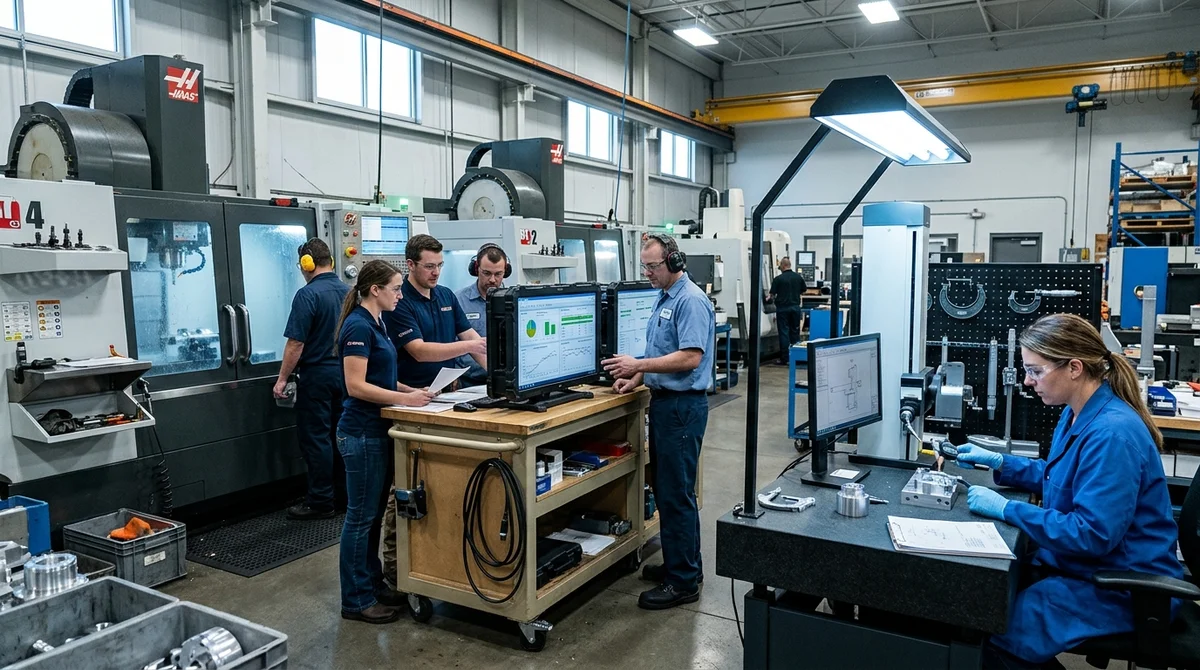
Manufacturing has long been generating more data than it manages to use. A new analysis of digital manufacturing shows why Data Science is becoming the connective layer between the digital thread of a product, product quality, and solutions at the factory.
How Digital Manufacturing Works
Digital manufacturing is not just shop automation, but an attempt to unite everything that happens to a product from design to disposal in a single environment. This chain includes design models, calculations, process planning, procurement, machine data, measurement results, testing, logistics, and operation. If these data arrays exist separately from each other, the enterprise gets archives and reports.
If they are connected, a digital thread emerges—a continuous structure in which you can quickly find the needed data and understand how one decision affects the next. On this basis, a digital twin forms—a virtual representation of a specific product that develops alongside it. At first, its core can be a 3D model, then calculation results, manufacturing parameters, quality control, metrology, testing, and real operational data are added to it.
This approach solves an old problem in manufacturing, where information about actual component behavior is lost after release and rarely returns to the engineering loop. The more complete the twin, the more accurately design intent and actual results can be compared.
Where Data Science Helps
Classical analytics works well where data is already structured in tables and the question is clear in advance. But in manufacturing, the causes of defects, failures, and losses are often scattered across different stages of a product's lifecycle. One defect can depend simultaneously on material batch, processing mode, tool condition, output measurements, and operating conditions. This is where Data Science provides an advantage: it knows how to work with time series, event logs, images, text documents, and equipment data streams, and then search for hidden patterns in them.
- Automates visual quality control using computer vision
- Compares calculations, testing, and actual product parameters
- Predicts equipment failures and reduces unplanned downtime
- Helps adjust technological modes for quality and cost
- Identifies anomalies before deviations turn into mass defects
The practical effect of such systems is quite direct: fewer manual checks, higher quality repeatability, faster identification of causes of non-conformities, and fewer decisions made on intuition. Beyond this, accumulated data can be used for more complex scenarios—from semantic search of engineering documentation to generative design and ML models that link decisions of designers, technologists, and operators. For enterprises with long product lifecycles this is especially important, because this is where the value of historical data grows with each new stage.
What Hinders Implementation
Even at large enterprises, digital manufacturing often remains a set of scattered initiatives. Somewhere there's already a PDM or PLM system, electronic document management, 3D models, and separate elements of a digital twin, but there's no full digital thread. The main problem is not the absence of trendy algorithms, but basic data readiness.
Data can be incomplete, noisy, unlabeled, stored in different systems, and lack a unified process for collection, cleaning, and use. In such an environment, even a strong ML team quickly hits infrastructure constraints. There is also an organizational barrier.
The transition to digital manufacturing requires spending on storage, integrations, sensors, employee training, and restructuring internal processes. Meanwhile, returns don't always come quickly: management needs clear cases where big data has already reduced costs, cut downtime, or improved product quality. Without such evidence, projects easily remain pilots.
Therefore, development here depends not only on technology, but also on the ability of enterprises to turn data into a regular management tool, not a beautiful facade of digitalization.
What This Means
For industry, Data Science stops being optional analytics under the IT department and becomes part of the production system. The winners will not be enterprises that simply collect more data, but those that can link design, production, control, and operation into a single loop and make decisions based on this connectivity. That is where real results appear: fewer defects, less downtime, and more predictable quality.
Need AI working inside your business — not just in your newsfeed?
I build production AI for companies — custom CRM, internal tools, autonomous agents, workflow automation. Owned by you, shaped to your process, no per-seat tax. Built by Zhemal Khamidun, CPO of AlpinaGPT (AI platform, 6,000+ users).
The AI world, distilled — once a week
Seven stories that actually mattered, hand-picked. No noise, no reposts, no press releases.
Done! Check your inbox for a confirmation.