Microsoft, NVIDIA, and IBM made the list of the 19 leading AI red teaming tools of 2026
AI red teaming is quickly shifting from a rare practice to a required pre-release check. The new list of 19 tools highlights Microsoft PyRIT, NVIDIA Garak…
AI-processed from MarkTechPost; edited by Hamidun News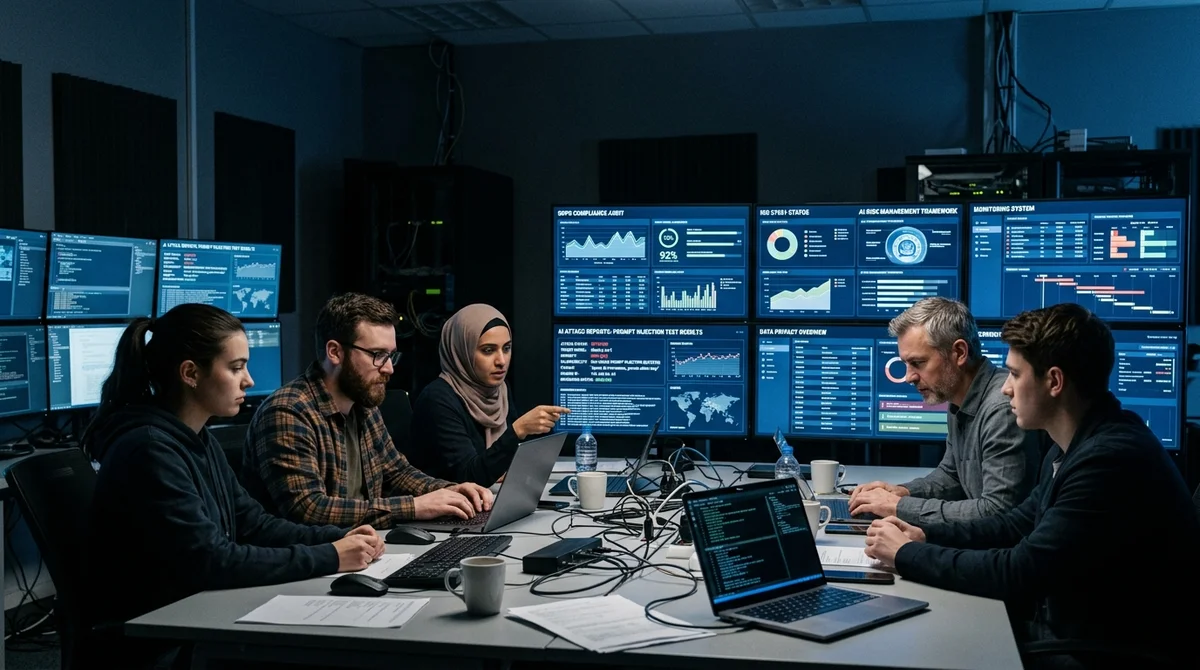
AI red teaming has evolved from a niche practice for researchers into a mandatory step before deploying models to production. A new guide covering 19 tools shows that security teams are now testing not only model robustness but also data leaks, bias, jailbreak scenarios, and AI agent resilience against malicious instructions.
Why This Became the Norm
Generative models have become deeply embedded in products, customer service, and internal processes, and the cost of error has risen accordingly. Previously, companies needed only to check APIs, access controls, and classic application vulnerabilities. Now they must understand how the model itself behaves under pressure: will it expose hidden instructions, leak confidential data, allow protective rules to be bypassed, or confidently hallucinate in a critical scenario?
Unlike a conventional penetration test, AI red teaming is not aimed solely at known bugs. It simulates the behavior of a real attacker: attempting prompt injection, jailbreak, poisoning, bypassing protective filters, extracting system prompts, exploiting bias, RAG-based attacks, and failures in production agent chains.
This is why the practice increasingly becomes part of formal requirements for risky AI systems, rather than merely a voluntary check for peace of mind.
Who Entered the Guide
The list includes 19 tools and platforms: from open-source libraries to commercial products for continuous monitoring. Among the most notable are Mindgard for automated red teaming and model vulnerability assessment, Garak from NVIDIA as an open-source LLM vulnerability scanner, and PyRIT from Microsoft, which helps systematically run generative systems through malicious scenarios and repeatable multi-step attacks in real development pipelines and on production models.
Notably, the market has divided into several classes of solutions: some tools search for vulnerabilities at the model behavior level, others at the fairness and robustness level, and still others help embed checks into the corporate DevSecOps cycle and run them regularly rather than sporadically. There are also solutions that address adjacent challenges: monitoring production, verifying the retrieval layer, tracking risks in agent integrations, and helping teams fix regressions after updates.
- Mindgard, HiddenLayer, SPLX — platforms for enterprise teams needing continuous AI risk control and production environment management.
- Garak, PyRIT, DeepTeam, FuzzyAI — tools for automated adversarial testing, fuzzing, and LLM evaluation against typical attack scenarios.
- AIF360 and ART from IBM — focus on fairness, adversarial robustness, and measurable model reliability metrics.
- Foolbox, Meerkat, Giskard — suites for practical model resilience verification, problem visualization, and test generation.
- Pentera, Snyk, Guardrails, Dreadnode, Galah, Penligent — solutions at the intersection of application security, AI governance, and agent system protection.
How It's Being Implemented
The key takeaway of the review is that red teaming is no longer a one-time manual action before release. Best practices now revolve around continuous verification: attack scenarios are run in CI/CD, results are tied to specific model and system prompt versions, and identified failures become guardrail, data, and access policy requirements. This is especially important where AI is connected to search, CRM, company documents, or external tools.
Another shift is the combination of manual and automated work. Automation provides breadth of coverage and helps quickly run hundreds of typical attacks, but non-standard bypasses, multi-step manipulations, and contextual leaks are still better caught by live red team specialists. This is why companies increasingly adopt a hybrid process: an internal security team, external auditors, and a set of open-source or commercial tools that can be re-run after each model update, prompt change, retrieval adjustment, or connected tool modification.
What It Means
The AI security market is rapidly maturing: companies are no longer limited to input filters and the hope that the model won't break on its own. The winning teams will be those that embed red teaming into the normal development cycle and begin checking AI systems as regularly as they check code, infrastructure, and access controls.
Want to stop reading about AI and start using it?
AI News is a curated feed of AI/tech news. Hamidun Academy teaches you to use AI systematically in your work.