The Guardian: Early-career teacher describes how chatbots are changing literature classes
The Guardian has released a podcast about an early-career literature teacher trying to understand whether chatbots have a place in the classroom. The piece…
AI-processed from Guardian; edited by Hamidun News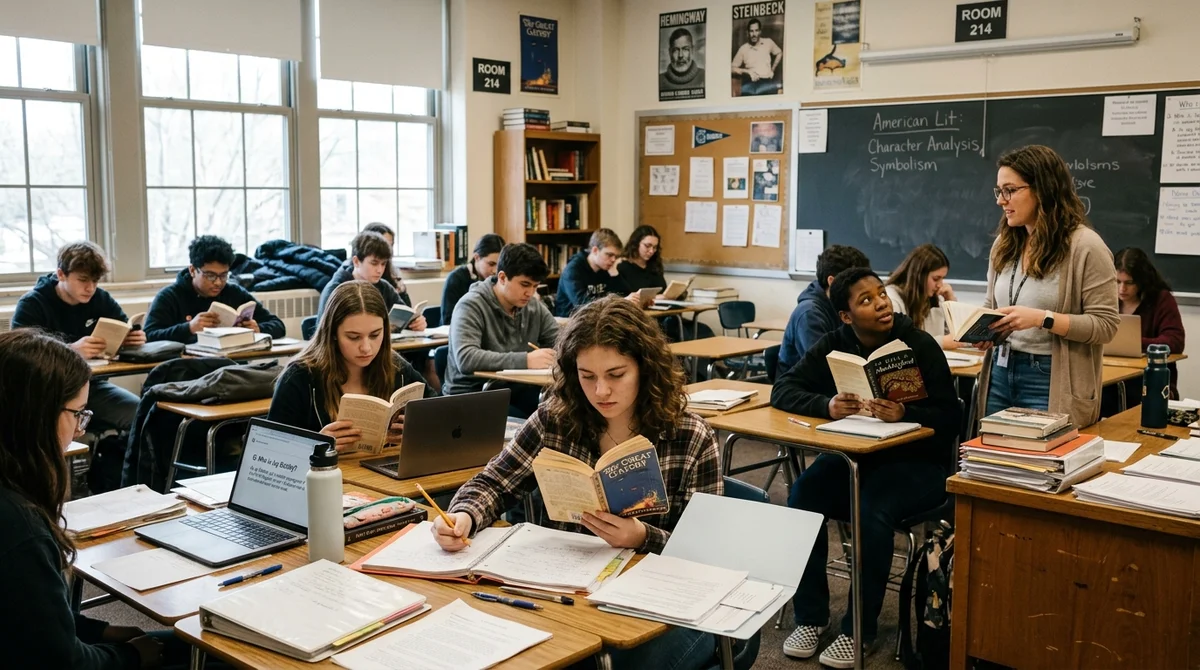
The Guardian published an audio version of Peter Baker's personal essay about how generative AI is changing the classroom. The author came to teach English literature and quickly understood: the debate about chatbots is no longer theoretical here, but daily and very stressful.
New Teacher's Anxiety
Baker began teacher training at 39 after a long career as a freelance writer and novelist. He wanted to teach teenagers to read more carefully, write more precisely, and work more deeply with literature. But almost immediately came a question he had no ready answer for: what to do with free chatbots capable of producing on demand coherent, convincing, and perfectly school-toned text. For a new teacher this overlapped with the usual anxieties of the first year and turned AI into the main professional stress.
"Adding AI to this mix was like drinking coffee during a panic attack."
He then dives into the dispute between two camps. For some teachers AI is a cheating machine that discourages students from going through difficulty, doubt, and lengthy revision of thought. For others it's a potential assistant capable of giving personalized feedback to each student and helping those stuck at home over a draft. Baker doesn't choose a simple ideological position. He doesn't need a manifesto about the future of education, but a working solution for a real literature class and real writing assignments.
How Chatbots Break the Class
During practice at a suburban Chicago school he observed lessons taught by an experienced teacher called Emily in the text. That's where the abstract debate turned into a set of daily scenes: checking suspiciously smooth essays, conversations about non-existent quotes, finding the boundary between student growth and text polishing by a machine. Additional pressure is created by the fact that AI is now built into almost everything: search, email, school laptops, and programs that teachers themselves use.
- Fully generated school papers
- AI-invented quotes and references
- Switching from Google search directly to Gemini and AI Mode
- Chatbots that by instruction imitate the style of a 15-year-old student
Yet the strongest contrast Baker saw was not in the technologies, but in their absence. When the class read All Quiet on the Western Front without laptops and phones, the text gradually came alive: students stopped complaining, began arguing about the motives of characters, and actually entered the book. For the author this became a reminder that the task of a literature class is not only to get an answer, but to hold attention, go through misunderstanding together, and give the text time to work.
Why Talk About AI
Over the summer Baker specifically tested chatbots, including educational versions and modes for students. Testing began with the worst-case scenario: could you make a model write text as if made by a regular teenager with minor errors and uneven style. His conclusion is unpleasant: the old comfort that a teacher always immediately recognizes machine text no longer works.
At the same time some bots proved useful as draft editors and answered follow-up questions about assignments quite well. So the choice no longer comes down to naive "allow or ban." The most productive moments in his class were not attempts to integrate AI into every assignment, but direct conversation about what this technology even is.
Students reported using chatbots for flashcards, test prep, advice on clothing, cooking, workouts, and even pet care. Yet many were themselves afraid that such tools blur the ability to think independently. From this Baker draws a cautious conclusion: schools need simultaneously protected zones for slow reading and writing and separate AI literacy—conversation about data, business models, moderator labor, and the risks of the systems themselves.
What It Means
The Guardian's story does not give a universal rule for schools, but shows well what the first real wave of AI in education looks like. Chatbots are already too close to ignore and too powerful to blindly let into every piece of writing. It seems the most sensible middle course now is to preserve areas of learning without AI, discuss the technology openly, and keep human reading and human response to texts at the center of the class.
Want to stop reading about AI and start using it?
AI News is a curated feed of AI/tech news. Hamidun Academy teaches you to use AI systematically in your work.