Blue Energy raises $380 million for modular nuclear plants for data centers
Blue Energy has raised $380 million for prefabricated nuclear plants for data centers. The startup plans to build a significant share of each facility at…
AI-processed from Bloomberg Tech; edited by Hamidun News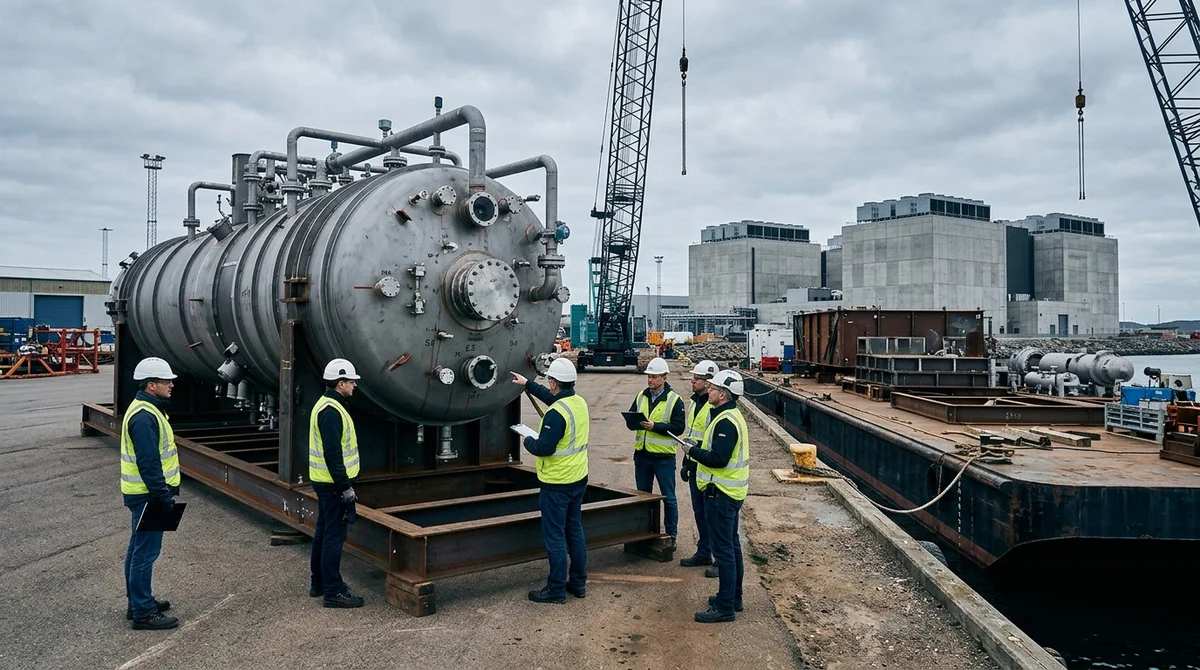
Blue Energy raised $380 million to accelerate the development of modular nuclear power plants for major energy consumers, including AI data centers. The startup is betting not on a new type of reactor, but on a different construction approach: more factory assembly, fewer complex on-site works.
Where the Money Goes
The round includes equity and debt financing. It was led by VXI Capital, with participation from Engine Ventures, At One Ventures, and Tamarack Global. According to the company, the funds will be directed toward purchasing equipment with long supply cycles, project development, and team growth.
Blue Energy plans to develop its first facility in Texas: a site with capacity of up to 1.5 gigawatts, designed for major electricity consumers — including AI data center operators, who are already running out of available capacity on the grid.
Interest in such schemes has grown against the backdrop of the AI boom. New data centers require enormous volumes of stable energy, and grid connections in the US often stretch on for years. That's why investors are looking not only at the reactor itself, but at the speed of capacity deployment. For Blue Energy, this is a convenient moment: the company can sell not just low-carbon generation, but a way to deliver megawatts to customers faster than in the classical nuclear construction scenario.
How the Blue Energy Scheme Works
Blue Energy is trying to solve the part of a nuclear project that has deterred investors for years: construction. Instead of assembling the plant almost entirely on-site, the company wants to transfer a significant portion of the work to existing production facilities and shipyards. There it's easier to standardize processes, maintain schedules, and reduce dependence on scarce specialists at a particular construction site. Then large modules can be delivered to the site by water and assembled on-site.
The company separately emphasizes that it is not inventing a new reactor from scratch. Blue Energy's approach is compatible with already known reactor technologies, and the main innovation is in the sequence of work, the contractual model, and the level of factory readiness for each delivery. For the industry, this represents a fundamental shift from one-off projects to repeatable assembly.
The company's materials point to a target of 48 months for plant deployment — noticeably faster than classical nuclear construction projects, which often far exceed original timelines and budgets.
"The problem with nuclear energy is not the technology, but the cost and predictability of construction," — this is how CEO
Jake Yurewicz describes the project's logic.
What the Round Changes
For Blue Energy, this is not just a venture check for research. The round should push the project toward actual construction: the company speaks of early work at the Texas site already in 2026 and aims for a final investment decision in 2027.
A separate signal for the market is regulatory. The NRC has already approved Blue Energy's approach to phased construction, under which part of the non-nuclear infrastructure and the turbine circuit can be brought online earlier, and then the facility can be switched to nuclear generation.
This matters for several reasons:
- the company is trying to make the nuclear project understandable for regular project financing, not just government support;
- off-site assembly should reduce the risk of schedule and cost overruns;
- capacity of up to 1.5 GW makes the project relevant specifically for hyperscale data centers;
- demand from AI infrastructure creates a rare scenario for the nuclear industry, where a new source of baseload capacity is needed quickly, not "sometime later."
What This Means
The AI infrastructure market is increasingly running into a bottleneck not in chips, but in electricity. Against this backdrop, Blue Energy is selling to investors and clients not so much "new nuclear technology" as a promise of predictable construction and clear economics. If the company actually brings the Texas project to fruition and maintains the schedule, it will strengthen the trend of linking data centers and new nuclear generation.
Want to stop reading about AI and start using it?
AI News is a curated feed of AI/tech news. Hamidun Academy teaches you to use AI systematically in your work.