Futuresource: everyday AI gadgets will turn people into a "walking supercomputer"
Futuresource believes that within the next few years, a set of personal devices — from a smartphone to headphones and a laptop — will give a person AI…
AI-processed from 3DNews AI; edited by Hamidun News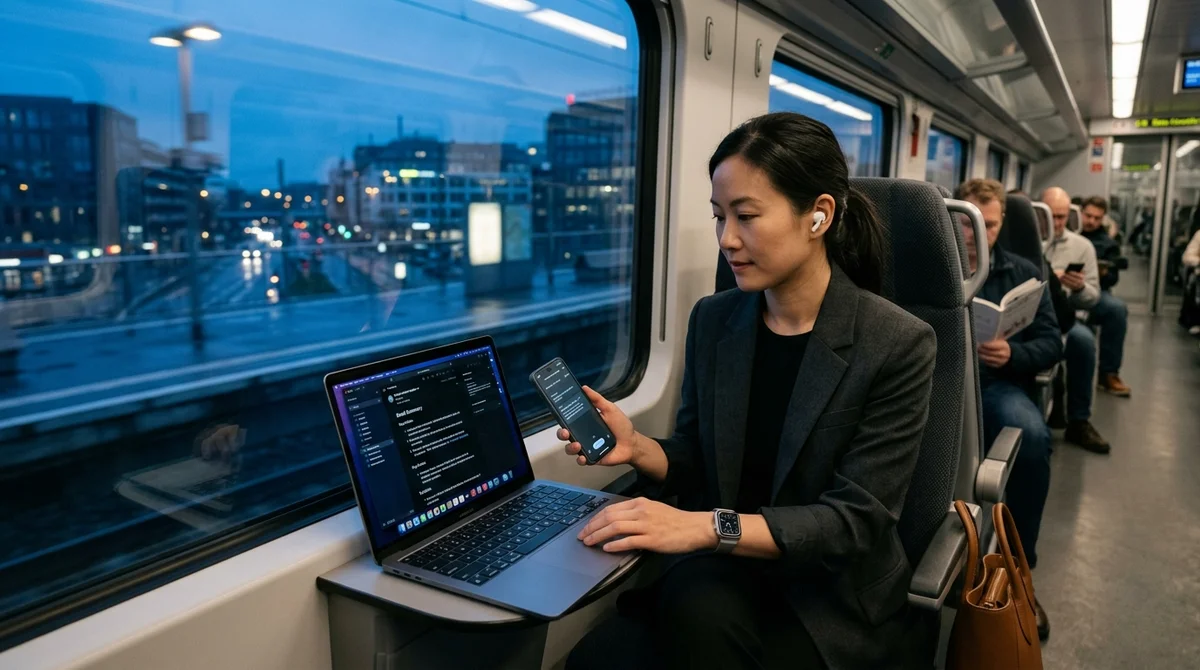
Futuresource, a consulting company, predicts that in the coming years a person will carry computational power that was previously associated with a separate data center. This is not about a single device, but about the sum of AI capabilities of a smartphone, laptop, headphones, watch, and other personal electronics.
From Data Center to Pocket
Until recently, complex AI tasks were almost entirely offloaded to the cloud: servers processed the request, and the user saw only the result on the screen. Now computations are gradually shifting closer to the user. Specialized AI blocks are appearing in smartphones, laptops, and wearable gadgets, and the models themselves are becoming more compact and efficient. Against this backdrop, Futuresource's forecast looks logical: the combined power of personal electronics will soon be comparable to what previously required a separate server rack or even a small data center.
The phrase about a "walking supercomputer" sounds grandiose, but it has a very practical meaning. It's not about everyone having a machine for scientific calculations in their pocket, but about a new density of computing in everyday life. A single set of devices will be able to continuously recognize speech, analyze images, translate conversations on the fly, filter notifications, generate text, and adapt interfaces to the owner's habits. What previously launched as a rare cloud service will become background mode for personal technology.
What Will Appear in Devices
The main change is that personal electronics will stop being merely a "terminal" for accessing large models. It will start performing a significant portion of AI tasks locally, without constantly accessing remote servers. This is important not only for speed, but also for privacy: the more data can be processed on the device, the less needs to be transmitted externally.
For users, this shift will be noticeable not by abstract performance figures, but by how quickly and seamlessly the technology helps with routine tasks.
- Continuous voice assistants that understand the context of the day, not just individual commands
- Local photo and video processing without lengthy cloud uploads
- Real-time speech translation in headphones, smartphones, and future glasses
- Personal AI assistants that work simultaneously in email, notes, calendar, and messengers
- More accurate security features: biometrics, anomaly detection, and data protection on the device itself
Local AI is especially valuable where latency, stability, and control over personal information matter. If a device understands voice, camera, documents, and user habits without constant network dependence, it becomes more useful while traveling, in meetings, and in work scenarios. That's why the race is not only about model power, but also about how well manufacturers can distribute computing between the cloud and the hardware in a person's hands.
Why the Market is Changing
This forecast fits into a broader trend: chip and device manufacturers are already restructuring consumer electronics around AI workloads. Laptops are receiving NPU modules, smartphones are gaining increasingly powerful neural blocks, and wearables are learning to process speech, sound, and sensors locally. For companies, this is not just marketing.
If AI becomes a basic function of a device, requirements change for architecture, battery, cooling, memory, and operating systems. AI economics also change. Training the largest models will still remain the domain of cloud platforms and hyperscale data centers, but everyday inference will increasingly move to edge devices.
This reduces network load, decreases latency, and makes services more resilient. In the end, competition shifts from simple access to a model to the quality of user experience: whoever integrates AI faster, quieter, and more accurately into ordinary actions will win user attention.
What This Means
If Futuresource's forecast comes true, the next stage of the AI market will be associated not with a single "magical" model, but with the mass transformation of personal electronics into a constant computational layer around people. For users, this means faster and more personal assistants, and for companies, the need to design products for a world where AI is always nearby and works almost imperceptibly.
Want to stop reading about AI and start using it?
AI News is a curated feed of AI/tech news. Hamidun Academy teaches you to use AI systematically in your work.