NVIDIA showed how Gemma 4 with voice and a webcam runs on Jetson Orin Nano Super
NVIDIA built a local Gemma 4 demo for Jetson Orin Nano Super: the model listens to voice input, accesses the webcam on its own when needed, and replies via…
AI-processed from Hugging Face Blog; edited by Hamidun News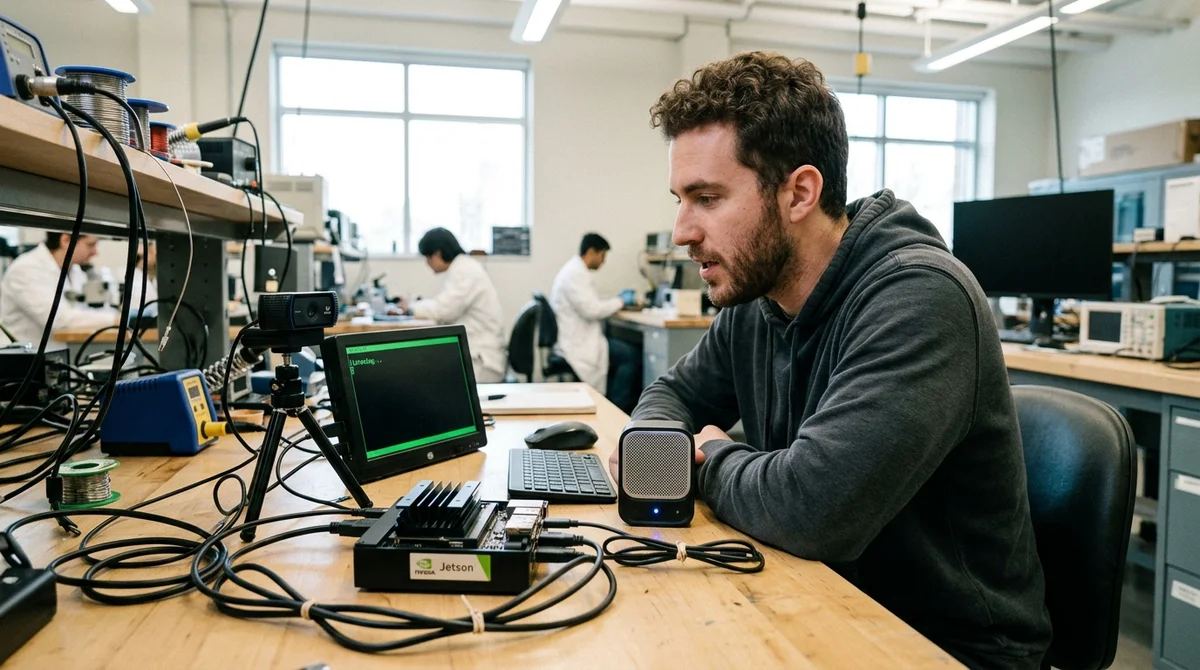
NVIDIA Demonstrates How Gemma 4 with Voice and Webcam Works on Jetson Orin Nano Super
NVIDIA demonstrated a practical edge demo: Gemma 4 can listen to a question, access the webcam when needed, and respond with voice — all locally on Jetson Orin Nano Super with 8 GB of RAM. The publication from April 22, 2026 is interesting not only for the tutorial itself, but also because a multimodal agent runs on a compact board rather than in the cloud.
How It Works
The scenario is assembled as a simple voice agent with one visual tool. The user presses spacebar, asks a question verbally, after which Parakeet locally converts speech to text. Then Gemma 4 receives the request and itself decides whether it needs to look through the webcam. If yes, the script captures a frame, passes it to the model, and the response is then voiced through Kokoro TTS. The article specifically emphasizes that the model does not describe the image at all, but uses what it sees only to answer the specific question.
"Honestly, it's already impressive that this works on
Jetson Orin Nano."
The key point is that there are no hard triggers or manual logic like "if the question contains the word camera." The script opens exactly one tool for Gemma 4 — `look_and_answer`, which takes a photo and analyzes the scene. Whether to call it or not, the model decides itself. For this, NVIDIA uses `llama-server` from `llama.cpp` with the `--jinja` flag, which enables native tool calling support. Essentially, this is a compact VLA scenario where vision is connected only when truly needed.
What You Need to Run It
The demo itself doesn't look like magic out of the box: it's more of a well-assembled instruction for enthusiasts and developers who want to replicate the local multimodal pipeline themselves. NVIDIA describes not only running the Python script, but the entire stack — from system packages and building `llama.cpp` to configuring audio, camera, and loading the vision projector for Gemma 4.
- Jetson Orin Nano Super with 8 GB RAM, webcam, USB microphone or camera with built-in microphone, USB speakers, and keyboard
- Python environment with `opencv-python-headless`, `onnx_asr`, `kokoro-onnx`, `soundfile`, `huggingface-hub`, and `numpy`
- Locally built `llama.cpp` with CUDA, `gemma-4-E2B-it` model in GGUF, and separate `mmproj` file without which Gemma 4 cannot see
- Configuration of `MIC_DEVICE`, `SPK_DEVICE`, `WEBCAM`, and `VOICE`, after which the demo runs with a single command `python3 Gemma4_vla.py`
- Separate text mode via Docker if you want to quickly test the LLM part without full visual configuration
Special emphasis was placed on RAM. The board with 8 GB handles it, but the author directly recommends freeing up RAM, disabling unnecessary processes, and even adding swap to avoid OOM when loading the model. The basic option is quantized `Q4_K_M`, and under very tight constraints you can drop to `Q3`. This is an important detail: this is not about a polished consumer product, but a working recipe where every gigabyte really affects the result.
Why This Matters
The news here is not that Gemma 4 can run on Jetson — that's expected for lightweight builds. What's more important: NVIDIA demonstrates a practical pattern for a local multimodal agent that combines STT, LLM, tool calling, vision, and TTS without mandatory cloud access. For edge devices, this is a strong signal.
Previously, such scenarios were more often associated with either a server or heavily stripped-down demos where the model simply responds to text. At the same time, the instruction honestly shows limitations. The first run is slow because models are pulled and voice files are generated.
Full VLA mode requires native build and vision projector, while the Docker variant is only suitable for text. If the system doesn't have enough memory, you have to manually clean up. NVIDIA also doesn't provide benchmarks for speed in the article or show video with real latency, so there's still a long way to a ready assistant for everyone.
But as a demonstration of the direction, this is a very strong case.
What It Means
Local AI agents are moving closer to practical use on affordable hardware. For developers, this means the ability to build private voice interfaces and multimodal prototypes without mandatory cloud infrastructure. For the edge AI market, it's another step from beautiful presentations to systems that can be actually set up on a desk, tested, and integrated into a product.
Want to stop reading about AI and start using it?
AI News is a curated feed of AI/tech news. Hamidun Academy teaches you to use AI systematically in your work.