LLMs and agent systems are displacing ROS from the center of robotics — why this matters
A shift is taking shape in robotics: ROS remains at the low-level control layer, while decision-making moves to LLMs and agent frameworks. Instead of…
AI-processed from Habr AI; edited by Hamidun News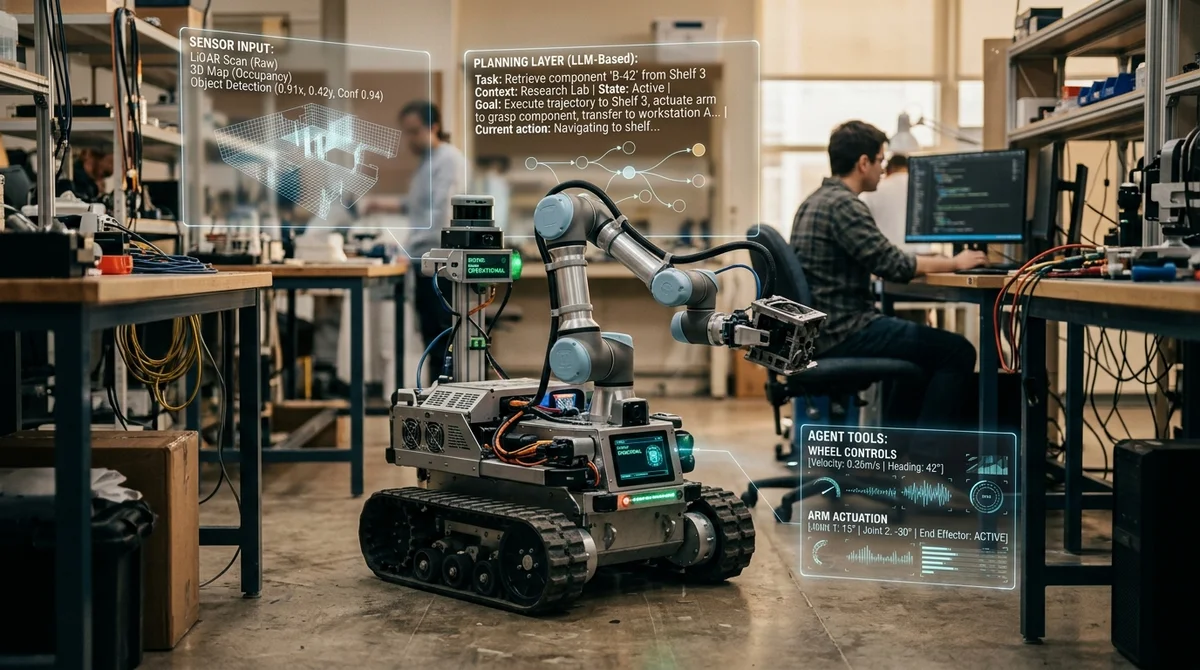
In robotics, a major shift is underway: ROS remains a foundational layer for hardware, but decision-making is increasingly moving to LLMs and agent frameworks. The author believes this combination could rewrite industry rules and make robot creation cheaper and faster.
Why ROS Is Struggling
ROS has been the standard for academic and industrial robotics for decades, but its logic is built around rigidly defined nodes, messages, and scenarios. To teach a machine a new action, a developer must write a module, connect it to the rest of the system, run simulations, and then test everything on a real device. In controlled environments like assembly lines, this works well.
But at home, on the street, or at a construction site, the world is too variable: step heights, lighting, people, and obstacles constantly change, meaning manual firmware updates for each scenario quickly hit a ceiling. Against this backdrop, the contrast between ASIMO and today's garage projects is telling. Large corporations spent years perfecting individual demonstrations, while small teams increasingly build robots that learn in simulation, get back up after falling, and adapt faster to new environments.
The key difference isn't just hardware, but approach: the industry is gradually moving away from the idea that every motion and reaction must be hard-coded in advance.
The New Robot Stack
Instead of monolithic logic, the author proposes a multi-layer architecture where thinking is separated from execution. At the lowest level are fast reflexes and safeguards: motor shutoffs, obstacle reactions, basic safety controls. Above that work sensory models, turning streams from cameras, microphones, and sensors into understandable entities. Then an LLM receives the goal, assesses context, and builds a plan, while an agent layer invokes specific tools and translates abstract commands into hardware actions.
- The reflex layer handles instant safe reactions
- The sensory layer recognizes objects, speech, and the surrounding scene
- The LLM planner decides what to do next
- The agent layer calls motors, files, APIs, and external programs
Such an architecture makes a robot less tied to any specific platform. Models don't need to know how each motor or sensor works: they operate on tasks like "navigate around an obstacle," "open a config," "adjust speed," or "test a new trajectory." In the extreme, this leads to an even more radical scenario: the LLM notices the system lacks a tool, generates a new module, tests it in simulation, and only then deploys it in production. For the classical ROS approach, such flexibility is atypical.
Benefits and Risks
The main gain here is scalability. To give a robot new behavior, you don't necessarily need to run a separate C++ or Python development cycle each time. You just describe the task in natural language, and the system breaks it down into steps. This opens the door not only to service and home robots, but to a broader class of "smart" devices: from apartment assistants to equipment that adapts to user habits without hard-coded automation scenarios.
"Because now it has not just a head, but hands too."
But with flexibility come risks. If an LLM can change configuration, run code, and make decisions in the physical world, you need sandboxes, restrictions on dangerous actions, simulation testing, and a clear rollback mechanism. Questions remain about power consumption, reliability, and legal responsibility: who is liable if a robot made a mistake following model advice. So it's not about ROS dying overnight, but its role shifting down the stack—closer to drivers and real-time levels.
What This Means
The idea of the "end of the ROS era" isn't that middleware will disappear tomorrow, but that robotics architecture's center is gradually moving from rigid rules to a layer of planning and agent execution. If this transition takes hold, robots will become easier to teach new tasks, cheaper to adapt to different hardware, and faster to move from labs into the real world.
Want to stop reading about AI and start using it?
AI News is a curated feed of AI/tech news. Hamidun Academy teaches you to use AI systematically in your work.