Meta unveiled a roadmap for four MTIA AI chips for inference, but without abandoning Nvidia and AMD
Meta unveiled a roadmap for four MTIA accelerators that are set to handle a growing share of AI workloads in the company’s data centers. The first chip is…
AI-processed from 3DNews AI; edited by Hamidun News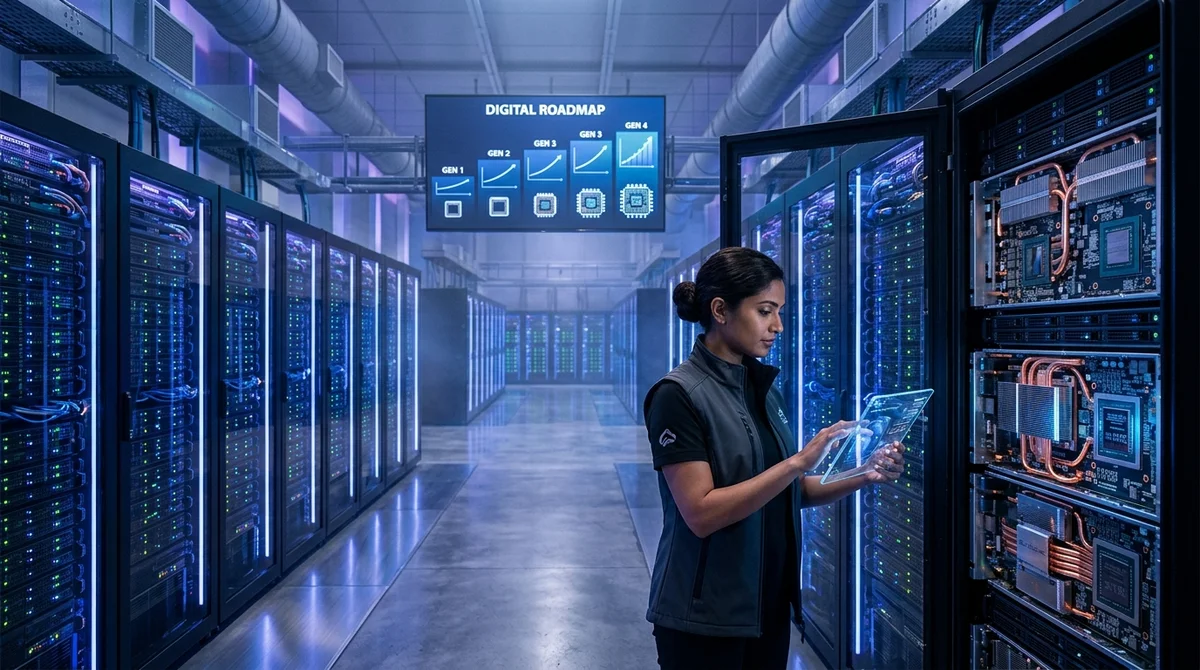
Meta revealed a plan to develop its own line of AI accelerators MTIA: over the next two years, the company wants to release four generations of chips for ranking, recommendation, and generative AI tasks. However, it won't be possible to completely abandon Nvidia and AMD — Meta views its own silicon as a supplement to third-party hardware purchases, not as an immediate replacement.
Why Meta needs its own chips
The main reason is simple: Meta's infrastructure load is growing too fast, and universal GPUs are becoming increasingly expensive. The company is expanding data center capacity for Facebook, Instagram, and its own generative services, so it's trying to gain more control over inference costs — the stage when a model is already trained and responds to user queries. For such work, the most versatile accelerator is not always necessary.
Sometimes it's more profitable to build a chip for specific internal scenarios and squeeze out the best efficiency per watt and per dollar. Meta says it already uses hundreds of thousands of MTIA chips for inference in recommendations, organic content, and advertising. Essentially, this is not about a laboratory experiment, but about an embedded part of production infrastructure.
Against this backdrop, the company is accelerating the development of new generations. Another telling number: in 2026, Meta expects capital expenditures at the level of $115–135 billion, and a significant portion of these investments goes into AI infrastructure. Its own accelerators should help not only scale faster, but also reduce dependence on prices and supplies from external vendors.
What the roadmap looks like
At the center of the new roadmap are four MTIA chips that Meta plans to deploy at a much higher speed than is typical in the industry. While many AI chips are updated every one to two years, Meta wants to move at roughly six-month intervals. This became possible due to a modular approach: new generations are designed to fit into already-prepared racks and network infrastructure without complete site redesign.
- MTIA 300 is already in production and designed for ranking and recommendation tasks.
- MTIA 400 will be the next stage and, according to the company, is being prepared for deployment in Meta's data centers.
- MTIA 450 is being designed primarily for generative AI inference.
- MTIA 500 will continue along the same line and is expected to strengthen infrastructure in 2027.
Starting with MTIA 400, Meta designs not only the chip itself, but a complete system around it: multiple server racks, network, and liquid cooling. This approach is important because in large AI clusters, performance limits have long been constrained not only by computing, but also by data delivery, power consumption, and heat dissipation. The better the company optimizes the entire stack, the less it overpays for versatility it doesn't always need.
Why this isn't a replacement for Nvidia
Despite the high-profile announcement, Meta doesn't directly position MTIA as an alternative that will displace Nvidia or AMD from its data centers. Instead, the company talks about a "portfolio" approach: different types of workloads require different chips, and there is simply no one universal solution for everything. In the coming years, external accelerators will remain critically important, especially where the heaviest scenarios of training large models or quick access to already-ready hardware and software ecosystems are needed.
Meta's bet is different: move to its own chips the workloads where you can get maximum gains in price and efficiency. At the same time, the company tries not to build a closed ecosystem. MTIA is initially designed with reliance on familiar industry tools — PyTorch, vLLM, Triton and Open Compute Project standards.
This simplifies deployment in existing data centers. Part of the development is conducted together with Broadcom, and manufacturing is entrusted to TSMC, so even the "own" silicon has a long external chain of partners.
What this means
Meta shows that the AI hardware race is shifting from simply purchasing the most powerful GPUs to a more sophisticated model: large platforms are assembling a mixed fleet of third-party and proprietary accelerators. For the market, this is a signal that the main shortage in the coming years will be not only chips themselves, but also the ability to quickly adapt infrastructure to specific types of AI workloads.
Want to stop reading about AI and start using it?
AI News is a curated feed of AI/tech news. Hamidun Academy teaches you to use AI systematically in your work.