Perplexity unveiled Personal Computer — an AI agent for Mac mini and teams
Perplexity unveiled Personal Computer — software for Mac mini that gives AI continuous access to local files, apps, and tasks. At the same time, the company…
AI-processed from TNW; edited by Hamidun News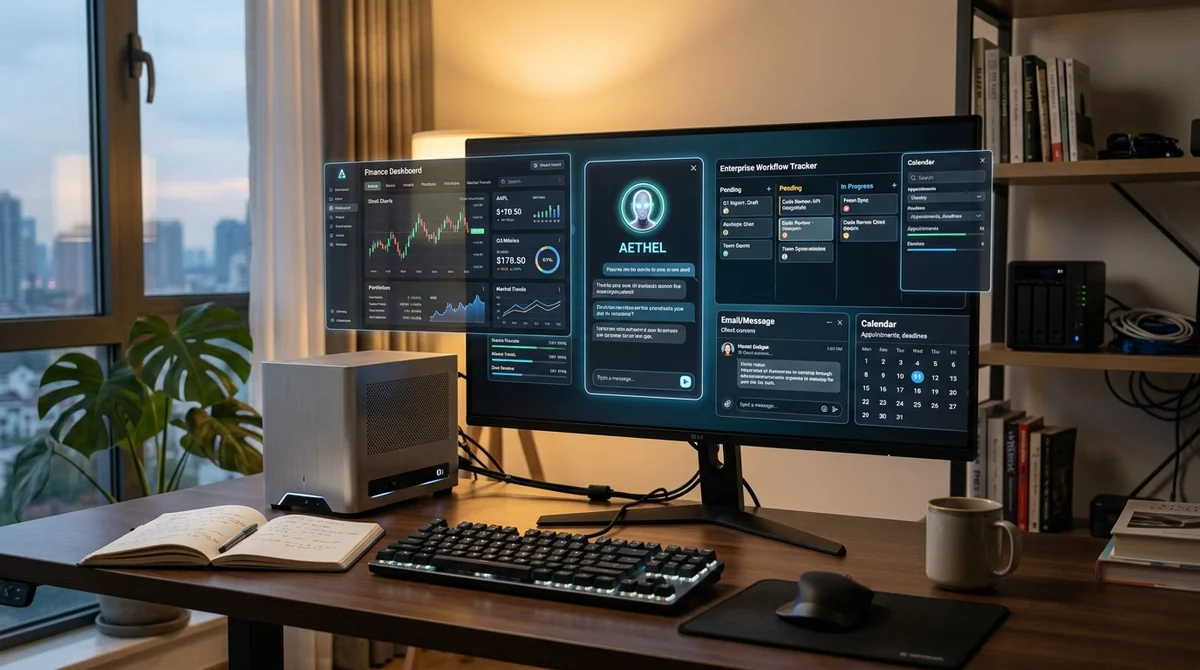
Perplexity is trying to redefine the computer's role: no longer just an interface for running programs, but a constantly working AI agent. At the Ask 2026 conference, the company showcased Personal Computer for Mac mini, a corporate version of Computer, and expanded financial tools.
How Personal Computer Works
The main announcement is Personal Computer. It's not a new device from Perplexity, but rather software installed on a dedicated Mac mini that connects local files, applications, and active sessions to the cloud-based Computer agent. By design, such a Mac mini works as a permanently enabled host: the AI gains access to the working environment, monitors events, and continues tasks without user involvement. You can manage this remotely from any device, and the system should be available around the clock.
- access to local files and applications
- launching and continuing tasks 24/7
- remote management from any device
- manual confirmation of sensitive actions
Perplexity separately emphasizes that this mode has protective mechanisms. Sensitive operations require explicit user approval, each session leaves a complete audit trail, and an emergency kill switch allows instant agent shutdown. At launch, Personal Computer is available only to Max subscribers for $200 per month with a package of 10,000 compute credits. The rollout is announced as Mac-only, and a waitlist is already open for early users.
Moving into Enterprise
The second major step is bringing Computer into the corporate environment. The business version received SOC 2 Type II, SAML SSO, action auditing, and an isolated sandbox for each request. The system natively connects to Snowflake, Salesforce, HubSpot, and hundreds of other platforms, allowing teams to extract data from repositories, pull context from CRMs, and build models without waiting in line for analytics or data teams. Essentially, this is an attempt to eliminate manual data gluing between fragmented corporate systems.
Perplexity separately makes a bet on embedding into already existing workflows. You can work with Computer directly from Slack—in private messages or public channels. The idea is that the agent shouldn't live in a separate tab: it becomes another participant in the work loop, able to write requests, gather structured results, update documents, and run recurring scripts. For companies, this looks not like another chatbot, but as a layer of automation on top of the current set of services.
The reasoning around models is also interesting. According to the company's internal data, in January 2025, 90% of enterprise requests went to just two models, but by December no single model accounted for more than 25% of usage. This is a good indicator of how quickly the market is moving away from the idea of "one provider for everything." Perplexity sells not its own frontier model, but orchestration: a system that selects the best AI stack for a specific task.
Finance and APIs
At the same conference, the company notably strengthened Perplexity Finance. According to its data, 75% of users ask financial questions every month, so Computer received direct access to more than 40 live data tools. Among the sources are SEC filings, FactSet, S&P Global, Coinbase, LSEG, and Quartr. This is important for the user for two reasons: you don't need a separate API key or license for each source, and each figure can be traced back to its original data.
The practical scenario here is quite straightforward: Computer can assemble interactive dashboards, build Excel models, and even help create full-fledged financial applications for external teams. For developers, Perplexity also announced new APIs, though without detailed specifications in the public post. The general logic is clear: the company wants to expand not only its user interface but also the programmable surface of its platform. This is a logical continuation of February's launch of usage-based API for Computer.
"A regular operating system receives instructions; an AI operating system receives goals."
With this formula, CEO Aravind Srinivas essentially described Perplexity's entire product thesis. The user specifies not a sequence of actions but a result, and the system itself decides which models, tools, and steps to use next. The company builds its differentiation from major AI providers on this: competing not only on model quality, but on how conveniently it links the web, local computer, corporate systems, and specialized data tools in a single interface.
What This Means
Perplexity is increasingly moving away from the image of an AI search engine and trying to occupy the position of an operating layer on top of models, data, and work services. If the bet pays off, value will be created not by the company's own models, but by its ability to assemble others' models, corporate data, and a local computer into one practical agent. For the market, this is another signal: the next stage of competition in AI is no longer just about answer quality, but about who better brings a task to completion.
Want to stop reading about AI and start using it?
AI News is a curated feed of AI/tech news. Hamidun Academy teaches you to use AI systematically in your work.