Claude turned into a personal medical analyst with access to sleep and lab results
Claude can be turned into a personal health analyst if given access to Notion, Oura, nutrition, and weight data. The author built a system where AI sees…
AI-processed from Habr AI; edited by Hamidun News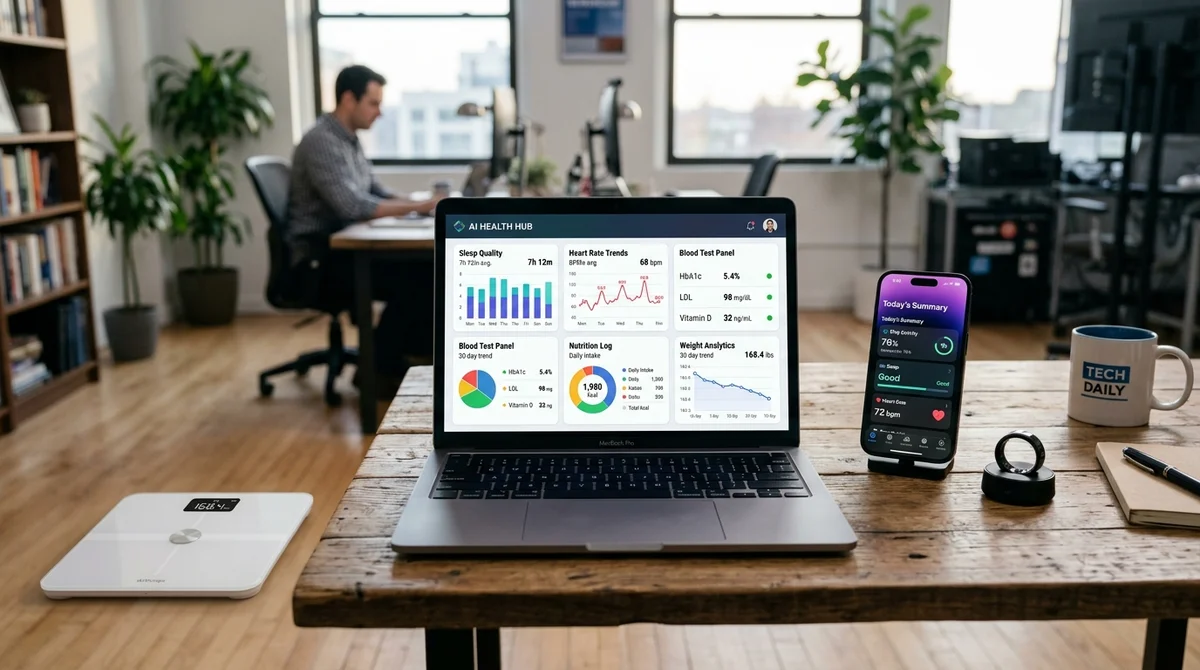
Claude can be transformed from an ordinary chatbot into a personal health analyst by connecting biometric data, nutrition, weight, and medical documents to it. The experiment author assembled such a system based on Claude Integrations and demonstrated how the model begins to see connections between sleep, heart rate, diet, and blood test results almost in real time.
How the system is structured
At the center of the system is Claude, which receives data not from a single application but from multiple sources simultaneously. For sleep, resting heart rate, HRV, and activity, an Oura Ring is used. Nutrition comes from the FoodTrack Telegram bot, where you can simply send a photo of food and get its macronutrients. Weight and body composition are pulled from Xiaomi scales through a chain of Zepp Life, Apple Health, and Health2Notion. Notion serves as a separate layer: laboratory results, doctor consultations, medications, and historical records are stored there. As a result, the model doesn't just have a scattered set of notes, but a unified digital map of the person's state.
Claude can match "raw" signals from wearable devices with rarer but important medical events: laboratory results, weight changes, medication prescriptions, and manual notes. It is at this level that the main value emerges: AI begins to search not only for answers to individual questions but also for correlations between multiple data streams that would be difficult to notice manually even with careful record-keeping.
How it was connected
Part of the system is assembled using standard tools. Notion is already among Claude's standard connectors, so it's enough to grant access to the necessary pages with medical data. However, for Oura, it was necessary to go through an open-source project from GitHub: the author deployed it on their own server and added it to Claude as a custom connector.
FoodTrack is connected using the same logic — the bot returns a unique MCP address that Claude then uses as another data source. The author separately emphasizes the role of the system prompt in Custom Instructions. In it, he briefly described which connector is responsible for what: Oura is needed for real-time metrics, Notion — for history and documents, FoodTrack — for nutrition.
After this, Claude stops guessing where to find the answer and immediately accesses the necessary source. Such a layer of instructions seems like a minor detail, but in practice it significantly improves analysis quality and reduces unnecessary clarifications.
What conclusions it provides
The most interesting aspect of this system is not the connection itself, but the type of questions it allows one to ask. The author doesn't ask the model for abstract advice like "how to become healthier," but instead uses it as an analyst on top of their own data array. For example, Claude can check whether resting heart rate increases after short sleep, whether calories and protein are sufficient for the current training load, or how biomarkers in tests changed against the background of medications, stress, and lifestyle.
- Connection between sleep duration and resting heart rate the next day
- Adequacy of nutrition for training volume and recovery
- Dynamics of weight and body composition along with activity and diet
- Changes in laboratory markers against the background of medications and lifestyle
Such an approach transforms an LLM from a generator of general recommendations into an interface to personal medical history. The article provides an example of a response not in the spirit of "get more sleep," but with a concrete relationship: on days with insufficient sleep, resting heart rate the next day is consistently higher. This is no longer magic or diagnosis, but a convenient way to quickly obtain a hypothesis from one's own data.
"This is not a replacement for a doctor, but a tool that helps ask the
right questions."
What this means
This story well illustrates where consumer AI tools are moving: from universal chat to personal analytical layers on top of fragmented services. If a user has quality data and a clear access scheme, the model can become a useful assistant in self-analysis and preparation for a doctor's visit. However, with this comes an increase in the cost of errors, privacy, and misinterpretations, so it makes sense to view such systems as a second opinion rather than a medical conclusion.
Want to stop reading about AI and start using it?
AI News is a curated feed of AI/tech news. Hamidun Academy teaches you to use AI systematically in your work.