Dell and the U.S. Department of Energy build national AI infrastructure for science and government missions
Dell and the U.S. Department of Energy are building a national AI infrastructure for science and government missions. At the center of the plan are the…
AI-processed from Bloomberg Tech; edited by Hamidun News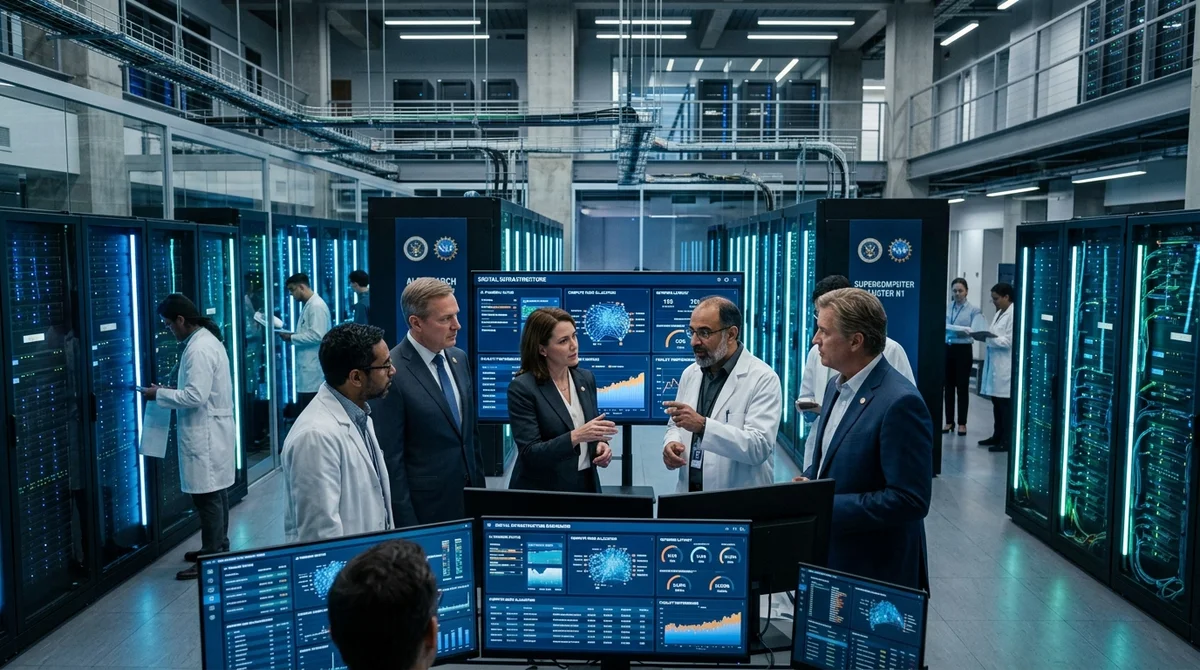
Dell Technologies and the U.S. Department of Energy have agreed to jointly build a national AI infrastructure to support scientific and government projects. The focus is not on individual models, but on the entire chain: computing, data, supercomputers, and a platform to accelerate research.
Betting on Infrastructure
The partnership was publicly discussed by Michael Dell and U.S. Deputy Secretary of Energy for Science Dario Heil. Their thesis is straightforward: the U.S. already has strong laboratories, universities, and contractors, but the next breakthrough requires a shared computational layer that will connect AI, high-performance computing, and scientific tools. Dell acts as an industrial infrastructure assembler in this scheme, while DOE serves as the customer and coordinator of scientific tasks, from energy to national security.
This is part of the broader Genesis Mission program, which the U.S. presents as a national platform to accelerate scientific discoveries. Its goal is to link supercomputers, experimental facilities, AI systems, and unique datasets into a single environment and double the productivity of American R&D spending over the course of a decade. According to Heil, this infrastructure should support not only fundamental science but also practical applications: power grids, new materials, biomolecular design, and quantum technologies.
What It's Built From
The most concrete element of the partnership is the Doudna supercomputer for the NERSC center at Lawrence Berkeley Lab. It is planned to be commissioned by the end of 2026, and the U.S. Department of Energy explicitly states that the system could serve as a template for other agencies. The machine is being built by Dell together with NVIDIA and should deliver more than a tenfold performance increase compared to the current flagship Perlmutter, to handle both classical HPC workloads and AI training and inference simultaneously.
- Doudna for tasks in energy, materials science, and biomolecular research
- CPU-GPU pairing of NVIDIA Vera Rubin platform and Dell servers with liquid cooling
- unified environment for simulations, scientific data, and AI models
- use as a base platform for Genesis Mission and future government programs
In parallel, DOE has already broken down the initiative into 26 scientific and technological challenges. Among them are accelerating power grid planning, digitizing decades of nuclear data, developing adaptive accelerators for science, and AI-driven materials design that reduces development cycles from years to months. In other words, the government is not simply trying to build "another supercomputer," but a pipeline where computational power is immediately tied to specific practical scenarios, the country's national priorities, and measurable results.
Politics and Boundaries
A separate political layer of this story is the dispute over who controls the rules for AI use when the technology moves into the government sector. In response to a question about the Anthropic-Pentagon conflict, Michael Dell took an extremely hard line: if a company works with the government, it cannot completely dictate how authorities use its tools. This is an important signal not only for defense contracts but for any major AI government procurement in the U.S.
"A company cannot dictate to a sovereign state how to use its tools."
The context here is sensitive. The Anthropic-Pentagon conflict arose over restrictions on using AI for mass surveillance and fully autonomous weapons. Against this backdrop, Dell's words show that part of the infrastructure market views the problem differently than foundation model developers: for the former, the priority is scaling and access; for the latter, it's control over use cases. The deeper AI penetrates science, energy, and defense, the more frequently such contradictions will move from backrooms into public policy.
What It Means
For the market, this is a sign of a phase shift: AI in the U.S. is increasingly moving from chatbots and pilots to national computing systems built for specific scientific and government tasks. If Dell and DOE bring Doudna and Genesis Mission to operational scale, it will not simply be another hardware procurement, but a model for how governments will build sovereign AI infrastructure around science, energy, and security.
Want to stop reading about AI and start using it?
AI News is a curated feed of AI/tech news. Hamidun Academy teaches you to use AI systematically in your work.