AWS showed how to fine-tune NVIDIA Nemotron Speech for accurate ASR in niche scenarios
AWS released a practical guide to fine-tuning Parakeet TDT 0.6B V2 from the NVIDIA Nemotron Speech lineup on Amazon EC2. The idea is to use synthetic speech…
AI-processed from AWS Machine Learning Blog; edited by Hamidun News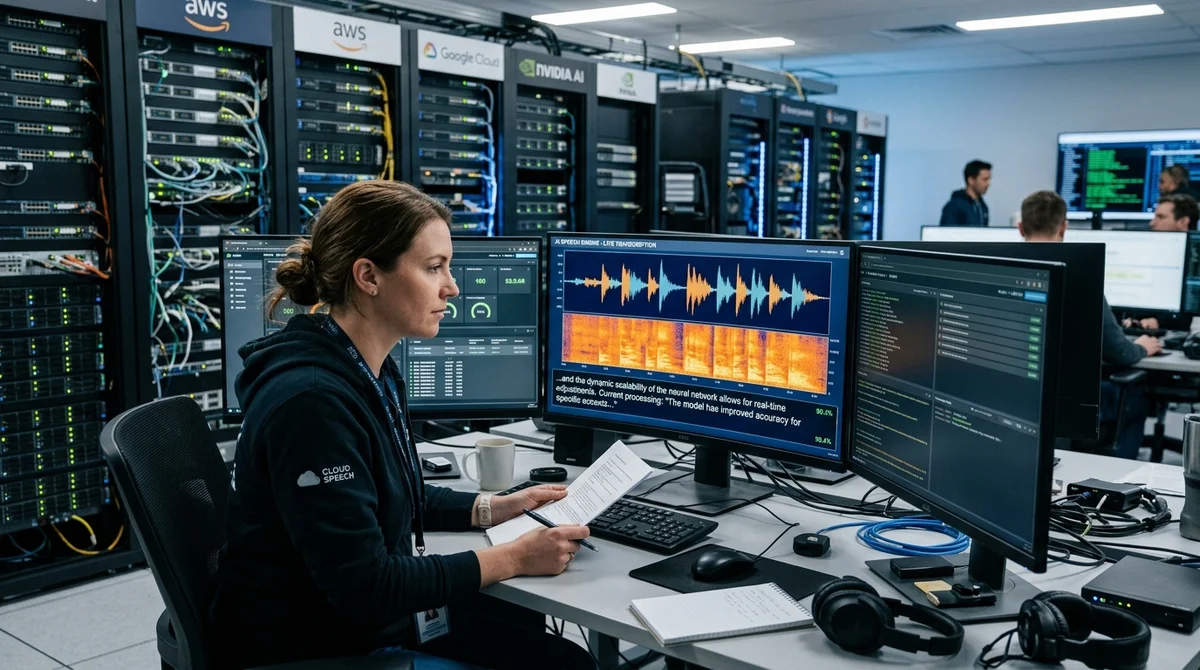
AWS has released a detailed breakdown of how to fine-tune Parakeet TDT 0.6B V2 from the NVIDIA Nemotron Speech line for tasks where standard speech recognition is no longer enough. The material demonstrates how to assemble a domain adaptation pipeline on Amazon EC2 and improve transcription quality in specialized scenarios.
What AWS Demonstrated
This isn't about a new model, but about a practical recipe for adapting it to a specific environment. AWS takes a strong baseline ASR model from NVIDIA and shows an end-to-end process: data preparation, fine-tuning, running an experiment on EC2, and subsequently evaluating the result. This format is important for teams that need not abstract research, but a clear sequence of steps that can be replicated within their own project and quickly tested on their own data.
Special emphasis is placed on the fact that a model's high ranking on leaderboards does not by itself guarantee better results in a real business case. If audio contains many industry-specific terms, abbreviations, accents, or specific noise, even a strong universal model begins to make errors. This is precisely why AWS considers domain adaptation as a practical way to bring the recognition system closer to the data it will see in production, rather than in laboratory tests.
Why Synthetic Speech
The key idea of the post is to use synthetic speech for fine-tuning. This is useful in cases where live labeled recordings are scarce, expensive to collect, or difficult to use legally due to privacy concerns. Synthetic audio data allows you to quickly increase the volume of examples with the needed terminology, pronunciation, and dialogue scenarios, and then test how the model behaves on the target task. For closed industries, this is often the fastest path to a viable dataset.
Such an approach is particularly interesting where recognition errors cost money—not in an academic sense, but in actual dollars, time, or service quality. In specialized domains, models need not just to "hear speech," but to correctly recognize rare names, abbreviations, and stable phrases. This is especially important when transcription needs to distinguish between similarly-sounding brands, internal codes, product numbers, or medication names in daily employee and customer conversations.
- Contact centers with product names and service plans
- Medicine with terminology, medications, and abbreviations
- Legal and compliance scenarios with formal speech
- Industrial recordings with background noise and radio traffic
- Internal corporate calls with accents and language mixing
But synthetic speech doesn't work automatically. For adaptation to truly yield gains, synthetic recordings must resemble the future load: in speech pace, phrasing, noise, and term composition. Otherwise, the model will learn a polished training set, not a live stream of conversations. This is exactly where AWS's approach matters: not just to take any voice generation, but to build data tailored to the specific operational context and to the speech that actually occurs in a team's work.
Why This Is Practical
For engineering teams, the value of such material lies in connecting infrastructure and open-source tools into a single reproducible workflow. Instead of a situation where a model is good "somewhere in a benchmark," AWS shows how to bring it to a state useful for a specific niche. This lowers the barrier to entry for teams that want to test fine-tuning without weeks of building a pipeline from scratch, and accelerates hypothesis testing in practice.
Another important takeaway: ASR quality is increasingly determined not only by architecture, but by the quality of domain adaptation. If a company already has a scenario where recognition errors hurt KPIs, the next logical step is not to search for a "magical" universal model, but to adapt a strong baseline to its own data. In this sense, the combination of Amazon EC2, synthetic dataset, and Nemotron Speech looks like a quite practical recipe, not a demonstration for the sake of demo.
What This Means
The ASR market is shifting from a race for general leaderboards to adapting models to real working environments. For business, this is a signal that wins can come not only from choosing a model, but also from careful fine-tuning to your own vocabulary, noise, lexicon, and conversation format.
Want to stop reading about AI and start using it?
AI News is a curated feed of AI/tech news. Hamidun Academy teaches you to use AI systematically in your work.