Humanoid: demand for humanoid robots is surging, deployments will begin as early as 2026
Humanoid says the humanoid robot market is finally moving beyond demo mode. CTO Jarad Cannon said demand is “off the charts,” with eight commercial pilots…
AI-processed from Bloomberg Tech; edited by Hamidun News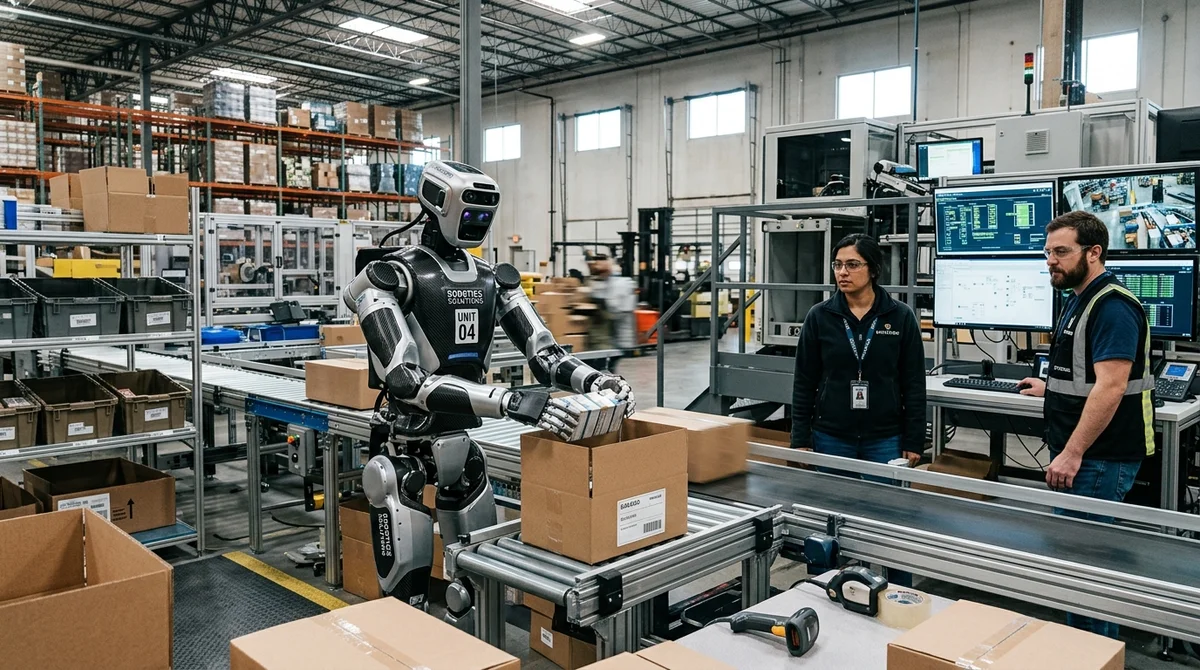
The British company Humanoid says that the market for humanoid robots is moving out of the stage of beautiful demos toward the first commercial implementations. According to CTO Jarad Cannon, demand for such systems is already noticeably outpacing the typical robotics sales cycle.
First working scenarios
According to Cannon's assessment, real commercial applications of humanoids will begin in the second half of 2026 and will intensify in 2027. We're not talking about home assistants or robots "for all occasions," but about industrial sites with clear, repeatable tasks. He believes that the basic technology for this is already ready: modern AI systems can learn not just one narrow operation, but several tasks within a single entity, and this is precisely what makes the economics of implementation plausible.
According to Humanoid, the first wave will include warehouses, logistics centers, and automotive suppliers. The logic is simple: in such places, work changes throughout the day, and businesses need not one specialized machine, but flexible automation. Roughly speaking, in the morning the robot helps with unloading, during the day it packages, and in the evening it participates in shipment.
For classical robotics, this is often too fragmented a scenario, but for a humanoid platform—it's exactly the case it was built for.
Why demand is skyrocketing
The strongest thesis from the interview is not about technology, but about the market. Cannon says that over 15 years in robotics, he's been accustomed to selling the idea to clients almost from scratch, but now he sees a different picture: many large companies are already pre-forming their own strategies around humanoid robots. In other words, the market in some cases is not waiting for an explanation of why this is needed, but for the emergence of a sufficiently reliable product that can be put into real operation and evaluated by KPI.
"In many cases, companies already have strategies around humanoid robots."
- Humanoid has already completed eight commercial POCs based on prototypes
- The company promises to deploy the first production-intent systems in operation later in 2026
- Target for shipments by the end of 2027—from hundreds to low thousands of devices
- The company sees primary demand in logistics, warehouses, and automotive suppliers
The main driver of demand, according to Humanoid, is a labor shortage. The company is targeting segments where it's either difficult to hire people geographically, or where the vacancies themselves are becoming increasingly unattractive. Cannon separately highlights dangerous and repetitive roles: from routine operations at facilities to tasks in energy-intensive areas where accidents still occur every year. Therefore, the first goal for humanoids is not to "replace everyone," but to cover dumb, difficult, and risky scenarios where ROI previously didn't add up for narrowly specialized automation.
Humanoid's bet
Cannon emphasizes that Humanoid was built from the start with a commercial focus, not as a purely research project. Hence the engineering solutions. The company is betting on a more pragmatic architecture: a wheeled base where it provides an advantage, simplified grippers instead of expensive and complex hands "for all cases," and also emphasis on payload and working range.
According to him, this helps get safety certification faster and close exactly those tasks that clients are willing to pay for right now. When discussing competition, Cannon doesn't deny China's strength: faster hardware iterations there and a stronger local supply chain. But he doesn't believe in a scenario where one player takes the entire market.
Some components, in his view, will become almost commoditized, as has already happened in the automotive industry, but complete systems and confidence in their origin will remain a factor in choice. For clients from the US, UK, and Europe, the question of supply chain sovereignty, judging by his words, will be no less important than the price of the robot itself.
What this means
If Humanoid truly converts pilots into operational implementations in the coming quarters, the market will receive an important signal: humanoids are starting to be sold not as a showcase for conferences, but as a flexible layer of automation for warehouses and factories. This is the moment when the industry transitions from hype to operational economics.
Want to stop reading about AI and start using it?
AI News is a curated feed of AI/tech news. Hamidun Academy teaches you to use AI systematically in your work.