Google radically updated Maps: Gemini answers questions, and navigation is now 3D
Google significantly reworked Maps: the app added Ask Maps with Gemini for natural-language queries and a new Immersive Navigation mode. The service now not…
AI-processed from TNW; edited by Hamidun News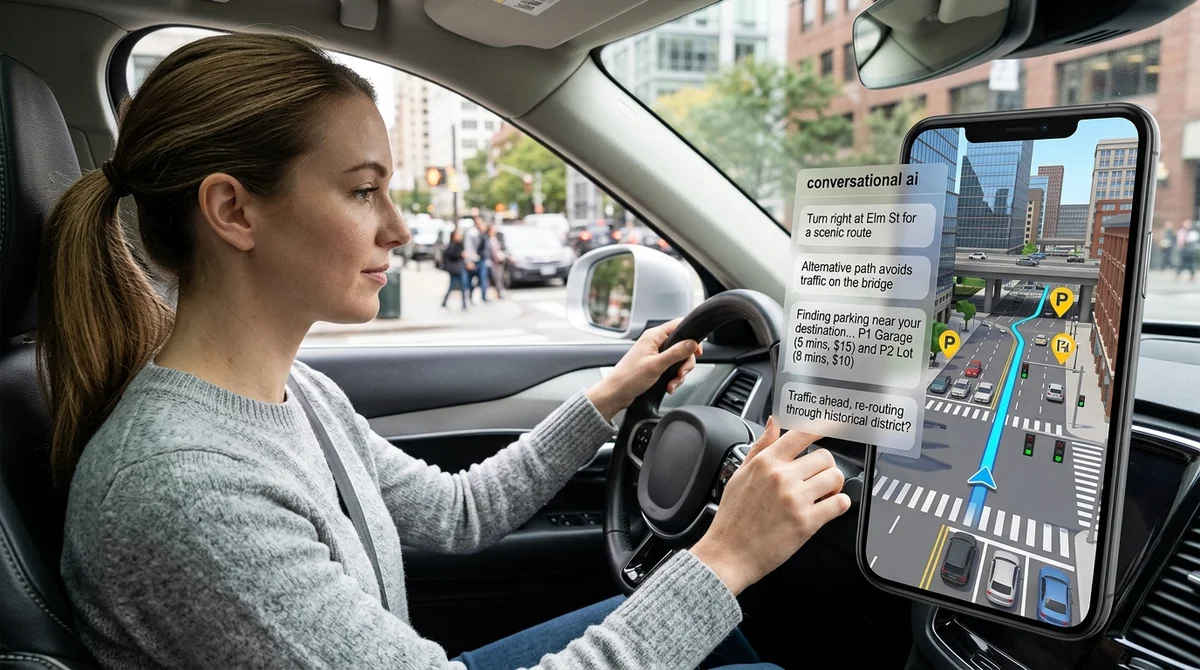
Google has launched the largest Maps update in over a decade. The service now features Ask Maps powered by Gemini for conversational queries and a new Immersive Navigation mode that transforms step-by-step directions into a live 3D scene.
How Ask Maps Works
The main innovation is the Ask Maps button, through which you can ask not just search phrases, but everyday questions in natural language. For example, where to quickly charge a phone without waiting in a café, whether there's a lit public tennis court nearby for the evening, or what stops to make along the way to multiple route points. Instead of making separate searches, Maps responds in a conversational format and immediately shows a personalized map with suitable options.
Google is betting that maps should now not only show points but also understand context. Ask Maps responses take into account saved places and a user's past searches. If a person frequently searches for vegan restaurants, the service can itself rank such options higher in results. After that, found places can immediately be saved to a list, sent to friends, booked at a table, or a route can be built without switching to other apps.
According to the company, Ask Maps relies on information about more than 300 million places and reviews from a community of more than 500 million members. The launch has already begun in the US and India on Android and iOS, with the desktop version to appear later.
"We are turning the exploration of the world into a simple conversation,"
Google describes the new approach to Maps.
Navigation in 3D
The second part of the update is Immersive Navigation. This is not a cosmetic redesign, but a complete reworking of driving mode. Instead of the familiar flat map, Google Maps now shows a volumetric scene with buildings, overpasses, and terrain around the route. On complex sections, the service visually highlights lanes, traffic lights, pedestrian crossings, and stop signs so the driver understands earlier where to change lanes and where to prepare for a turn. This visualization is powered by a combination of fresh Street View data, aerial photography, and Gemini models that help the service understand the space around the route.
Voice guidance has also become more human-like. Here's what this offers in practice:
- the map shows a wider section of the route, uses smart zoom and transparent buildings to prepare in advance for complex interchanges;
- for alternative routes, the service explains the trade-offs — faster but with a toll road, or longer but without traffic;
- the route includes real-time warnings about accidents, road work, and other disruptions;
- before a trip, you can view Street View at the destination point and understand where parking, the entrance, and the right side of the street are.
Google particularly emphasizes the scale of data: Maps processes more than 5 million traffic updates per second, and drivers send more than 10 million signals about road conditions daily.
Immersive Navigation has already begun rolling out across the US, and then the feature will appear on compatible iOS and Android devices, as well as in CarPlay, Android Auto, and cars with built-in Google. In other words, Google is immediately targeting not only smartphones but also car interfaces, where the quality of guidance is especially critical.
Betting on Interface
This update is important not only because of beautiful 3D graphics. Google is moving Maps from the mode of "enter a query and select a point" to the mode of an assistant that understands user intent. Previously, Gemini in Maps mainly helped with AI summaries of places and reviews, but now it has become a full layer on top of search and navigation.
For Google, this is a way to keep Maps at the center of local search at a time when Apple is strengthening its mapping product, and AI services like Perplexity and ChatGPT are also moving toward more contextual answers.
There is also a technological subtext. Detailed 3D navigation at this level has long looked like a logical next step, but it requires very detailed maps, fresh visual data, and sufficiently cheap real-time rendering on mobile devices. It appears that Google now believes that both the infrastructure and Gemini models are ready to take this experience from demonstration mode to a mass product. If this works, Maps will become an even stronger entry point to local search and recommendations.
What This Means
Google Maps is ceasing to be just a map and is becoming an interface for everyday decisions: where to go, what to choose along the way, and how to get there without extra stress. If users become accustomed to formulating queries in regular language, local search will become less "keyword-based" and more conversational — and this changes both audience behavior and the rules of the game for services and businesses that live off maps, recommendations, and navigation.
Want to stop reading about AI and start using it?
AI News is a curated feed of AI/tech news. Hamidun Academy teaches you to use AI systematically in your work.