Nvidia hints at an optical chip that could reshape AI data centers ahead of GTC 2026
Ahead of GTC 2026, Nvidia is raising expectations with a promise of “a chip that will shake the world.” The most discussed scenario is the unveiling of a…
AI-processed from Habr AI; edited by Hamidun News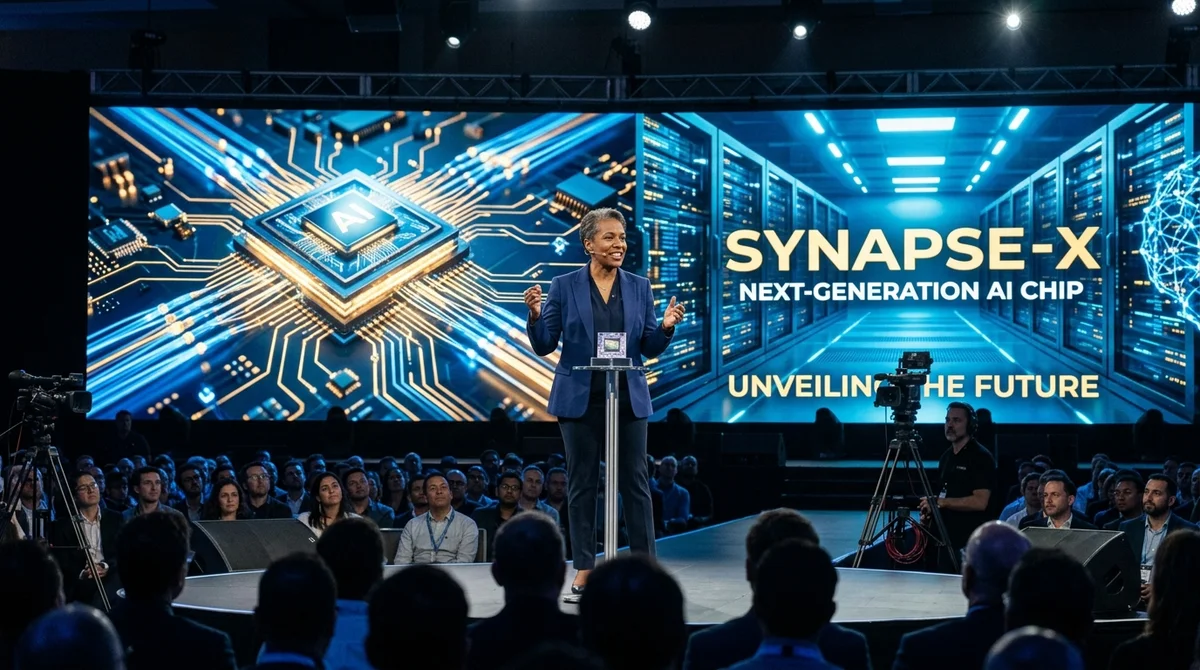
Before Nvidia's presentation at GTC 2026, the market is discussing not just another teraflops increase, but a possible shift in the very architecture of connections between AI chips. The occasion was Jensen Huang's phrase about "a chip that will shake the world," spoken before the presentation on March 16, 2026, in San Jose.
What Nvidia Promises
On the surface everything looks like a routine lineup update. Nvidia has already established Blackwell as the current flagship, and at GTC the market expects an official emphasis on the next generation Vera Rubin. Blackwell Ultra GB300 already has extreme specifications: 288 GB HBM3e, up to 15 petaflops in FP4, and NVL72 racks that assemble dozens of accelerators into a single computational unit.
For the industry, these are important numbers, but by themselves they do not explain such a loud promise. The comparison with 2016 is not accidental: back then, the presentation of P100 turned out to be one of the key moments for today's AI boom. The intrigue lies in the fact that Huang did not tie the statement to a specific product.
Nvidia usually sets markers in advance: new architecture, new rack, new DGX cluster. Here the market heard a formula without decryption, and that is precisely why attention shifted from dry specifications to the very idea of a breakthrough. If Vera Rubin truly brings multiple memory bandwidth growth and noticeably reduces inference costs, that would already be a major event.
But the formula about "shaking the world" hints at a step of a different scale.
Why Everyone Is Looking at Optics
The main hypothesis around the announcement is silicon photonics, that is, data transmission between chips using light instead of electrical signals over copper. At the center of these expectations is the Feynman architecture, which is associated with the period after Vera Rubin. The idea is straightforward: modern GPUs are constrained not only by the power of the crystal itself, but also by how quickly it exchanges data with neighboring accelerators, memory, and network infrastructure. The larger the cluster, the more painful the losses in connections, heat, and distance limitations become.
"At GTC 2026 we will present a chip that will shake the world."
If Nvidia really demonstrates a working optical interconnect, it will not be a cosmetic improvement, but an attempt to eliminate the main bottleneck of AI infrastructure. Electrical lines lose efficiency as speeds and placement density increase. Light channels promise more bandwidth per bit, less heat, and better scalability. That is precisely why the conversation has suddenly shifted from plus 20% to performance to rebuilding how large clusters are constructed for model training and deployment.
What This Changes
The transition to optics is important not only for engineers who count nanoseconds between chips. It affects the economics of data centers because today's AI race is increasingly hitting limits on energy, cooling, and the cost of maintaining models. The larger clusters become, the more money goes not to the "brains" themselves, but to transferring data between them and fighting the heat that this transfer creates. If Nvidia's bet works out, the industry could get several practical effects at once:
- lower energy costs for transferring each bit of data;
- less heat generation and, consequently, simpler rack cooling;
- ability to place accelerators at greater distances without sharp loss of speed;
- more flexible data center and network infrastructure planning;
- further reduction in inference costs for mass AI services.
But there is also strong skepticism here. Optical interconnects have been promised to the industry for many years, and the path from a laboratory prototype to a serial server rack is always longer than it appears in a presentation. Moreover, Nvidia is a company that has a direct incentive to raise expectations: its capitalization is huge, competitors like AMD, Intel, Google, and Amazon are investing billions in alternative accelerators, and every presentation instantly becomes a test of leadership. That is why the main question is not whether they will show a beautiful slide, but whether there will be specifics on stage: a working sample, delivery schedules, and customer names.
What This Means
If on March 16, 2026, Nvidia confirms its bet on silicon photonics, the news will be more than another GPU announcement: it will be about a shift in AI data center architecture and a new wave of reducing computing costs. If, however, loud words hide only a planned Blackwell and Vera Rubin upgrade, the market will get an important, but still evolutionary step, not a technological breakthrough. That is precisely why investors, engineers, and cloud providers will be watching not the slogans, but the timelines, prototypes, and first customers.
Want to stop reading about AI and start using it?
AI News is a curated feed of AI/tech news. Hamidun Academy teaches you to use AI systematically in your work.