Unity showed how to build voice NPCs with memory and world context
Unity showed an approach to building a voice NPC that hears the player, remembers past conversations, and responds with the game world's context in mind. The…
AI-processed from Habr AI; edited by Hamidun News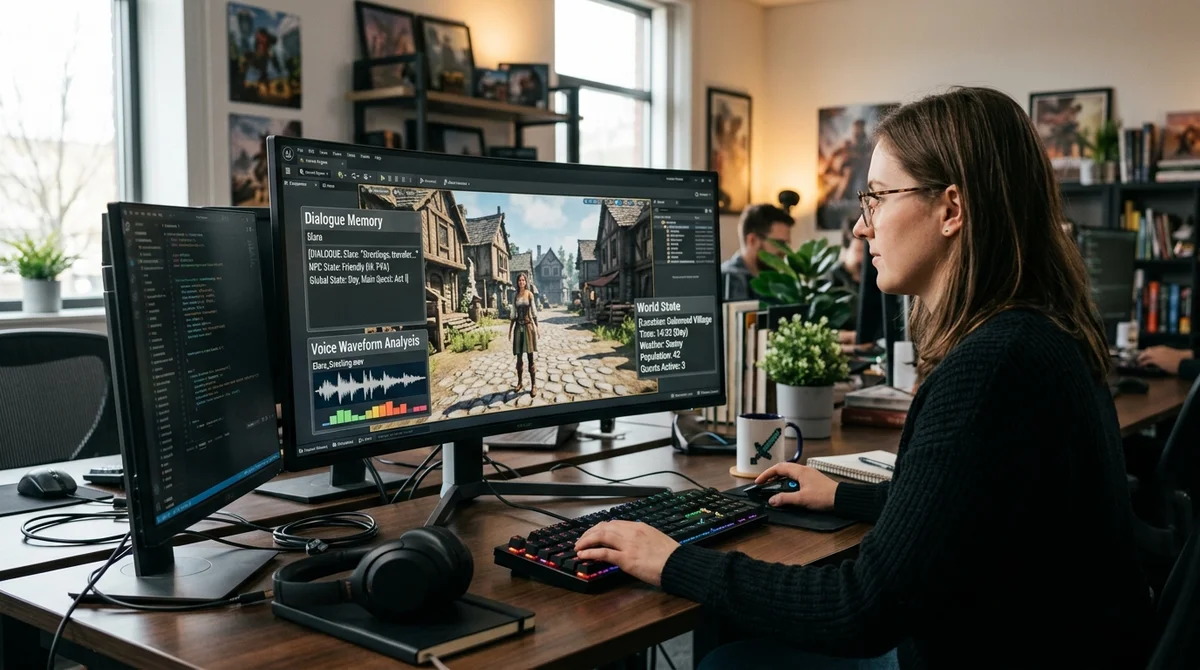
A detailed guide has appeared on how to build voice-based NPCs in Unity that not only respond by script, but account for memory, world state, and previous dialogues. The approach combines a local LLM, voice input, and the Generative Agents architecture, so the character responds to the player as a real interlocutor.
How NPC Changes
The main idea of the material is to move away from classic lines triggered by events and build a character who perceives conversation as a continuous story. If the player already asked about the blacksmith, visited the village during daytime, and then returned in the evening, the NPC doesn't start the dialogue from scratch. He receives context, remembers past meetings, and responds as though he actually lives inside the world, not just exists in one dialog window.
The author describes the system as sequential assembly: from the first request to a local language model through to a full-featured voice interface. As a result, the NPC can hear the player's phrase, interpret it considering world rules, make simple inferential reasoning, and return a voice answer. For indie developers, this is a significant shift: instead of rigid dialogue branches, a more flexible behavior layer emerges that can be developed without thousands of pre-written lines.
What Blocks It Consists Of
At the center of the architecture—not one magical prompt, but several working layers that sustain the feeling of a "living" character. According to the description, the system is built around memory, scene context, and voice contour, and the LLM acts not just as a text generator, but as a mechanism for making local decisions within the defined world.
- Local LLM processes lines and forms an answer without necessarily sending data to the cloud
- Memory stores past conversations, facts about the character, and important events
- World context hints to the model the time of day, place, NPC roles, and current situation
- Voice layer converts the player's speech to text and voices the character's final answer
Separately important is reliance on Generative Agents from Stanford. This architecture is known for dividing agent behavior into observations, memory, reflection, and planning. In game context, this approach is valuable because the NPC stops being just a "talking button". It can connect the current player question with past events, account for local rules, and respond not randomly, but within its character and role.
Why This Interests Developers
The material shows not an abstract idea of "AI in games", but a practically applicable route for Unity development. Here the step-by-step format matters: first a basic communication channel with the model is established, then knowledge about the world is added, after that—long-term memory and voice. This order lowers the barrier to entry. A developer doesn't need to build a perfect system right away; you can start with one NPC, check dialogue quality, and then complicate the mechanics.
"Hi, where's the tavern here?"—an example of a request that the NPC
should answer considering past conversation and current context.
Another strong point is emphasis on a local model. For prototypes and small studios, this means more cost control, less dependence on external APIs, and the ability to experiment even where constant internet or cloud budget is limited. Of course, such an approach requires careful tuning: you need to monitor memory volume, speech recognition quality, and ensure the model doesn't fall out of lore. But the fact that such a system can be assembled in Unity in a clear sequence makes the topic far closer to real development than many general conversations about AI-NPC.
What This Means
The gaming market is gradually moving from scripted dialogues to characters who remember, listen, and respond to context. Such guides matter not because they deliver ready AAA results, but because they turn the idea of "living NPCs" into a repeatable engineering task for Unity teams.
Want to stop reading about AI and start using it?
AI News is a curated feed of AI/tech news. Hamidun Academy teaches you to use AI systematically in your work.