Google released Gemini Embedding 2 for multimodal RAG with video, audio, and PDF
Google updated its embedding lineup and released Gemini Embedding 2, a model that can work not only with text, but also with images, video, audio, and PDF…
AI-processed from Habr AI; edited by Hamidun News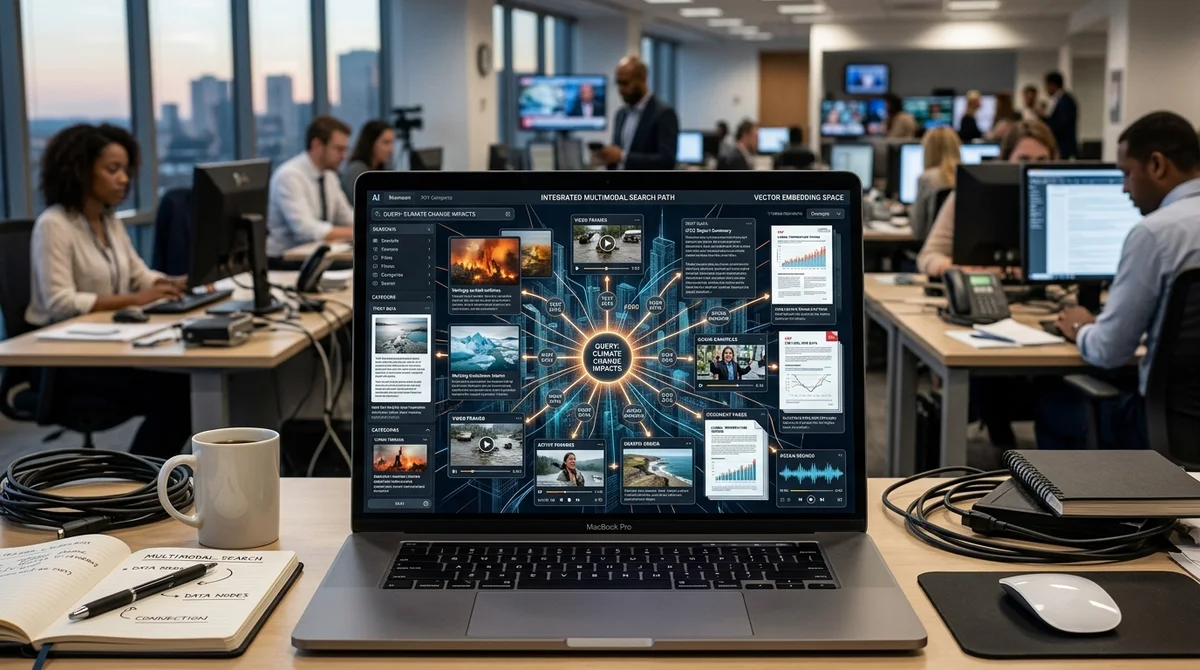
Google has released Gemini Embedding 2 — an embedding model that translates not only text, but also images, audio, video, and PDFs into a single vector space. For multimodal RAG, this is an important step: a single query can now find both an article in a knowledge base and the needed fragment of a training video.
What
Changed Previously, search across mixed content types was built through a long chain of transformations. Videos had to be split into frames, audio had to be transcribed, images had to be described using a vision model, and then all of this had to be reassembled back into text before being sent to the embedding model. This approach worked, but lost details at each stage.
If speech recognition made a mistake or a frame description turned out too generic, search quality immediately dropped, and developers had to maintain a cumbersome pipeline of several services. With Gemini Embedding 2, some of this complexity goes away. The model can accept raw files directly and build representations for different formats in a unified space.
This means a text query like "how to set up authorization" can match not only documentation, but also a relevant video fragment, an interface image, or a PDF instruction. For teams that store knowledge in scattered formats, this removes one of the main limitations of classical RAG.
How to
Build a System But the embedding model itself doesn't automatically make multimodal RAG useful. A large language model can't simply "read" an MP4 or image the way it reads text context. That's why a working architecture is built in two channels: one handles search using native embeddings, the other prepares a text description of the found object, which can then be passed to the LLM for answer generation. It's precisely this combination of channels that turns a pretty demo into a working product.
- Index raw files natively, without unnecessary transformations Store text descriptions, transcripts, and metadata nearby Search across a unified vector space for all content types * Pass to the LLM not the file, but its text representation and context In practical implementation, this combines well with the standard RAG stack: Python for the pipeline, Gemini API for embeddings and description generation, Supabase or another vector database for storing indexes. This approach allows you to search simultaneously across a knowledge base, screenshots, presentations, and internal videos without forcing the user to think about what format the needed answer is in. At the product level, this is no longer just document search, but a single point of access to company knowledge.
Where the
Bottlenecks Are The main limitation hasn't gone anywhere: the found multimedia object still needs to be explained to the model and to the user. If the system returns a video but doesn't know which exact fragment contains the answer, the user still gets a weak result. That's why the quality of multimodal RAG now depends not only on embeddings, but also on how carefully segmentation, annotation, and binding of the text layer to the source file are constructed.
A query like "how to set up authorization" can return both an article and the needed video fragment.
This leads to engineering requirements: you need to think through chunking for video and audio, updating descriptions when files change, storing timecodes, and controlling costs. Native multimodal search reduces information loss, but doesn't eliminate the need for good data. If descriptions are weak, the LLM won't be able to confidently assemble an answer even with an exact search hit. That's why the main value of Gemini Embedding 2 reveals itself where the team is ready to build a full index, rather than just upload files and wait for magic.
What
This Means For corporate knowledge bases, support, onboarding, and training platforms, this is a notable shift. Google is bringing RAG closer to a scenario where text, visuals, and video become equal sources of answers. The winners will be not those with more files, but those who correctly combine multimodal search with a clear text layer for the LLM.
Want to stop reading about AI and start using it?
AI News is a curated feed of AI/tech news. Hamidun Academy teaches you to use AI systematically in your work.