Nvidia added the NemoClaw security stack to OpenClaw for personal AI agents
Nvidia is betting on OpenClaw as the foundation for personal AI agents, but wraps it in the new NemoClaw stack. It installs OpenShell, runs the agent in an…
AI-processed from ZDNet AI; edited by Hamidun News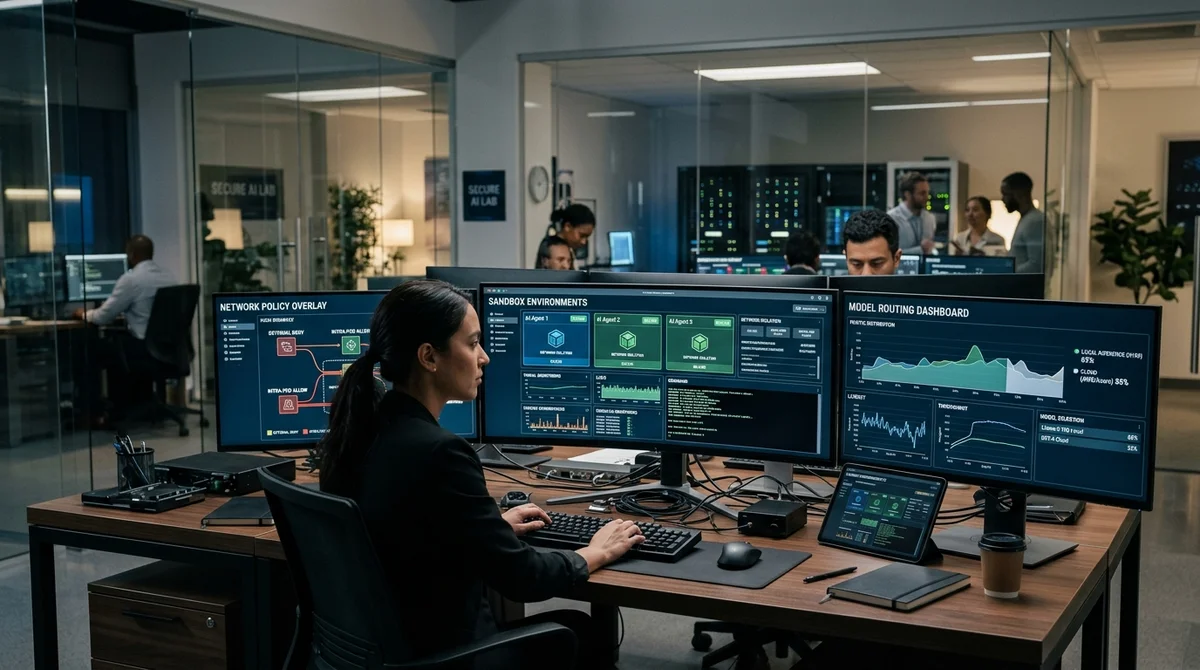
Nvidia has unveiled NemoClaw — a security stack for OpenClaw designed to make personal AI agents not just suitable for demos, but for continuous operation. The company is clearly positioning itself not merely as a chip supplier, but as an infrastructure layer for always-on assistants running on PCs, workstations, or in local environments.
Betting on OpenClaw
At GTC 2026, the company described OpenClaw as a platform around which a market for personal AI could grow. Nvidia's logic is clear: if agents are starting to not only answer questions but also read files, invoke APIs, write code, and execute lengthy scenarios, they need more than just an LLM — they need a full-fledged execution environment. This is precisely why Nvidia is promoting NemoClaw alongside OpenClaw — an add-on layer that deploys the necessary components with a single command and immediately adds security, privacy, and access management rules.
For Nvidia, it's also an attempt to establish itself above the hardware — at the runtime and orchestration level. Jensen Huang even compared OpenClaw to an operating system for the age of personal AI, rather than just another open-source framework. If this thesis holds, the winner will not be the one with the best model, but the one who controls the environment where an agent gains access to data, tools, and networks.
"OpenClaw is an operating system for personal AI," —
Jensen Huang declared.
How the Stack Works
Technically, NemoClaw combines OpenClaw, the new OpenShell runtime, Nemotron models, and Nvidia's Agent Toolkit. The idea is that an agent doesn't run directly on the host, but inside an isolated sandbox. OpenShell monitors which folders can be accessed, what external addresses are allowed, what processes can be launched, and how requests to models are made. There's also a separate privacy router: it can keep sensitive data on a local model and only send a task to a cloud frontier model when the policy permits.
- One-command stack installation
- File system and process isolation through sandbox
- Network guardrails with deny-by-default principle
- Routing between local and cloud models by policy
- Running on RTX PCs, workstations, DGX, or in local data environments
This matters because the main concern around autonomous agents has long not been answer quality, but the fact that they must be given too broad access. If an agent can write code, read documents, and browse the internet, without a separate control layer it quickly becomes a source of leaks and errors. NemoClaw closes this gap: it doesn't ask you to blindly trust a prompt or system instruction, but instead moves control to the execution environment level. For corporate teams, this is much closer to a real security model than "just don't tell the model to do bad things."
Why Now
The launch of NemoClaw shows where the market is shifting: from standalone chatbots to agents that live permanently and perform background tasks. Nvidia specifically emphasizes that such claws can operate around the clock on a dedicated machine — from RTX PCs and laptops to DGX Station or DGX Spark. In other words, the conversation is no longer about a one-off browser experiment, but about personal or team software that has memory, tools, communication channels, and its own runtime.
For developers, it's also a convenient package: no need to separately assemble a model, sandbox, policies, routing, and integration with OpenClaw. But the main question remains the same — how well guardrails will withstand prompt injection, non-standard tools, and live corporate infrastructure. Even Nvidia acknowledges the limits of isolation: a sandbox significantly reduces risk, but doesn't turn an autonomous agent into a completely safe object.
So the product looks not like a magical shield, but as a practical minimum for real-world use.
What This Means
Nvidia is attempting to become the standard not only for AI hardware, but also for the layer where autonomous agents actually launch and gain access to data. If NemoClaw simplifies the secure deployment of OpenClaw on local machines and in companies, the market will more quickly transition from eye-catching demos to useful always-on assistants that can be trusted with part of the routine without abandoning control entirely.
Want to stop reading about AI and start using it?
AI News is a curated feed of AI/tech news. Hamidun Academy teaches you to use AI systematically in your work.