NVIDIA at GTC 2026 announced a 'ChatGPT moment' for self-driving cars and robots
At GTC 2026, NVIDIA called the current stage a 'ChatGPT moment' for self-driving cars. The company is expanding its robotaxi project with Uber: 28 markets by…
AI-processed from ZDNet AI; edited by Hamidun News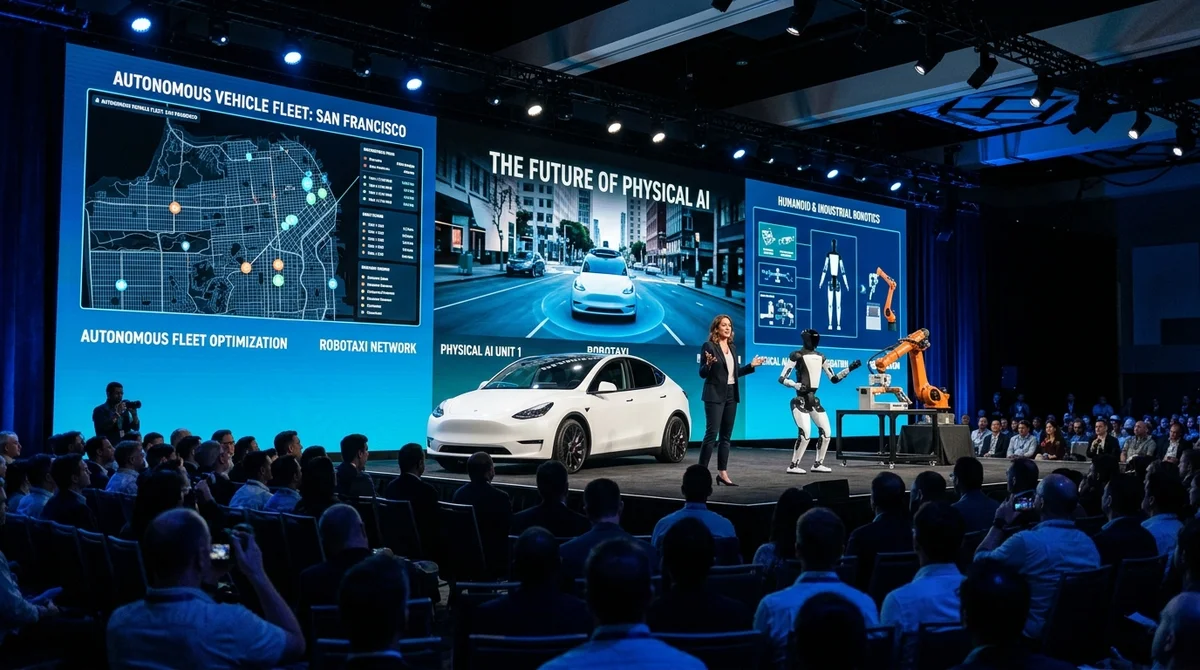
NVIDIA at GTC 2026 moved the conversation about physical AI from demonstrations to a deployment roadmap. The company announced that a "ChatGPT moment" has arrived for autonomous vehicles, while simultaneously showing how it plans to scale the same stack to robotaxis, industrial robots, and digital twins.
A Turn for the Auto Industry
NVIDIA's main thesis sounds maximally ambitious: autonomous driving is ceasing to be an endless R&D project and becoming a commercial platform. At GTC 2026, the company announced that BYD, Geely, Isuzu, and Nissan are building L4-ready programs based on NVIDIA DRIVE Hyperion, while Uber is expanding its partnership with NVIDIA to launch a fully AI-managed robotaxi fleet in 28 cities across four continents by 2028. The launch is scheduled for Los Angeles and the San Francisco Bay Area in the first half of 2027.
An important emphasis here is not only on computation, but also on safety. NVIDIA is promoting Halos OS as a unified safety architecture for AI vehicles and linking it to the open model Alpamayo 1.5, which should help vehicles parse rare and complex road scenarios. This is an attempt to move away from the old scheme where each team separately solves the tasks of sensors, planning, and validation, and instead assemble a unified stack for serial production.
"The autonomous transport revolution has already begun — this is the first multi-trillion robotic industry," said NVIDIA CEO
Jensen Huang.
Tools for Robots
Beyond the auto industry, NVIDIA expanded its physical AI stack for robotics. The company showcased Cosmos 3 for world generation and simulation, Isaac Lab 3.0 for large-scale robot training in simulation, and GR00T N1.7 as an open model for universal robotic skills. The company also announced the upcoming GR00T N2 model, which, according to NVIDIA, handles new tasks in new environments more than twice as successfully as leading vision-language-action systems.
The point of these releases is that NVIDIA is no longer selling just a separate chip or even only an SDK, but a complete path from training to deployment. Manufacturers like ABB Robotics, FANUC, KUKA, YASKAWA, Figure, Agility, and Boston Dynamics use Omniverse, Isaac, and Jetson to first run robots through physically accurate digital twins, and then transfer models to real hardware. For the industry, this reduces the cost of errors: expensive experiments move from the shop floor to simulation.
Betting on Data
A separate layer of announcements is dedicated to training physical AI faster and cheaper. NVIDIA presented the Physical AI Data Factory Blueprint — an open reference architecture that combines data collection, synthetic generation, augmentation, and model evaluation in one pipeline. The logic is simple: the real world is scarce, it's too chaotic, and the most dangerous cases for autonomous vehicles and robots are rare occurrences. This means data needs to be not only collected, but massively produced.
This layer includes several components:
- Alpamayo 1.5 for reasoning-based autonomous driving and parsing long-tail scenarios
- Omniverse NuRec for scene reconstruction and refinement when training AV systems
- Cosmos 3 for synthetic world generation and action simulation
- Isaac Lab 3.0 and Jetson Thor for the transition from training to real execution
- Cloud deployments through Microsoft Azure and Nebius for scaling the data factory
This strategy explains well why NVIDIA increasingly talks not about GPUs separately, but about infrastructure. If the approach succeeds in which compute transforms into data, and data transforms into ready-made policies for machines, the company will be able to capture value at several layers at once: models, simulation, orchestration, edge computers, and partner clouds.
What This Means
NVIDIA is attempting to establish itself as a core physical AI provider in the same way it previously established itself in generative AI. If the company executes its plan for Uber, auto partners, and the robotics stack, the market will receive not another showcase with demos, but operational infrastructure for mass deployment of autonomous systems on roads, warehouses, factories, and service robotics.
Want to stop reading about AI and start using it?
AI News is a curated feed of AI/tech news. Hamidun Academy teaches you to use AI systematically in your work.