Universal Robots and Scale AI launch UR AI Trainer platform for robot training
Universal Robots and Scale AI unveiled UR AI Trainer, a platform for training robots on the same hardware later used on the factory floor. In leader-follower…
AI-processed from TNW; edited by Hamidun News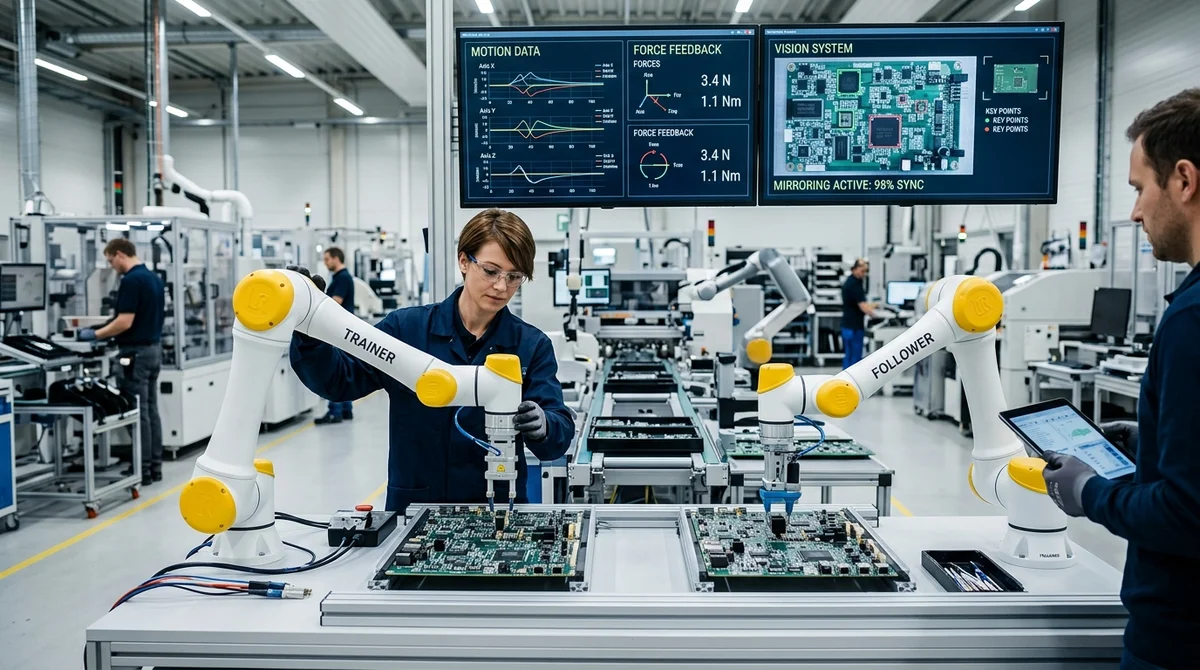
Universal Robots, together with Scale AI, have presented UR AI Trainer — a hardware and software suite for collecting training data directly on industrial cobots. The announcement at GTC 2026 targets one of the most pressing challenges in physical AI: models show decent performance in the lab, but often struggle when deployed to real production lines, especially in assembly, packaging, and other tasks involving physical contact.
How the Platform Works
The UR AI Trainer is built on a leader-follower scheme. An operator manually guides the "leader" robot through a specific task, for example packaging a smartphone, while a second robot simultaneously mirrors the movements. The system doesn't just record the trajectory. It collects multimodal data in the same cycle in which the robot actually interacts with objects and surfaces. This is crucial for training Vision-Language-Action models, which need more than to see an image: they need to understand how movement relates to contact, resistance, and accuracy of task execution. During the demonstration, the system simultaneously records four types of signals:
- movement trajectories and kinematics
- force and torque feedback
- visual data from the camera
- synchronization of all modalities into a single dataset
The key idea is that data is collected on the same Universal Robots machines that can later work on the shop floor. This closes the gap between the experimental cell and industrial deployment: if a model was trained on a UR3e or UR7e in a controlled environment, it's easier to transfer it to identical equipment in production without fully rebuilding the pipeline. Additionally, this reduces the risk that model behavior will break down when transitioning from a research setup to a conveyor task.
Why Contact Matters
Most robotics datasets to date rely primarily on vision. For tasks like "drive up and pick," this sometimes suffices, but in production many operations require the robot to feel the moment of contact, pressure, and material resistance. Screwing, inserting parts, pressing, packing fragile objects, precise assembly — all of this falls under contact-rich manipulation, and these scenarios are the hardest to automate reliably.
UR is betting on direct torque control and force feedback. Simply put, the model gets not only an answer to what the robot saw, but also what it "felt" when executing the action correctly. Because of this, training becomes closer to the real physics of the process rather than an abstract demonstration of trajectories in mid-air. For manufacturers, this is critical: an error in object contact doesn't just mean a failed prediction, but defects, line downtime, or part damage.
"This is the first solution in the industry that transfers AI model training directly from the lab to production," says
Anders Beck from Universal Robots.
Data and Ecosystem
The partnership with Scale AI adds to this scheme not just annotation, but a full data handling loop. Scale's software is embedded in the UR AI Trainer platform and helps capture, structure, and store collected demonstrations. The logic here is similar to a flywheel: operators record examples, models train on this data, robots improve task execution quality, and new work episodes return to the next retraining cycle. This closed loop turns physical AI from a one-time experiment into a repeatable production process.
The companies have also promised to release a major industrial dataset collected on UR robots later in 2026. The GTC booth demonstrates this concept in two formats simultaneously. In the physical demo, visitors control a pair of UR3e robots that transmit movements to two UR7e units for a smartphone packaging task. Parallel to this, NVIDIA Omniverse and Isaac Sim run a virtual scenario with Haply Inverse3 tactile controllers, while Generalist AI demonstrates how two UR7e units already autonomously perform the same task.
For Universal Robots, this is also a scale argument: the company already has over 100,000 cobots in deployments worldwide.
What This Means
The robotics market is moving from rigidly programmed scenarios to models that can be retrained on real production episodes. If Universal Robots and Scale AI truly turn factory data collection into a standard tool, industrial companies will have a shorter path from pilot to deployment, and businesses won't have to build separate research infrastructure from scratch — especially for tasks where contact, precision, and repeatability matter.
Want to stop reading about AI and start using it?
AI News is a curated feed of AI/tech news. Hamidun Academy teaches you to use AI systematically in your work.