Goldman Sachs: AI investment shifts from hype to data centers and infrastructure
Goldman Sachs sees a new stage in the AI market: investors are moving away from broad bets on «anything related to AI» and focusing on data centers. The…
AI-processed from AI News; edited by Hamidun News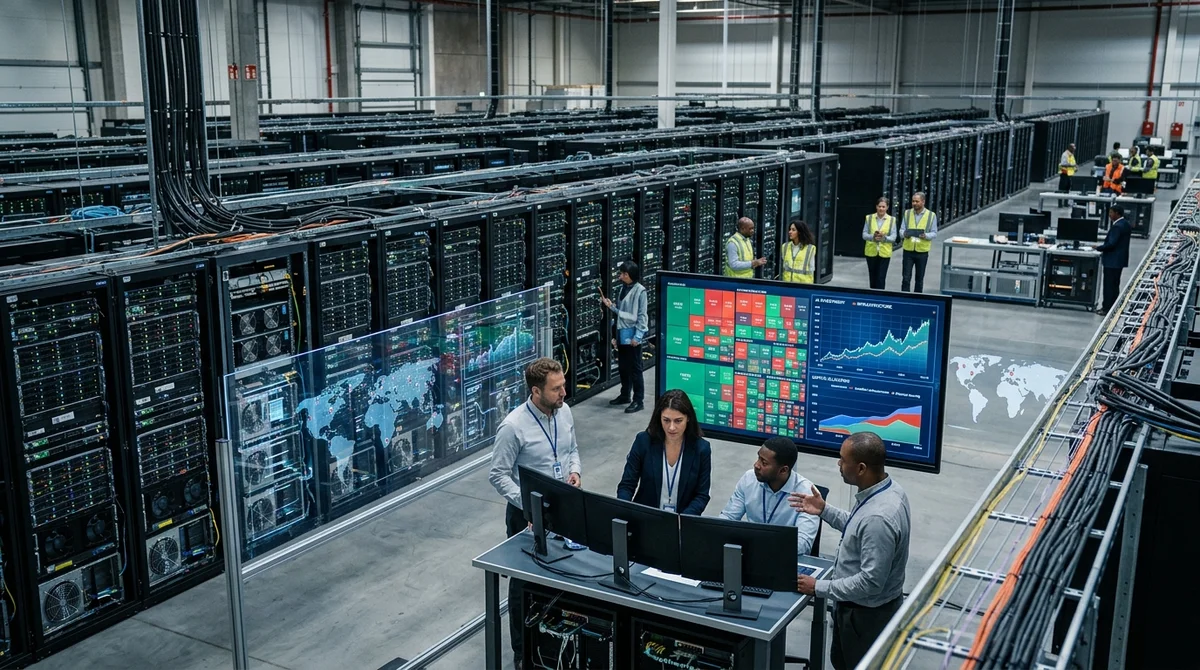
Goldman Sachs believes that the AI investment market is moving out of the phase of general hype and becoming noticeably more selective. The focus is shifting from flashy AI applications to data centers, power supply, networks, and other infrastructure without which models simply cannot function.
Where Capital Is Shifting
According to the bank's assessment, investors are increasingly looking not at companies that simply added AI to their pitch deck, but at players controlling the physical foundation of the industry. This includes owners and operators of large data centers, providers of computing power, chips, and networking equipment. The logic is straightforward: whichever interface or AI service wins in the market, model training and inference still require hardware, communication channels, and stable power supply.
During the first wave of generative AI, the market was raising the market capitalization of many companies just for mentioning AI. Now this effect is weakening. Goldman Sachs describes the shift as a "flight to quality": money flows to where there are infrastructure assets, understandable revenue, and a chance to profit from the long cycle of AI adoption, not just from hype around the next application. For investors, this is a transition from betting on promises to betting on the already functioning foundation of the AI economy.
"Flight to quality" — that's how
Goldman Sachs describes the new phase of the AI market.
Why Data Centers Matter More
Goldman Sachs Research expects that already in the next two years, AI workloads could occupy around 30% of total data center capacity. The reason lies in the nature of AI tasks themselves. Training large models requires thousands of chips working in parallel and running non-stop for weeks. Inference is not free either: when a service is launched for users or business, it needs constant computing power, not short spikes like some classical cloud workloads do.
The load is growing on several fronts simultaneously:
- new GPU and CPU clusters for model training
- continuous computing power for inference in products and enterprise systems
- expansion of network infrastructure between clusters, storage, and the cloud
- new facilities with cooling, backup power, and physical security
This is exactly why major cloud providers and AI developers are investing tens of billions of dollars in new data centers and computing equipment. For the market, this means a simple shift: at the bottom of the stack, the most stable layer is back in place. If applications can still appear and disappear quickly, demand for computing, networks, and hosting remains a basic need for almost all AI development scenarios. In this logic, both data center operators and key component manufacturers benefit.
The Main Growth Constraints
The next phase of the AI race hinges not only on models but also on utility realities. Goldman Sachs Research estimates that global data center demand for electricity by 2030 could grow by approximately 175% compared to 2023 levels, with AI workloads being the main driver. The report compares this to adding another top-10 electricity-consuming country to the global power system.
For governments, utility companies, and providers themselves, this is no longer theory but an investment task. It's already affecting where new facilities are being built. Large AI clusters require not just server rooms but stable power sources, powerful communication lines, cooling systems, and sufficient land. This is why some new facilities are being considered in remote regions where access to electricity and territory is easier.
Researchers also note that energy consumption and water usage are influenced not only by chips but also by geography and cooling architecture. In other words, the efficiency question increasingly becomes a location question. There are also more mundane barriers. Building large data centers takes years and depends on a long supply chain: you need to process land permits, connect to power grids, negotiate long-term energy supply contracts, purchase electrical equipment, and wait for network infrastructure expansion. Component shortages and delays in power grid upgrades slow down projects, which is why investors especially value companies that already have a large network of data centers today. Existing infrastructure becomes not just an asset but a competitive advantage with high value.
What This Means
For the AI market, this is a signal of maturation. The era when it was enough to add the abbreviation AI to your pitch is gradually ending. The next round of competition will be won not only by whoever has the best model or interface, but by whoever can provide computing, energy, and reliable service delivery at scale. In other words, the future of AI increasingly depends not only on algorithms but on concrete, cables, and megawatts.
Want to stop reading about AI and start using it?
AI News is a curated feed of AI/tech news. Hamidun Academy teaches you to use AI systematically in your work.