Alibaba Unveiled MAOSS AI Model for Early Detection of Fatty Liver Disease
Alibaba unveiled medical AI model MAOSS for early screening of fatty liver disease. The system uses non-contrast CT scans and serum markers to identify…
AI-processed from Bloomberg Tech; edited by Hamidun News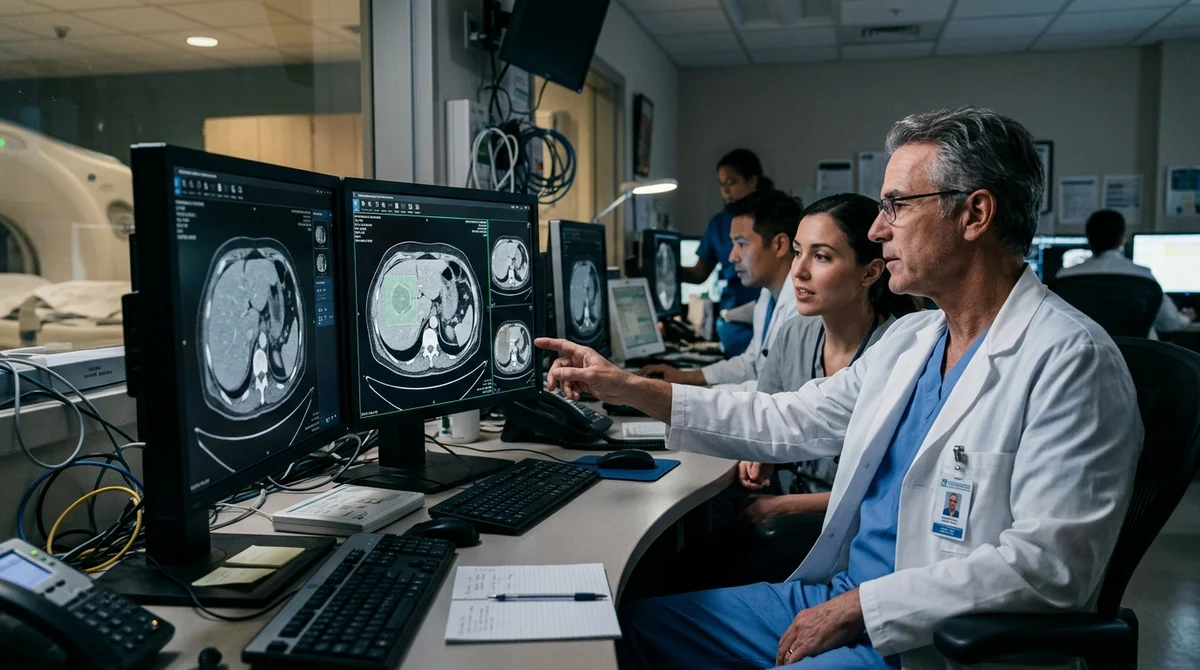
Alibaba DAMO Academy presented MAOSS — an AI model that detects signs of fatty liver disease in routine non-contrast CT scans and helps select patients earlier for in-depth diagnosis. For medicine, this is an important case not about "AI instead of a doctor," but about how to extract more value from existing examinations.
Why this matters
Fatty liver disease, increasingly called steatotic liver disease in English-language literature, can remain asymptomatic for a long time. Because of this, patients often come to a doctor only at the stage of fibrosis or cirrhosis, when the window for early intervention narrows significantly. According to Alibaba DAMO Academy, the disease currently affects around 30% of the world's population and could grow to 55.
7% by 2040. Routine ultrasound and serum markers are not always sensitive enough, and more accurate methods are not available in all clinics. MAOSS targets precisely this gap.
The model was developed together with Shengjing Hospital of China Medical University and Nanjing Drum Tower Hospital, and the results were published in Nature Communications. The system combines several types of data: non-contrast CT, blood indicators, and computed features like texture, density, and liver shape. The idea is not to force a hospital to buy a new rare instrument, but to fine-tune the existing routine examination workflow so it suggests who cannot be sent away without additional testing.
What MAOSS can do
According to the Nature Communications article, the model was trained and validated on several datasets: from an internal set of 2,071 cases to a real array of 18,504 examinations. A cohort of 1,192 patients was analyzed separately, where the task was not just to detect steatosis, but to identify people at high risk of more severe progression — steatohepatitis and significant fibrosis. This design is important: it shows the system was tested not only in laboratory conditions, but closer to a typical clinical workflow.
Key results look like this:
- the share of identified high-risk patients increased from 16.6% to 52.4%
- AUC for different stages of steatosis was 0.904–0.917
- the average AUC of radiologists without model assistance was 0.709
- with MAOSS as an assistant, physician accuracy increased to 0.798
The most interesting point is different: the model finds signal where a patient might have come for a completely different reason. If a person already had a standard CT, the system can use that scan for additional opportunistic screening without requiring a separate expensive procedure. For healthcare systems, this is a strong argument because the cost of implementation often depends not only on the algorithm but also on the need to change the patient pathway. Here, Alibaba is trying to integrate into already existing infrastructure.
Not instead of a doctor
In Alibaba's presentation, this is not a "digital hepatologist," but a decision-support tool. MAOSS does not replace diagnosis, biopsy, clinical assessment, and subsequent patient management, but helps notice earlier those who might be missed by a standard pathway. This approach looks pragmatic: the model does not promise autonomous medicine, but reduces the proportion of missed cases and makes early screening cheaper.
This fits well into the broader DAMO Academy strategy, which is already promoting AI-based cancer screening and reports more than 50 million people covered by medical AI checks in ten countries and regions. But it's also worth not overstating the result. This is about retrospective validation and a research publication, not that the model has already become a universal standard for hospitals worldwide.
Any such tool requires local validation, adaptation to a specific patient flow, and clear physician accountability. Otherwise, even a strong metric on paper can run into false positives, specialist overload, or interpretation issues in real practice.
What it means
The MAOSS story shows where medical AI is moving fastest: not toward conversational assistants, but toward quiet systems that extract additional signal from data already collected. If this approach scales, a routine CT might gradually transform from just an image for the current complaint into an early filter for chronic diseases that today are noticed far too late.
Want to stop reading about AI and start using it?
AI News is a curated feed of AI/tech news. Hamidun Academy teaches you to use AI systematically in your work.