Nvidia forecasts $1 trillion in revenue by 2027: AI infrastructure not slowing down
Nvidia forecasts $1 trillion in revenue by 2027 — leadership expects to maintain current growth rates for another two years. In parallel, IBM announced an…
AI-processed from Bloomberg Tech; edited by Hamidun News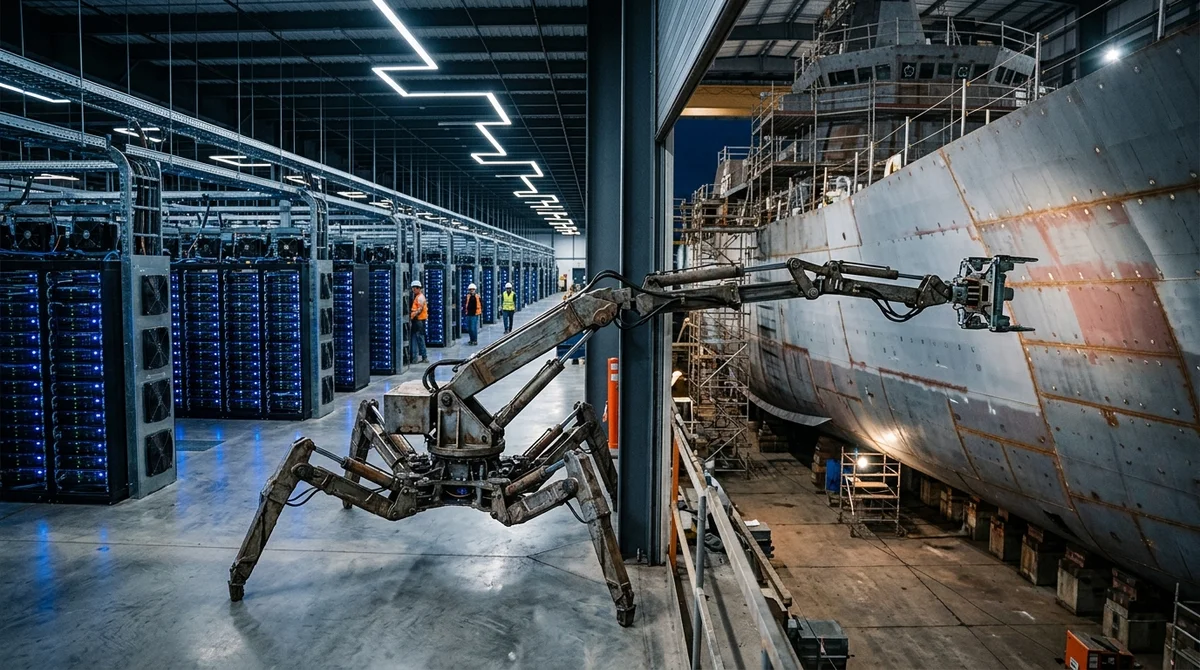
Nvidia announced that it expects to generate $1 trillion in sales by 2027 — a forecast that would have seemed unrealistic not long ago. Against this backdrop, IBM revealed its M&A strategy in AI, while startup Gecko Robotics demonstrated how autonomous robots are already inspecting U.S. Navy warships.
Nvidia's
Trillion-Dollar Forecast The forecast was unveiled at the GTC conference — Nvidia's annual AI event, which it has turned into one of the industry's major showcases. The company's revenue for fiscal year 2024 exceeded $60 billion, and by 2025 is approaching $130 billion. The $1 trillion forecast by 2027 means management expects to sustain current growth rates for at least another two years.
The company, known primarily as a gaming graphics card manufacturer in 2022, has completely transformed its positioning. Today, Nvidia is the backbone of the global AI infrastructure market. Behind this growth lie several factors: H100 chips and Blackwell architecture — the foundation of most large-scale AI clusters Hyperscalers (Microsoft, Google, Amazon, Meta) are ramping up GPU capital expenditures without slowing the pace Sovereign AI projects — from the Middle East to Europe — are creating demand independent of American bigtech The CUDA and NIM software ecosystem creates developer-level lock-in * Competitors — AMD, Intel, custom chips from Google and Amazon — cannot yet offer serious competition ## IBM's Bet on M&A Arvind Krishna, CEO of IBM, gave an interview to Bloomberg following the company's announcements at GTC.
IBM announced a range of AI initiatives, including integration with Nvidia's platform for enterprise solutions. According to Krishna, the company is simultaneously actively exploring mergers and acquisitions deals focused on AI capabilities. IBM's positioning fundamentally differs from the consumer AI race.
The company methodically embeds artificial intelligence into the enterprise segment — where sales cycles are longer, but contracts are more stable and predictable in terms of margins. In this logic, M&A is primarily about acquiring ready-made expertise and customer bases faster than building them from scratch.
"We are looking at companies that help us deliver AI capabilities to enterprise customers faster," said
Krishna.
Gecko
Robotics: Robots Head to Sea Against the backdrop of big numbers from Silicon Valley, it's worth paying attention to Gecko Robotics. The startup is deploying autonomous robots to inspect U.S.
Navy warships: they scan ship hulls, detect corrosion, cracks, and structural defects in hard-to-reach locations where divers previously had to be sent or the ship had to be placed in costly dry dock repairs. The company's CEO explained that the robots work faster, more accurately, and in conditions dangerous for humans. AI models analyze the collected data and produce a structured report on the technical condition and operational readiness of the vessel.
Gecko Robotics is one of the most concrete examples of how AI robotics is transitioning from laboratory demonstrations to real government contracts at defense scale.
What
This Means Three stories from one news cycle fit together into a single narrative: the AI market has materialized. Nvidia is building forecasts in the trillions, IBM is acquiring expertise, and the U.S. Navy is trusting robots to inspect warships. This is no longer a trend on slides — it's infrastructure, contracts, and measurable money.
Want to stop reading about AI and start using it?
AI News is a curated feed of AI/tech news. Hamidun Academy teaches you to use AI systematically in your work.