Nvidia open-sourced OpenShell, a secure environment for autonomous AI agents
Nvidia has open-sourced OpenShell, an environment for securely running autonomous AI agents with access to shell, files and the network. It includes isolated…
AI-processed from MarkTechPost; edited by Hamidun News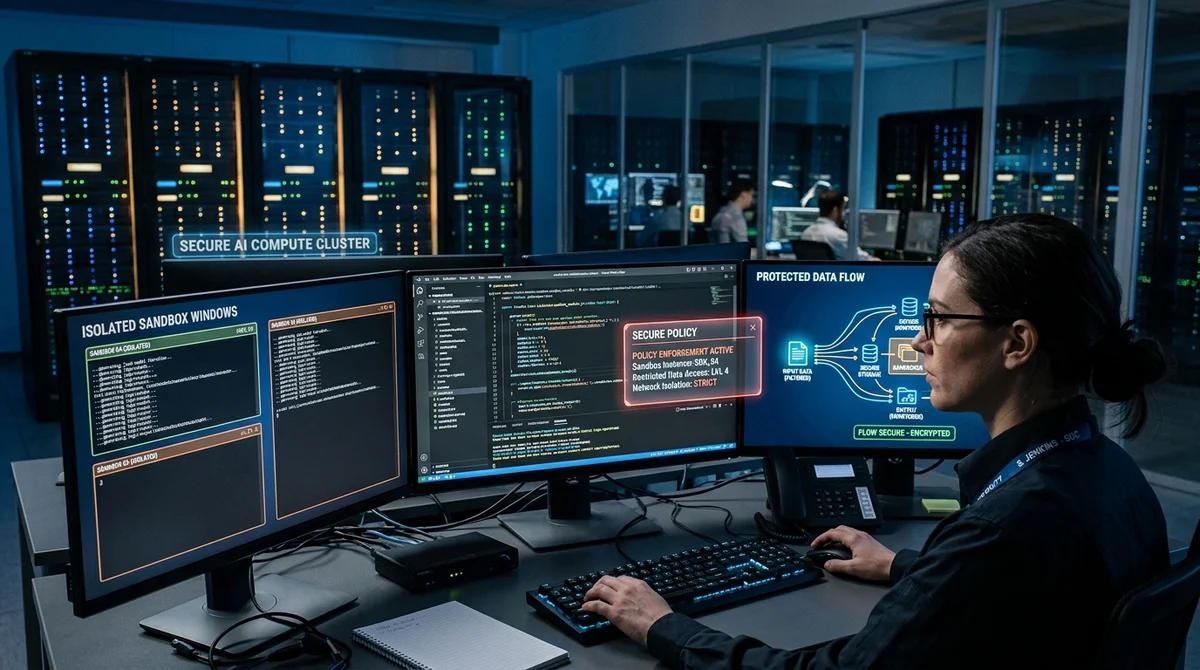
Nvidia has open-sourced OpenShell — an execution environment for autonomous AI agents that need access to the shell, files, and network. The project aims to address a primary concern around agent systems: how to give a model tools without surrendering full control of the machine and corporate data.
Why This Matters
A typical chatbot responds with text and has virtually no attack surface. An autonomous agent is a completely different class of system: it maintains context between sessions, executes commands, writes code, installs packages, accesses internal APIs, and can run for hours without human intervention. In this model, any prompt injection becomes not just a poor response, but a risk of key leakage, reading private files, or executing unwanted actions in infrastructure.
This gap is precisely what Nvidia is trying to close with OpenShell. The company released the project under Apache 2.0 license, showcased it at GTC 2026, and integrated it into its agent system stack.
The idea is simple: security should be ensured not only through prompts and internal model constraints, but through a separate execution layer that sits between the agent and the operating system and is independent of how carefully the agent itself behaves.
How OpenShell Works
OpenShell operates as an external control loop. An agent within it can use familiar tools, but all actual actions pass through separate control mechanisms. Nvidia describes this as moving security policy outside the model itself: even if the agent is compromised or makes a mistake, it should not be able to circumvent infrastructure constraints. This approach makes OpenShell agent-agnostic: you can wrap OpenClaw, Claude Code, Codex, and other systems inside without rewriting logic for a new SDK.
- An isolated sandbox limits access to the file system and prevents the agent from freely modifying the host machine.
- A policy engine sets granular rules for binaries, network addresses, HTTP methods, and access paths.
- A privacy router decides where to send inference: to a local model or an external API if the policy allows it.
- An audit log records why an action was allowed, blocked, or redirected.
At its core are declarative YAML policies. Static constraints on the file system and processes are set when the sandbox is created, while network and inference policies can be updated on the fly without restarting. In its documentation, Nvidia emphasizes that OpenShell uses kernel-level isolation, including Landlock for file system paths and seccomp for blocking dangerous system calls. This also provides an explainable trace: the team sees not just the fact of a block, but the specific reason for the decision.
What Developers Get
The practical advantage is that OpenShell doesn't require rewriting existing agents. A developer can spin up a sandbox with a CLI command, connect to it via terminal, then selectively open required permissions through policy. There's also a remote mode: the sandbox can run not only locally but on a remote machine or GPU cluster, and be managed from an ordinary terminal.
This makes the project suitable for local development, CI/CD, and heavier production scenarios. Another important aspect is secret handling. OpenShell doesn't place keys in the sandbox file system, but injects them as environment variables at runtime.
Simultaneously, the privacy router allows keeping sensitive context on the local loop and sending requests to external models only by company policy. Essentially, this is an attempt to turn agent system security from a collection of ad hoc constraints into a reproducible infrastructure practice.
"Sessions are isolated, resources are controlled, and permissions are checked before any action," — this is how
Nvidia describes OpenShell's basic logic.
What It Means
For the market, this is a significant signal: the next competition in AI agents will not be based solely on model quality, but also on execution environment quality. If OpenShell takes off, companies will be able to run more autonomous agents without the usual tradeoff between usefulness and risk. For business, this opens the door to longer and more expensive automation scenarios in corporate environments that were previously hampered by security and control concerns.
Want to stop reading about AI and start using it?
AI News is a curated feed of AI/tech news. Hamidun Academy teaches you to use AI systematically in your work.